
This writing is by Anna G. Joujan, CMA, CPT, MLIS, the recipient of a 2026 Archives & Special Collections Research Grant to study the use of non-traditional book formats with children experiencing vision, hearing, and physical impairments, ADHD, and Autism. Joujan is a Bilingual Medical Assistant/Phlebotomist at Lifespring Pediatrics in Chattanooga, TN and a pre-nursing student at Chattanooga State Technical Community College. Joujan was the recipient of a Billie M. Levy Research Grant in 2008.
I have always been fascinated by the human body. My first memory of being aware of my own was when an elementary school classmate alerted me to the fact that I had “muscles like a boy.” I was embarrassed, wishing I had the delicate, feminine limbs of my little sister instead of my own. I would soon discover the power of these same muscles, and learn that in harnessing, strengthening, and pushing them, I could also focus my brain, calm my nerves, and train myself to push through hardship in all areas of my life. I learned that a powerful motivator to me, in facing the demands of any given day, is the reminder that it will not get easier, but that I will get stronger. I cannot remember where I heard this, or from whom, but I did find a similar quotation, via an online search, from Asma Naqi: “A secret life taught me: it doesn’t get easier, you become stronger.” (wisefamousquotes.com)
When I became a professional educator, it came naturally to incorporate movement into my own lessons, in the library and in French classes. I understood the children who struggled to sit still, and I made lesson plans that included song-and-dance, games, and manual tools. I sought out studies that others have done about whole-body considerations, and learned that there are many. I am certainly not pioneering this idea.
I am, however, in a different era than the one in which past scholars, educators, and artists were in. As such, I have a different lens through which to consider these same topics: a lens that has been informed by the age of the Internet, AI, an ever-shifting political climate, immigrant and migrant upheavals, and other modern considerations. In order to adequately address the needs I see before me, in my pediatric clinic workplace, in my rural homesteading community, and in my continuing education, I must take these considerations into account.
What, then, I ask, do the individuals and communities I see before me need?
What do the insights provided by those who have gone before me have to offer to those I see now?
Alternative Approaches to Educating
One modern thinker who is asking some of these same questions as he addresses the state of educational systems is Aditya Vishwanath. In an interview with Kelly Corrigan on her podcast, “Kelly Corrigan Wonders,” Vishwanath describes the traditional method of schooling in India as heavily memorization–focused. And even though he thrived academically in this setting, due to his remarkable memory, his life work now is to campaign for a system that recognizes the value of creativity more than memorization. His reasoning is that considering the technology we have available to us, and the tools that allow for rapid calculations and AI solutions, it makes little sense to spend the majority of one’s education memorizing methods that can artificially be done much faster than is possible with the human brain. He concludes,
“So, in a nutshell, it is taking something as transformative, world transformative as AI, to wake us all up and say, we’re not teaching the right things . . . I’ve been doing a lot of work in the AI literacy space and the education reform space, even in the United States in public schools. And we’re seeing the same thing happening. A lot of people are in panic, throwing darts at a wall, trying to see what sticks without any real first principles thinking, without a more rigorous, intentional approach towards how do we systemically ask a broader overarching question of what should we be preparing our young people with, such that they are employable, happy, self-sufficient citizens tomorrow.”
In this interview, Vishwanath does not offer concrete ways in which to promote this creative incorporation. So I would like to do so now:
If a textbook is doing nothing for a struggling student, for instance, why not hand her the supplies (printed out from the Brooklyn educational manual website) needed to make a book with the instructions to write, and put together, your own textbook, that teaches the information in a way that you’d want to learn it? This textbook need not be a “book” at all, in the traditional sense. Along the lines of the books in the Artists’ Book Collection, it could look like a puzzle, such as State of the Union, by Pfeiffer. When I experienced this work, I wore gloves, following the instructions of the archivist, who walked me through the initial opening-up of this puzzle, which as a whole makes an American flag. I was careful to pick up one block at a time, unfolding it with care, reading the words printed on the front and the back of each one before refolding the accordion fold and placing it back in its slot. The blocks are categorized: “Economy,” “Health,” and “Business” are the short lines of the red and white stripes. “Education” is a long white stripe. Then “Politics,” “Environment,” and “Society.” Printed inside each of these is a collection of quotes about that topic, some of which are familiar to me, by poets, writers, and thinkers. The stars are a brief manifesto about the current state of the union. I read, “At the moment the ‘we’ (in the ‘We the people . . .’) has given way to a troublesome ‘us’ and ‘them.” The experience of handling this work of art is not unlike that of undertaking a delicate procedure on a patient in the clinic, and the sort of learning it offers is a far cry from any traditional educational texts.
If an effort is being made to solve a particular problem, or master a particular subject, and it seems like the student is just banging their head against a wall, why not take a break altogether, regardless of where in the expected day’s schedule this wall happens to fall? Countless examples from history have proven that sometimes a break is exactly what the brain needs in order to find clarity. In a recent lecture given about the physicist Freeman Dyson, a creative thinker named Andy Patton described what happened when he was working on a particular problem concerning the laws of quantum dynamics. As he explains it:
So he made that his work. He spent months … doing endless calculations by hand on giant stacks of paper at his desk. But he couldn’t find a solution…So he let his brain shut off. He switched from creative output mode, banging his head against the wall, to recover, rest, and incubate mode. So beneath the surface of his conscious thought, something was transforming. Something was about to rise through the surface of the soil. As Dyson spent days staring at the Pacific, walking up and down the beach, and just, as he said, bumming around, insights were assembling themselves in the silent dark of his unconscious mind. So at the end of the California getaway, he got on a bus and rode back to Princeton, and that is when the insights started to hit. He was staring out at the window on the prairies of Kansas, in the dark, and suddenly everything just clicked…The new growth didn’t break through the surface of the ground until after he rested. He took a breath, he let his mind roll along, and suddenly the whole thing was crystal clear.
If a student is arguing that their studies don’t mean anything in real life, why not let them do something that does? Aditya Vishwanath, a pioneer in the world of education is running a secondary school that incorporates hands-on learning in actual career fields, as an alternative to traditional classroom learning. These students learn to repair airplanes, install plumbing systems, and build houses. As he explains in an interview with Kelly Corrigan,
“And so we build a house every year for Habitat for Humanity. And again, if we ever get students who are a little disconnected from the project, all we have to do is go to the local area where folks are either in some of the tiny homes that we also build, or they’re actually going to be in the Habitat community. And we just have them meet the people who are going to live in the house. And it is an absolute motivator. They understand that this is a family that may or not have housing otherwise. And only then are they reinvested, which we’ve done a couple of times, it’s fantastic.”
Physical, Mental, and Social Considerations
The examples I have given so far can easily be imagined, potentially useful for any average student. For many students, however, there are specific challenges that make traditional classroom settings especially challenging:
Language, for instance–when a student is learning in a place that does not use the native tongue of his or her household. These children are often seen as slow, or behind, when in fact they are often highly intelligent, learning how to function in multiple languages while their peers are learning in the language they easily acquired from infancy.
Other children are faced with learning disabilities, such as ADHD and Autism Spectrum Disorder.
Still others have physical handicaps that affect their sensory abilities, such as hearing, visual, or physical impairments.
For these sorts of challenges, there are models that are addressing this in very practical ways. One is the Montessori Method, started by Maria Montessori in the early 1900s. In 1995, Joyce S. Pickering, in an article entitled “Montessori and Multisensory Structured Language Therapy Applied to At-Risk Children,” outlined ways in which children at risk for “specific learning disabilities” (5) benefit from non-traditional instructional methods. She begins the article with the clarification that “Learning disabled children have average or above average intelligence; they possess the visual acuity needed to see and the auditory acuity needed to hear; they are not physically handicapped, mentally retarded, or emotionally disturbed.” While I appreciate this acknowledgement of the intelligence of the children she is referring to, I would expand the value of non-traditional methods to children who do have actual physical handicaps, intellectual delays, or emotional struggles.
One of the specific methods she makes a note of includes geometric shapes in metal frames. While reading the article, I envisioned a sort of stencil, and verified this with an internet browse for images. This simple addition of tactile tools allows children to combine the touch of the shape with the limited auditory and visual lesson that a more traditional educational setting may include.
After describing aspects of this multi sensory approach, and detailing its benefits, Pickering concludes that, “The normal child quickly begins to associate visual symbols and sounds; remembers information after several exposures; grasps the concept of blending; begins to use ‘key words’ in a word pattern to help read other words (hat, cat, sat, etc.); begins decoding and comprehension; and, begins writing. An at-risk child has difficulty in sound-symbol associations, blending, and using ‘key word’ patterns to generalize other words. Not able to master the code (emphasis mine), the at-risk child relies on memory, avoids language activities (if possible); appears ‘nervous’ when asked to work with language; and struggles with written work.” (21)
When considering the value of the Montessori Movement as a whole, it is worth considering the background and, consequently, motivation of its founder, Maria Montessori. Maria herself was raised by parents who seemed ahead of their time. She considered the careers of engineering and medicine, deciding upon medicine and graduating as the first female doctor in Italy, at the age of 26. From there she went on to study illnesses in young children and, of course, education, incorporating the remainder of her life spent traveling internationally and publishing results of her research.
Historical Approaches to Learning Obstacles
As I considered the idea of physical handicaps that some students are faced with, I decided that it would be helpful to consider historical approaches to this topic. One collection I came across studied what was coined “handicapped homemakers,” conducted between the years of 1956 and 1957. This study proved fruitful for my research in two ways: one being the adaptive measures taken by handicapped individuals, and the other being the consideration of the challenges faced by the children of these handicapped individuals.
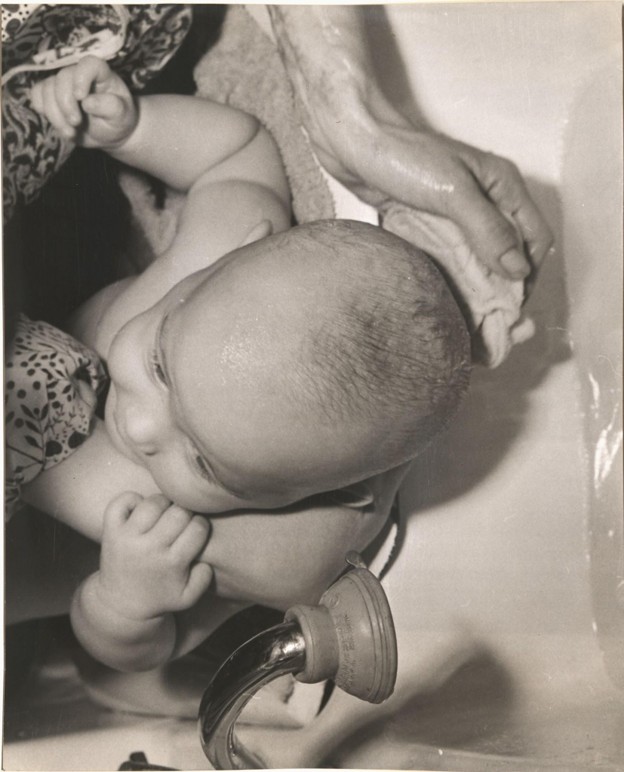
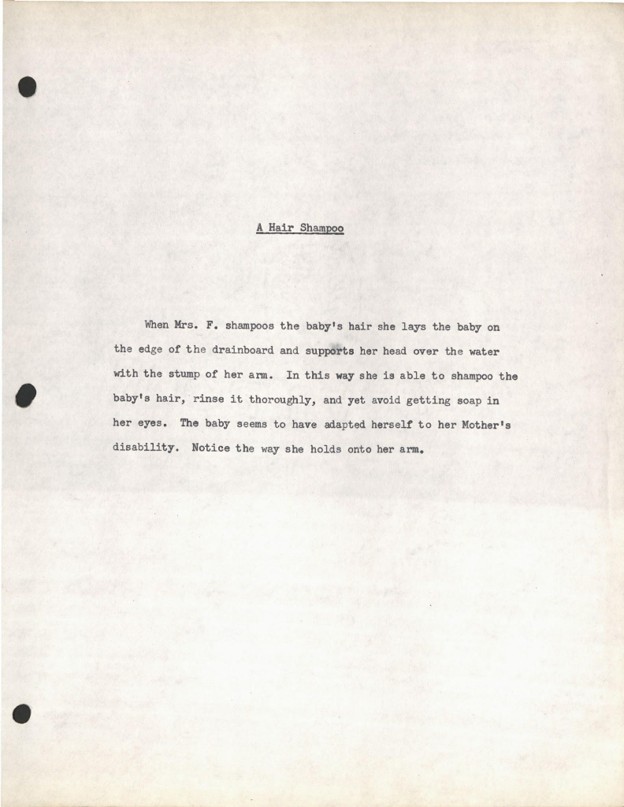
Our automated life has eliminated (for those who choose modern conveniences, at least) some of the original household difficulties that handicapped women dealt with: the labour involved in hanging items outside on a clothesline, for instance, or of washing and drying cloth diapers. So some of the types of solutions and aids that were being investigated in this study are inapplicable to modern life. The idea of adaptability and ingenuity, however, is timeless. In one image from this study, we see a woman with an amputated right arm and left side bodily burns.
She has learned how to lean her child against her right stump while shampooing his head with her left hand; the baby, meanwhile, learns to grasp onto that stump, rather than perhaps simply leaning against her forearm and hand as he would have if she had the limb available to support him.1 Her four children have the same needs any child would have of an able-bodied mother. Life does not adjust its expectations of her based upon her own limitations: rather, she adjusts her own expectations of what she will continue to do, and how she will do it.
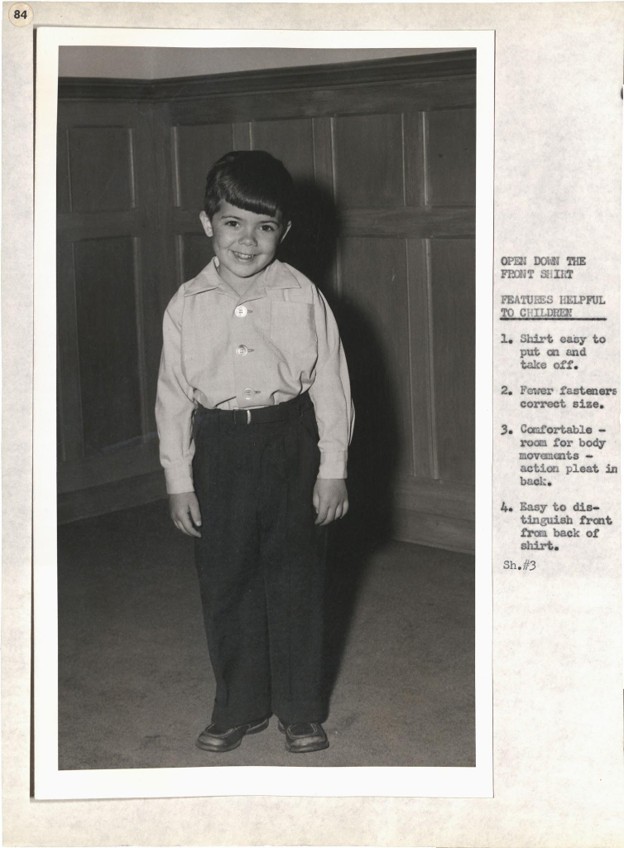
In one of these studies, the assertion was made that “Because of necessity, children of handicapped mothers often develop self-reliance, independence, and a sense of family cooperation at an early age.” One example of this independence, from the study, was in the need to begin dressing themselves at an earlier age than generally expected. In order to help with this, images in the collection show clothing designed so that children can more easily dress themselves (large buttons, fewer articles of clothing, easy to tell front from back, etc).2 The children, then, are able to learn this skill of dressing due to tactical aids, similar to the Montessori Method’s tactical aids for learning.
As the child of a handicapped parent, I can attest to this early development, which I witnessed in my younger siblings. When my mother was paralyzed, I was already independent enough (due to both age and the fact that I had been attending boarding school since the age of 5) that her handicap did not have as great of an influence on my early childhood development. It did, however, significantly affect my adolescence and teenage years. I consequently had a personal interest in this study, and found myself revisiting childhood memories while conducting my research.
One of the sections of particular interest to me, due to the focus of my research, was a project entitled, “Play Experiences Handicapped Mothers May Share With Young Children.” Many of the ideas given here (such as building a sandbox, sending bathing-suited little ones out into the lawn with a sprinkler, singing together, or making finger paint) are ideas any caregiver, able-bodied or not, could easily undertake. One of my own mother’s playtime inventions came to mind as I read this pamphlet: once she had mastered her wheelchair, she would zip down our zigzag-curved driveway, with a “Watch me!” While perhaps not the most readily-sanctioned of activities, I do suspect that my siblings and I benefited somewhat from the training in facing fears that we developed from our experimentation with our mother’s “play experiences,” as we learned how to steer her wheelchair and to “pop a wheelie” which she also demonstrated.
Present Day Hands-On Applications
An examination of the value of merging body and brain leads naturally into hands-on application. How, then, do I see the tactics examined in this paper being successfully applied in individuals today?
One of my tasks as a pediatric nurse is conducting vision tests. For this we use the standard Snellen eye exam. Many of the children I do this with are just beginning to learn how to read and, oftentimes, I find the immigrant children hesitant and underconfident when it comes to reading letters out loud, even if the parent assures me the child can read well. Considering the point I made earlier in this paper, concerning the intelligence of children who are learning in a culture that speaks a different language than that of their home, I decide to adjust my own expectations when conducting the Snellen. This child has to remember not 1, but 2 different names for each letter as they learn to associate the correct sounds for both languages. So perhaps a struggle to read a particular letter stems from the question, “Which language should I use?” or from the difficulty in memory recall when twice as much is being remembered as a single-language child.
The next time I am beginning a Snellen exam, then, and the child hesitates, I think of this struggle. I suggest that she give me the sound instead of the name. “Mmm,” she promptly responds. I point to the next: “Ah.” Then “sss.” We are on a roll. She passes the test with flying colors, now beaming with confidence. Since the purpose of this exam is to assess vision, rather than the child’s ability to read letters, I am not compromising the exam at all by making this alteration. I am, however, allowing the child to use her sense of hearing, with the formation of sounds, instead of requiring her to rely solely on her memory of words that she may struggle to associate with anything suitable to help them cement in her brain.
In another real-life scenario, I conducted my own situation in which children are making their own books. Incorporating my hobby of visual art (mostly pencil or ink drawing, but other mediums as well) into my experience as a writer and school librarian, I planned a summer day camp in my home, advertising it in my neighborhood, community, and friend groups. It was called “Creative Pages,” and the idea was to have the children spend the day reading award-winning picture books for inspiration, writing their own stories, illustrating with their own artwork, and then putting it all together into a book. I researched bookmaking techniques, found places to purchase discounted materials, and scheduled the sessions. Afterwards I was confident that I did well for these children, seeing the pride on their faces when they saw their own hard work come together.
This was years ago, before the existence of the Brooklyn education manual. But I see no reason why this same sort of scenario, as I did with my Creative Pages students, would not be equally as successful with a group of students making their own science, math, or geography textbooks.
While sitting in the library, working on this report, I overheard a conversation between two parents whose children are playing in the reading nook. They were speaking of their efforts to expose their children, at an early age, to multiple languages. One mom explains that her own experience includes 3 languages, living in one home country but raised by parents speaking a different language than that of the country in which they lived. English was the last language she learned, at the age of 6. She then mentions that she is dyslexic, but only in her 1st two languages. In English, oddly, she is not dyslexic. I cannot help but note the irony of this situation so introduce myself, ask a few follow-up questions, and request permission to include her as an example here. I cannot help but wonder if the challenges she faced, as a multiple-language child, played a role in her ability to now function exclusively in English, unhindered by dyslexia. I also suspect that she was aided in her learning ability, consciously or not, by some sort of incorporation of various senses as she navigated a challenging learning environment.
Suggested Applications of Researched Materials into Present-Day Scenarios
As I consider the value of the materials I have researched for this report, it occurs to me that a very recent educational situation could have benefited heavily from the wisdom of the past. Namely, the Covid pandemic. We are just now, 6 years since its beginning, starting to realize some of the effects this global trauma had on the learning of those in their educational years at the time. And as clearly horrible of a scenario as it was, there are ways in which it awakened us to things that needed to change. Of course there are those who suffered from the sudden isolation from their peers, and from the switch from in-class to virtual learning. But there are many others who managed to thrive, letting it be an opportunity to let go of expectations of how learning should look, and instead find ways to embrace the benefits available from a lack of schedule rigidity, from the freedom to be outside and not stuck in a classroom all day, and from the option of finding new methods available, beyond the textbook and the computer, with which to solidify a deeper understanding rather than rote memorization. When home schooling became the only option, many people realized that it could be turned into whatever each child thrived in, and let go of stereotypes of, and biases against, that option. I am by no means suggesting that children should forego traditional schools and all be home schooled. I am, however, suggesting that learning should expand outwards from the classroom, and that we should all consider ourselves lifelong learners, with the ability to learn in infinite ways and settings.
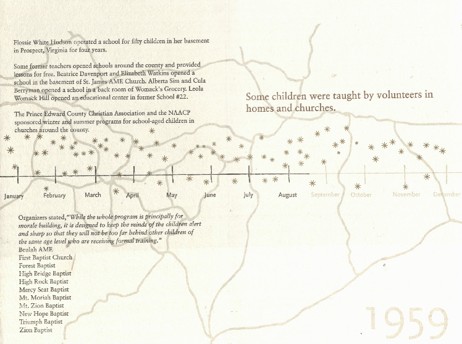
I saw this sort of expansive view in the American Montessori Society Records, in the Handicapped Homemakers files, and in the pages of the Artists’ Books. I saw ways in which those who came before us encountered unexpected challenges to learning, and found ways to thrive in spite of them. Our Pandemic is not the first time that physical school buildings have been removed as an option: one of the Artists’ Books I viewed was created as a commemoration of the Virginia school students affected when their public schools closed from 1959 to 1964, rather than obey a court order to desegregate. The book is composed of newspaper article clippings, quotes from students affected at the time, 50 years later, foldout timelines of court proceedings leading up to, and during those 5 years, and reactions to the “Free School” system (non-graded, tuition-free) that was set up for white students in the interim, and accounts of alternative solutions taken by other parents and former public school teachers.
While this closure came about as a result of a terrible racism, and created greatly negative disruption to the lives of those affected, it also bred a resilience and adaptability that has shown itself throughout history. When we take the time to consider the resilience that people have shown in the past, it can offer us the vision to see that we can show the same resilience in our present day challenges, and in those that are certain to arise in the future.
Conclusion
I spent my first 15 years in the workforce as a teaching librarian and a French teacher. I am now a pediatric nurse. I do not think these two careers are incongruous. The brain informs the body, and I feel like the years I spent in education play into my current work in healthcare.
When my brain feels stuck, or anxious, or upset, I go for a swim. Stroke by stroke, I let my brain wander in the silence, until suddenly, inevitably, the synapses start to fire, and I have a solution, am calm, or am soothed.
Whatever an individual’s particular physical needs may be, I think we all have this ability, if we are able to tap into it, to allow some sort of physical outlet to help with the needs of the brain. Consequently, there is great value in considering methods that have been successful in the past, as well as those being used in the present. My hope is that this paper can be an entryway to help us all to begin, or continue, the process of helping those around us, and ourselves, as we let the body teach the brain.
Works Consulted
Booklyn Education Manual: Bringing Bookmaking to Your Students. 2005, booklyn.org/programs/booklyn-education-manual-2/. Accessed 20 May 2026.
Cartoneras, Pensaré . Ayotzinapa, Desaparición Política. 2014.
“Deep Dive with Aditya Vishwanath on Creative Access.” Kelly Corrigan Wonders, 26 May 26, 2026, https://podcasts.apple.com/us/podcast/kelly-corrigan-wonders/id1532951390?i=1000769607810&r=1461
“Five Ways To Renew Your Creative Practice (Without Burning Out or Selling Out).”, 28 May, 2026, https://podcasts.apple.com/us/podcast/the-hutchmoot-podcast/id1437192826?i=1000769948176&r=1423
Frederick, Sommer. Alle Kinder Sind Botschafter. Nazraeli Press, 1992.
Gómez-Peña, Guillermo, et al. Codex Espangliensis from Columbus to the Border Patrol. San Francisco, Ca. City Lights Books Cop, 2000.
Hogrogian , Nonny. “Nonny Hogrogian Papers.” 2014. Images included on following pages.
“HPR4646: Mobile Gaming.” Hacker Public Radio, 24 May, 2026, https://podcasts.apple.com/us/podcast/hpr4646-mobile-gaming/id281699640?i=1000769507796&r=945
Lyons, Joan. My Mother’s Book. Rochester, NY, Visual Studies Workshop, 1993.
May Elizabeth, Eckhardt. Handicapped Homemakers. 1957. Images included on following pages.
Peterson, Jessica, et al. Unbound. Northport, Alabama, Paper Souvenir, [Farmville, Virginia, 2014. Images included on following pages.
Pfeiffer, Werner. State of the Union : A Snapshot of Our Political and Social Conundrum. 2014.
Society, American Montessori . American Montessori Society Records. 2022.
Stein, Sammy. Le Musee de La Tortue = El Museo de La Tortuga = the Turtle Museum = 亀博物館. 2017.
Weber, Marshall. Freedom of the Presses : Artists’ Books in the Twenty-First Century. Brooklyn, Ny, Booklyn, 2019.