
The following post is by Brandon Hurst, PhD student in UConn’s Department of English. His research interests include Nineteenth Century British and American Literature, Book History, and Digital Humanities and Media Studies.
We are excited to announce that a finding aid for the Wayne S. Franklin Collection of early American works and reference materials is now live, and researchers can request items!
The Wayne S. Franklin Collection of early American works and reference materials consists largely of books published and printed during the nineteenth century—including novels, histories, and autobiographical/biographical accounts—assembled by the American Studies and literary scholar and faculty at the University of Connecticut, Wayne S. Franklin.
Wayne Franklin was a University of Connecticut Professor of English and Professor of SCI/American Studies from 2005 to 2026; he was regarded by his colleagues, students, and all who know him as a generous, kind, and encyclopedic scholar and teacher. Franklin arrived at the University of Connecticut to serve as director of the American Studies program and was chosen head of the English department in 2009. He authored the two-volume, definitive biography of James Fenimore Cooper: James Fenimore Cooper: The Early Years (2007) and James Fenimore Cooper: The Later Years (2017). Both volumes were Choice Outstanding Academic Titles. During his illustrious career, he authored or edited another 12 books (with an additional 2 authored books in progress upon the donation of the collection), including a study of early American travel writing, Discoverers, Explorers, Settlers (1979), and a study of Cooper’s frontier fiction, The New World of James Fenimore Cooper (1982). He founded the University of Iowa Press’s “American Land and Life” series in 1990, for which he edited 30 books. Franklin also served for 20 years as an editor of the Norton Anthology of American Literature and served as a reader for several university presses. During his career he was a Mellon Foundation fellow (1981), Guggenheim fellow (2004), and awarded an American Antiquarian Society-National Endowment for the Humanities grant (1994).
Many of the items were collected for Franklin’s research and writing on James Fenimore Cooper, especially his two-volume biography of the novelist. Materials include early editions of works written by J.F. Cooper, his family, and his literary contemporaries; those providing context on Cooper’s historical sources, the contemporary socio-cultural landscape and literary milieu, or used for historical reference by Franklin; those owned by members of the Cooper family; and miscellaneous items. The collection has been arranged into three series, following Franklin’s own groupings and the installments in which they were received.
Presently, finding aid descriptions are only available for items in the first series, which I spent this summer assembling. This first series contains two subseries: early and first editions of Cooper’s works published in the U.S., England, and Continental Europe, and works owned and/or authored by the Cooper family. The first subseries, which Franklin assembled for research on Cooper’s publishing and printing history and Cooper’s navigation of the still emerging and tenuously enforced transatlantic copyright laws, makes up the bulk of the series.
The second series, received in 2022, includes works related to J.F. Cooper and early American literature more broadly, with the bulk of items related to maritime or naval literature and history. The third series, donated in 2023, contains largely reference materials acquired during Franklin’s research for the Cooper biographies and early American literature.
While the first series may, on initial glance, seem of interest mainly to scholars of J.F. Cooper, what I found most intriguing during my time working with the collection is that these earlier editions, initially collected for a biography and historical background on their author, held an abundance of insight into so many more individuals—the owners, the printers, the publishers, the users, (and, in the future, researchers), illustrating the importance of texts and literature in our lives and relationships. The material evidence of both the texts creation and these artifacts afterlives reveals much about the way literature mediates between the individual and sociocultural dynamics.
Perhaps the best, or at least one of the more interesting (to me), examples of this dynamic comes not in the form of any officially published edition of Cooper’s works. Rather, it was the paper-bound, cheap reprinting of Cooper’s The Red Rover by the London-based “Novel Newspaper” publication. The series republished novels cheaply, but did so by violating copyright. This inverted the more conventional practice, gestured to in the preface to the very first volume of the series (which contained “five of Fenimore Cooper’s novels: The Pilot, The Spy, The Pioneers, The Last of the Mohicans and Lionel Lincoln”), in which American penny newspapers and other publishers of inexpensive literature exploited the differences in English and U.S. copyright laws to reprint British novels in the U.S. without paying for the copyright, meaning their author’s received no compensation (Webby).
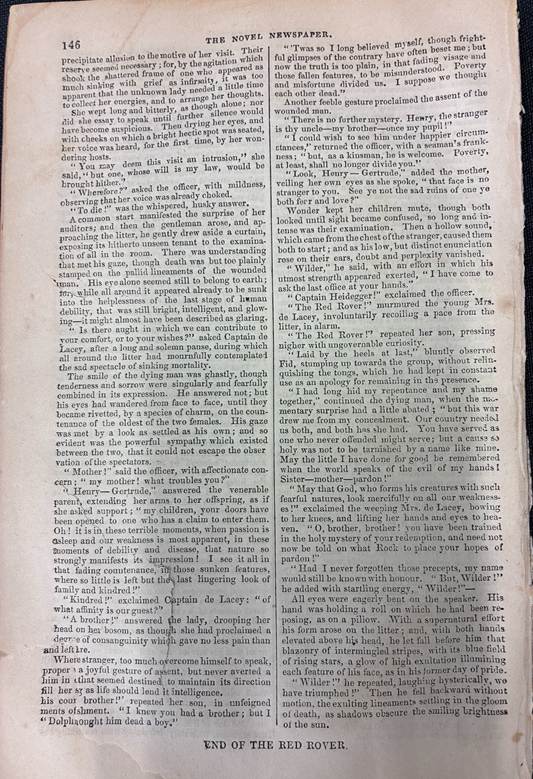
The Red Rover. A Tale. London: J. Cunningham, 1842. “Novel Newspaper”, 1842, /repositories/2/archival_objects/316176. Wayne S. Franklin Collection of early American works and reference materials, 2021-0097. Archives and Special Collections, University of Connecticut Library.
While the publishers behind this scheme justified their practice on moral and ethical grounds (and carried out their publishing quite ostentatiously, advertising in well-circulated journals their cheap reprintings of many American—and some British—works), what is particularly illuminating is that they also claimed that their work carried out a social good because it made Cooper’s novels more widely accessible and that the works would subsequently have an ameliorative influence on this newly reached class of readers. They wrote in the preface:
“Nor will Mr Cooper regret the wide circulation throughout England of the five novels contained in the present volume; since, being mainly on subjects of American history, they will tend to diffuse a better knowledge of his country amongst a class of persons whose national prejudices are even yet stronger than their reason.
Such practices and rhetoric point towards the shifting economics and politics of literary and cultural access in the nineteenth century. Book ownership, or lending, and printing was undergoing a large transformation in the eighteenth and nineteenth centuries with new technologies, changing legal practices, and increasing literacy rates all impacting who read, what they were reading, and in turn, what was being written and why—and artifacts like the “Novel Newspaper” reprinting of Cooper’s Red Rover provide us with examples that can teach us more about these dynamics.
Further revealing evidence about reading practices in the period, and the afterlives of these physical copies, can be found in the presence of bookplates in some of the volumes. (Notable bookplates in the collection include that of Henry A. Muhlenberg, son of U.S. Congressman Henry A. P. Muhlenberg; the American Antiquarian Society also holds bookplates from Muhlenberg. Another belongs to Dr. Noël J. Cortés, an early-20th-century collector of French manuscripts whose own collection is held at Yale. A third set belongs to Sir Frederick Milner (1849-1931), a former member of British parliament and a baronet).
These material markers of ownership personalize the text to the person, marking the book as one’s own while also identifying the individual as a “book owner” and “reader”. At the same time, by physically impressing or pasting a stylized signature and design, the physical book and content of the “text” become bound up with the owner’s identity. Together, owning the book and the intimate, process of materially making the book one’s own are acts of self-expression and identity-making.
The practice of adding a bookplate to a book is a curiously private and public act. The need to mark a text as one’s own implies that other readers may come across the text, and we need to identify our copy as ours—an inherently social practice. At the same time, the bookplate is pasted inside the book, and often kept in a private library, perhaps never to be seen by anyone. So not only does the bookplate signify an external act of identity/self-crafting, but it also reflects the very dynamics of identity itself: something deeply internal but defined by its capacity to be perceived and recognized by others.
Such practices can, we may intuit, create or become part of deeply affective relationships. Not only do we form intimate relationships with literature and the physical copy, but the act of ownership can become part of the rituals and interactions that help establish and/or cement interpersonal relationships. For instance, in the collection is a copy of The Bravo that bears two bookplates in each volume. One, a bookplate signed “Gertrude D Maling”, which reminds borrowers to return the book to its owner (again, the dually social and personal dynamics of book ownership and reading), and the other, a bookplate indicating the shared ownership of the book by her and her husband: Ex Libris Gertrude D. and Ernest H. Maling. The couple’s bookplate marks the book as belonging to a shared library—a manifestation of their shared lives together in the form of shared property—giving form, expression, and reaffirmation to a shared identity as married couple. At the same time, the presence of Gertrude’s own bookplate and her signature reminds us that her individuality is not erased in their marital union. She owns her own books, shares them with people she cares about, and is her own person; her reading/book owning practices give a material form to and outwardly express her multidimensional identity.
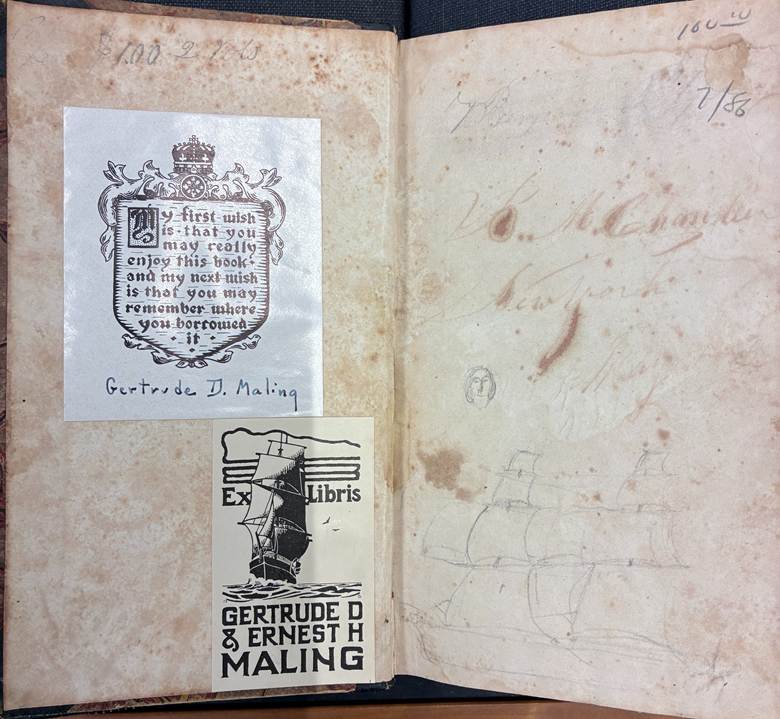
The Bravo: A Tale. Philadelphia: Carey & Lea, 1831. 2 vols. (Copy 2), 1831, /repositories/2/archival_objects/316187. Wayne S. Franklin Collection of early American works and reference materials, 2021-0097. Archives and Special Collections, University of Connecticut Library.
Gertrude’s bookplate reminds us that sharing books is another form in which books establish and reaffirm our affective, interpersonal relationships, a cultural practice we see further evidenced by the inscriptions many of the books bear, especially those in subseries two: the books owned and authored by the Cooper family. For instance, William Wake, D. D.’s The Principles of the Christian Religion Explainedcontains a signature marking the shared ownership of the book by the two Cooper sisters (inscribed “Susan & Caroline Fenimore Cooper | Paris May 15th 1831”), functionally reifying the sibling relationship in much the same way the Malings’ bookplate does for the marital connection. While this signature is partially overwritten, the evidence of their shared ownership of the book and the relationship it symbolized remains legible. Indeed, the palimpsest-like aspect highlights the accumulation of personal histories that the material book accumulates and records.
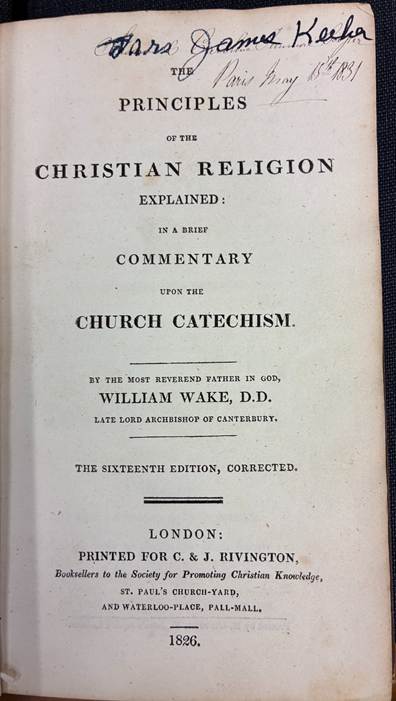
William Wake, D. D. The Principles of the Christian Religion Explained: in a Brief Commentary upon the Church Catechism. 16th edition “corrected.” London: C. & J. Rivington, 1826. Inscribed “Susan & Caroline Fenimore Cooper | Paris May 15th 1831”, 1826, /repositories/2/archival_objects/316140. Wayne S. Franklin Collection of early American works and reference materials, 2021-0097. Archives and Special Collections, University of Connecticut Library.
Many others in the series are gift copies (like this copy of Rural Hours, gifted on the winter solstice of 1993 “To Chris Schulty | Woodswoman | and | WYLDE writer”), with several being gifts between family Cooper family members, . The inscriptions mark the intimate, affective act of gifting, and the relationships these moments symbolize, reifying the familial bonds connecting one another, as demonstrated by Susan Fenimore Cooper’s gifting of her Rural Hours to her sister Caroline, the copy of Pages and Pictures from the Writings of James Fenimore Coopershe gave to her brother-in-law H.F. Phinney, and the copy of Howitt’s Home and Haunts of the Most Eminent British Poets she received from Phinney. The fact that these books are owned and authored by family members accentuates these implications. As seen in Susan Manning Sage’s gift to J.F. Cooper Jr (great-grandson of J.F. Cooper), not only do inscriptions mark the personal moments and tie identity to book ownership, gifting, and receiving, but these books authored by self or a family member act as extensions of our self or physically instantiate a reminder of a shared lineage, link, and identity.
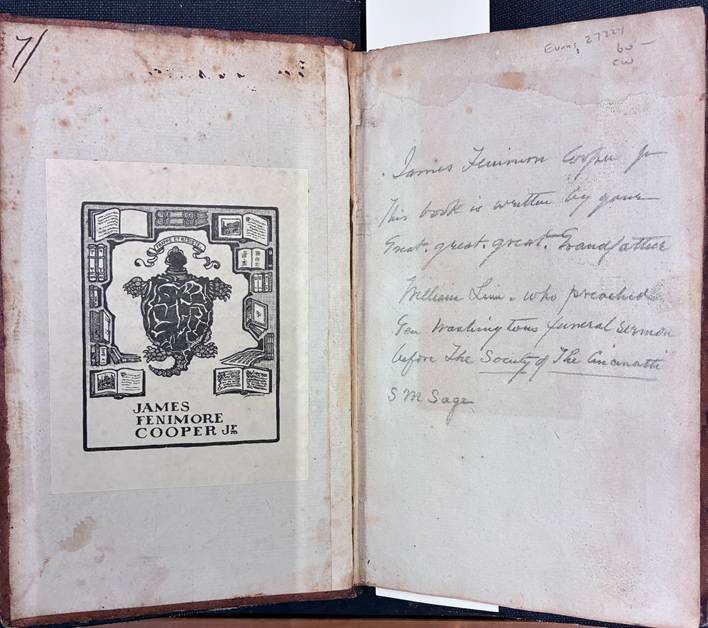
William Linn, D. D. (1752-1808). Discourses on Signs of the Times. New-York: Thomas Greenleaf, 1794. Bookplate of JFC Jr. [1892-1918], JFC’s great-grandson. Front flyleaf bears inscription to JFC Jr. signed by “S. M. Sage”, Sarah Manning Sage [Fenimore Cooper] (1841-1915), 1794, /repositories/2/archival_objects/316141. Wayne S. Franklin Collection of early American works and reference materials, 2021-0097. Archives and Special Collections, University of Connecticut Library.
To gift books in such a way can be “read” as gifting a part of the self, and a part of the self that is forever linked to the recipient. In some ways, it is to materialize and then gift the relationship itself in a material form.
This deeply personal relationship with books and reading practices can take on a poignantly political valence as well. For instance, two copies bear the signature of Mark J. Scearce (the inventor of the Mint Julep cup): The Headsmanand Sketches of Switzerland; By an American. Alongside Scearce’s signature is his inscription of his locale, Shelbyville, Kentucky, where he lived in the early to mid-twentieth century. Considering this context, Scearce’s owning and ostentatiously autographing the pastedowns of at least two first-edition novels by Cooper—a New York Yankee—can be read as a politically charged act of inscription. This is especially the case for a book like The Headsman, which Franklin describes as “intent on critiquing hereditary rank in all its forms. Every instance of it entailed a curse, if not on the heir then on humanity at large” (“Republican Principles” 141). Like with the bookplate, the signatures in the books tie the identity and self-expression of the Southerner with the texts of a Yankee (and, notably, two texts inspired by that Yankee’s experience in Switzerland—the second being Sketches of Switzerland, which itself was critiqued “by the European press for overzealously defending American republican principles” (AAS)). Scearce’s signatures and ownership become implicit expressions of political identity—intimately private yet externally material acts—articulating republican and egalitarian ideals in a region and time period in which race and class politics were especially fraught and tense. Yet Scearce explicitly identifies himself as a Kentuckian, inscribing his hometown alongside his signature. But doing so in these specific books reveals how politically and personally complicated that regional identity could be. In the evidence of these two signatures, we can see the role that literature and the material book play not only in an individual’s navigation of the complex dynamics of identity-crafting and self-expression, but also in the additional meaning this takes on amid the sociocultural and political climate of a given period and region.
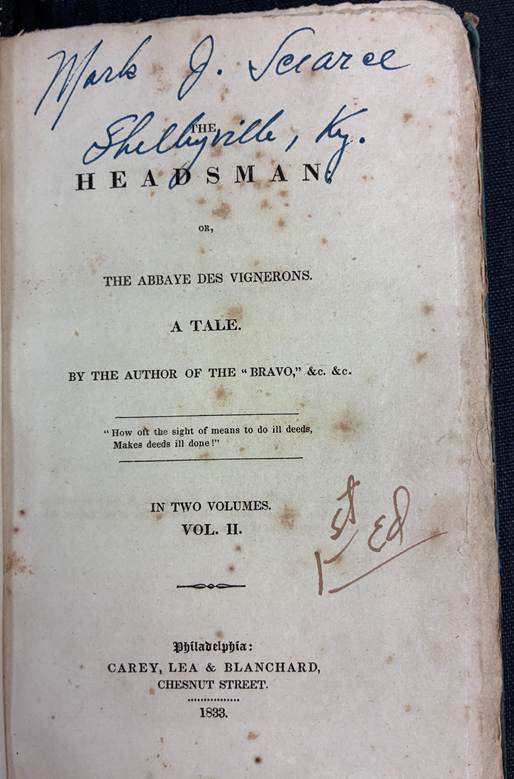
The Headsman; or, The Abbaye des Vignerons. A Tale. 2 vols., 1833, /repositories/2/archival_objects/316197. Wayne S. Franklin Collection of early American works and reference materials, 2021-0097. Archives and Special Collections, University of Connecticut Library.
I’d like to end this blog with a brief aside about the variety of uses and reading habits on display in just this series of the collection. One copy of Susan Fenimore Cooper’s Rural Hours bears markings and annotations from Franklin himself, offering a fascinating glimpse into a research- and scholarship-oriented reading and marking practice. Franklin’s annotations, cross-references, and systematic markings contrast with the marginalia by other readers, which range from unrelated poetry and drawings (like those shown below), to sporadic markings or annotating of passages which appear to have been marked for their personal or seemingly universal relevance, important plot moments, and corrective emendations. So, while the series may seem, on its surface, to be primarily about J.F. Cooper, it puts on display so much more about our relationships to books—material and conceptual—and the ways books mediate our relationships with each other and to larger sociocultural dynamics.
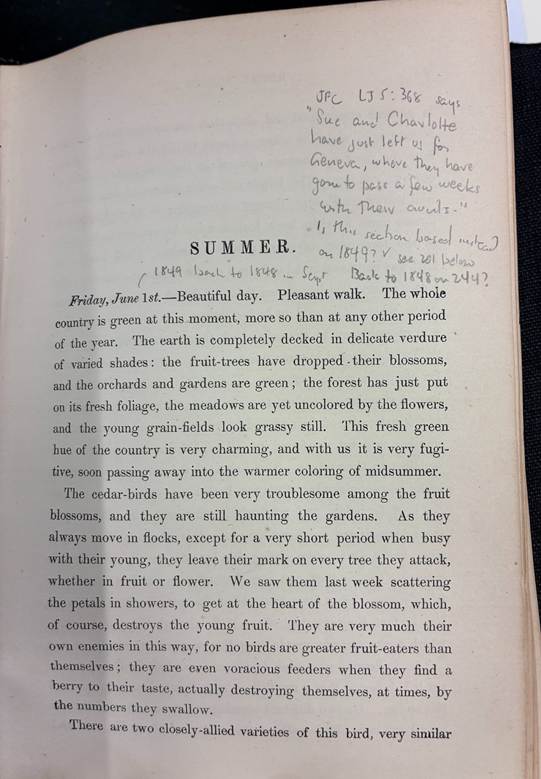
[Susan Fenimore Cooper], Rural Hours by a Lady. New York: George P. Putnam, 1850., 1850, /repositories/2/archival_objects/316130. Wayne S. Franklin Collection of early American works and reference materials, 2021-0097. Archives and Special Collections, University of Connecticut Library.
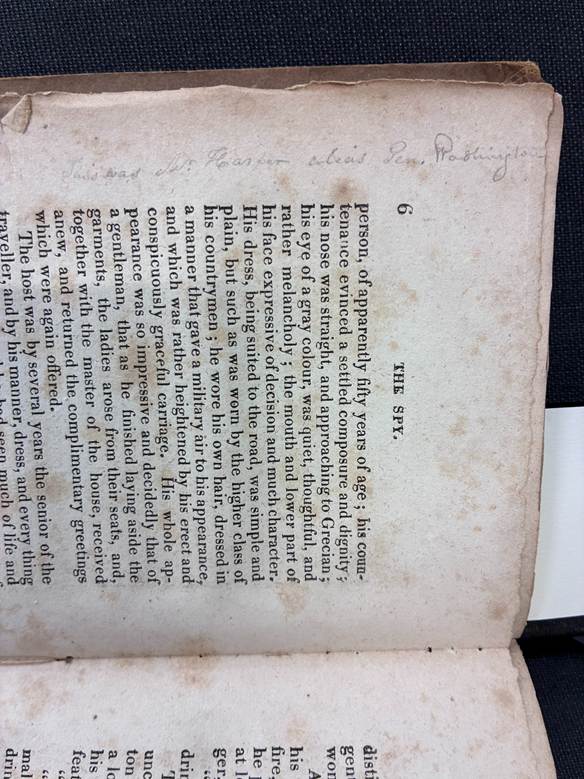
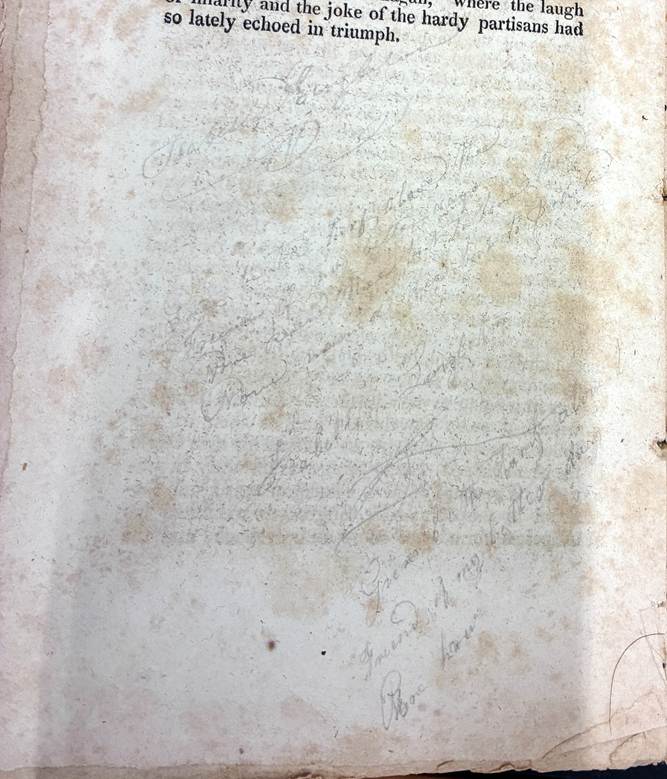
The Spy. NY: Wiley and Halsted. 1822. “Third Edition.” 2 vols., 1822, /repositories/2/archival_objects/316143. Wayne S. Franklin Collection of early American works and reference materials, 2021-0097. Archives and Special Collections, University of Connecticut Library.
I hope my discussion (and digressions; my many thanks to the readers who’ve indulged me to this point) has piqued some of your interests. And should you wish to explore the collection, following up on idea or item that sparked your curiosity, don’t hesitate to schedule an appointment in the reading room!
Bibliography
Wayne S. Franklin Collection of early American works and reference materials, 2021.0097. Archives and Special Collections, University of Connecticut Library. https://archivessearch.lib.uconn.edu/repositories/2/resources/1266
Franklin, Wayne. James Fenimore Cooper: The Early Years. 1st ed., Yale University Press, 2007, https://doi.org/10.12987/9780300135008.
Franklin, Wayne. James Fenimore Cooper: The Later Years, Yale University Press, 2017. https://doi.org/10.12987/9780300229103
Webby, Elizabeth. “The Novel Newspaper and Its Role in the Transmission of American Fiction to Australia.” Reading Across the Pacific: Australia-United States Intellectual Histories, edited by Robert Dixon and Nicholas Birns, Sydney University Press, 2010, pp. 167–76.