
This post was written by Professor Aaron Coy Moulton of Stephen F. Austin University, who has been researching our collections for information to support his work of The ‘Communist Hand’ in Cuba and Birmingham: Cuban Exiles and the U.S. Right.
Supported by the Kellems Family Fellowship, I had the opportunity to spend a week in Archives & Special Collections as part of my project on the activities of Cuban exiles across the United States. This was a truly productive experience thanks to the help of a generous and patient faculty who accommodated my eclectic requests. After all, tracking transnational subjects whose histories defy simplistic categories often requires a wide-ranging research methodology across diverse collections. Together, the Kellems Family Fellowship and the great staff gave me ample time to locate fascinating items regarding Cuban exiles who rallied US support against the 1959 Cuban Revolution and regime of Fidel Castro.
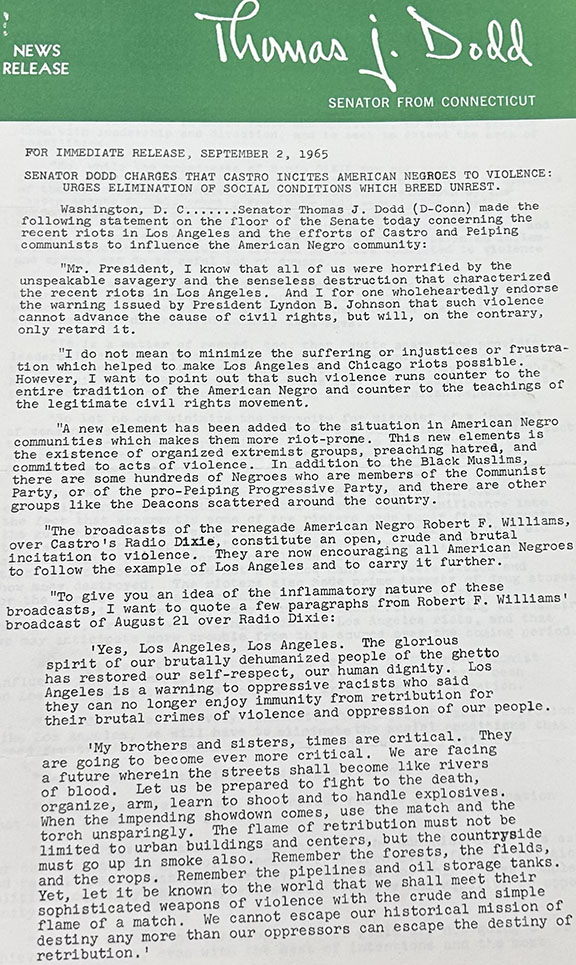
Much of this can be found in the Thomas J. Dodd Papers. Dodd was an influential Connecticut Senator who supported myriad anticommunist causes during the Cold War, so I was curious about his relationships with anti-Castro organizations and Cuban exiles. Right away, I came upon Dodd’s many speeches and writings denouncing Castro as a Soviet puppet, and some directly cheered Cuban exiles seeking to remove the island’s regime. One that stood out was a September 2, 1965, press release where Dodd blamed the Los Angeles Watts Riots on Robert F. Williams, a North Carolina civil rights activist who fled to Havana where his writings and “Radio Dixie” radiobroadcasts encouraged self-defense rather than nonviolent protest.
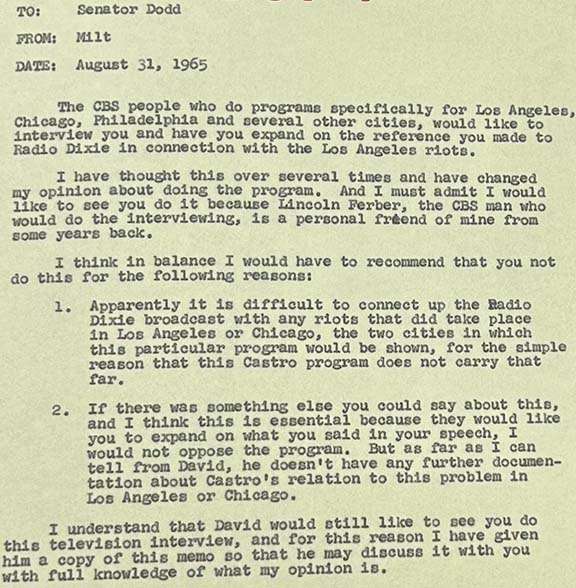
Conspiratorial right-wingers frequently summoned Williams as proof that Cuban communism influenced US civil rights activism, yet Dodd held a moderate anticommunist reputation that diverged strongly from those who put forward such claims; it was strange to find that the Congressperson agreed and insisted that Williams’s work in Cuba influenced African Americans to commit violent riots. Dodd’s public stance grabbed attention, and CBS requested an interview on this very subject. This forced his staff to intervene because they argued over whether Dodd should go onto a national forum and publicize a supposed link between “Radio Dixie” and US riots without evidence.
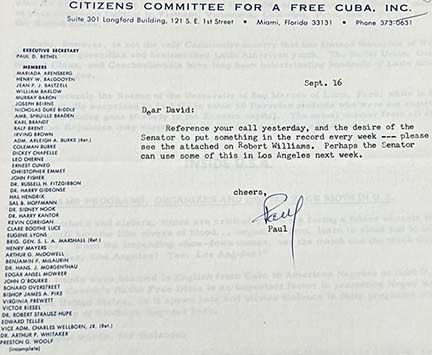
Dodd’s Papers reveal that anti-Castro organizations including the Citizens Committee for a Free Cuba (CCFC) responded positively to Dodd’s unfounded allegation. The CCFC brought together leading anticommunist activists ranging from Clare Boothe Luce and Edward Teller to Victor Riesel and Edgar Ansel Mowrer and blamed US social and cultural issues on Cuban communism. Hoping to know more about Williams and Cuba, one of Dodd’s assistants called CCFC executive secretary Paul Bethel about “Radio Dixie,” and Bethel gladly provided Dodd’s office with their materials on Williams. This demonstrates that Dodd’s office had a cordial relationship with the CCFC, illustrating how anti-Castro organizations assisted anticommunist Congresspersons.
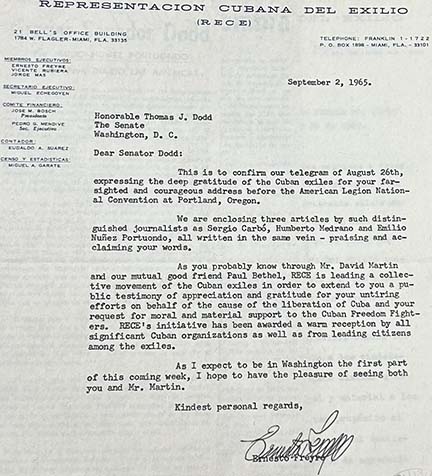
Cuban exiles also cultivated these relationships. Dodd’s Papers hold a handful of letters from Cuban exiles who cheered Dodd for his vocal opposition to Castro. José Bosch of the Bacardi liquor company was just one exile who thanked the Connecticut Senator for denouncing Cuban communism. Cuban exile organization Representación Cubana del Exilio [Cuban Exile Representation, RECE] both encouraged Dodd and gave the Congressperson’s staff various materials that could help Dodd make additional anti-Castro speeches. One reason I have found an ample number of Cuban exiles’ writings throughout the United States is that RECE, CCFC, and others disseminated those materials with the help of likeminded Congresspersons.
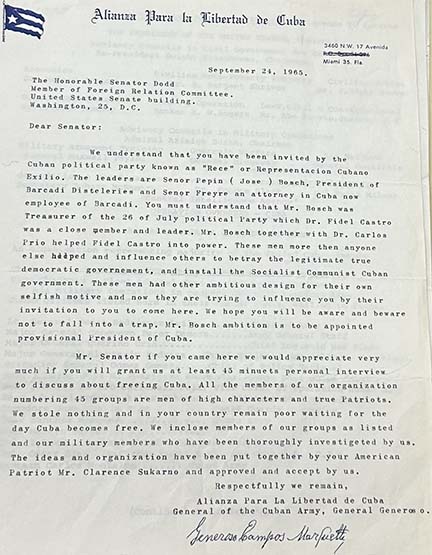
Dodd’s Papers also shed light into another aspect of my research: divisions among Cuban exiles. Even before the disastrous Bay of Pigs fiasco of 1961, exiles competed to secure the US government and US public’s support for their competing anti-Castro activities, severely undercutting the possibility of a unified movement. As a result, exiles regularly wrote Congresspersons and published articles denouncing their rivals as inauthentic, incapable, or even communist. At the same time that the CCFC and RECE were helping Dodd’s staff, Generoso Campos Marquetti with the Alianza Para la Libertad de Cuba [Alliance for Cuba’s Liberty, APLC] wrote the Congressperson. Marquetti warned Dodd against helping RECE and Bosch based upon how they had opposed the previous dictatorship of Fulgencio Batista whom Castro succeeded. APLC was another exile organization who kept alive longstanding grievances about fall of Batista and the rise of Castro, thereby hindering a universal movement to retake the island.
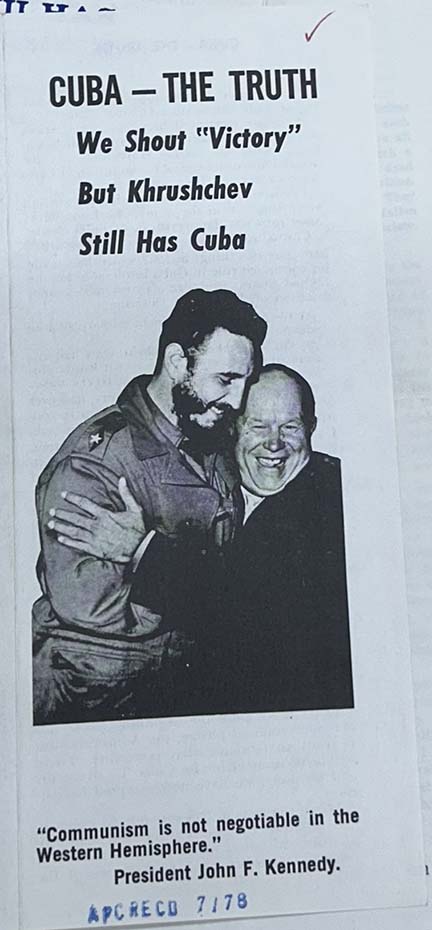
One of the most surprising finds, though, did not come from the Thomas J. Dodd Papers but the Alternative Press Collection. Elsewhere, I have often found Cuban exiles who reached out to right-wing organizations in order to raise financial and material support. For this reason, the staff allowed me to peruse the Alternative Press Collection’s various folders, specifically those for the Citizens Anti-Communist Committees of Connecticut. Like their compatriots across the United States, Connecticut citizens launched anticommunist organizations that reproduced the writings and allegations of regional and national outlets. For this reason, the Citizens Anti-Communist Committees of Connecticut folder happened to have a pamphlet published by the Committee on Pan American Policy (CPAP), a right-wing organization that in the late 1970s merged with the conspiratorial John Birch Society. CPAP spent two decades focused on alleged communist plots in Latin America, and here I found one of their popular pamphlets, “CUBA – THE TRUTH: We Shout ‘Victory’ But Khrushchev Still Has Cuba.” The pamphlet encouraged US citizens to oppose Castro’s regime, and this is certainly why it was distributed by Connecticut’s anticommunist organizations.
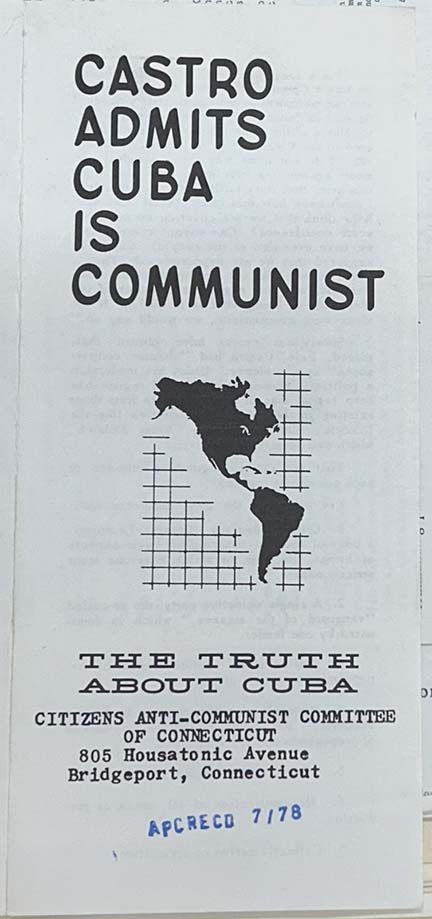
However, what I did not expect to find was a second pamphlet, this one titled, “Castro Admits Cuba Is Communist.” This pamphlet was produced by a well-known Cuban exile organization called The Truth About Cuba Committee (TACC). Led by Luis V. Manrara, TACC distributed anti-Castro materials, deployed speakers, and lobbied multiple US Congresspersons in opposition to Cuban communism. At first, this pamphlet does little more than reinforce what we already know about various exile groups. What makes this pamphlet stand out, though, is that it was stamped with the address of the Citizens Anti-Communist Committee of Connecticut based in Bridgeport. Not only did TACC mail its pamphlets from its Miami headquarters to Connecticut but the state’s anticommunists distributed TACC’s publications. This pamphlet in the Alternative Press Collection thus illustrates how local anticommunists amplified the work of Cuban exiles.
Further research might uncover even more materials about how the Cuban Revolution reverberated in Connecticut. Though my project focuses on those opposed to Castro, an investigation into those who supported the Revolution might show the other side of this history.