Ashlyn Anstee, Emmy-nominated Canadian-American director, artist, and writer, is the recipient of a 2026 Billie M. Levy Fellowship. She is a member of IATSE 839, and is a collaborator with The Center for Scholars and Storyteller. She also sits on the Associate Board of 826LA, and is a frequent workshop leader at museums, non profits, and libraries around Los Angeles. She holds a Bachelors in Applied Arts: Animation from Sheridan College, and a certificate in Early Childhood Education from UCLA.
I had the pleasure and privilege of spending a week at the Archives and Special collections at UCONN, peeking through children’s literature papers to research how many artists have different jobs as a part of their whole creative practice.
First, if you haven’t visited an archive before, it’s a little different than a regular library. You request the papers you want to see in advance (and UConn has a handy dandy system for that).
When you arrive at the library, they wheel out what you’ve requested. You might think you know what you’re requesting, but it’s not until it comes out that you get to see just what awaits you. These are originals after all, so sometimes things are in different sizes (little torn off pieces of papers) or not made of paper at all (some artists work on vellum, a thick sort of plasticky paper). The papers come in boxes and folders, sometimes big (like for original art) and sometimes banker box-sized with many folders for letters, papers and faxes. It’s like a beige brown Christmas.
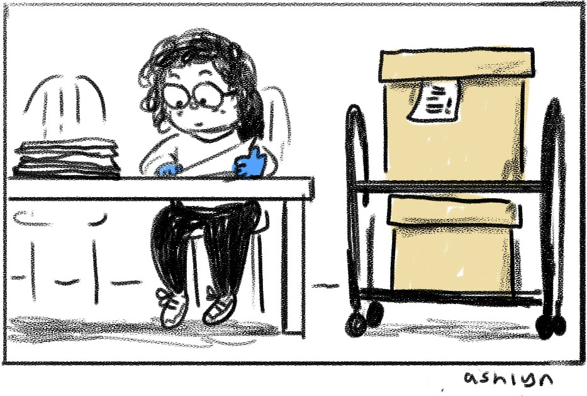
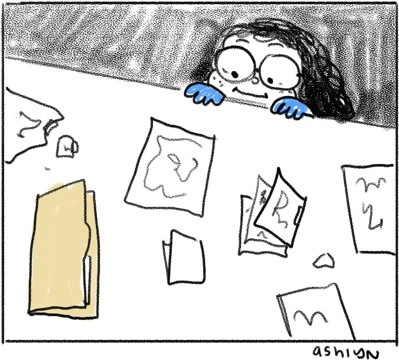
You sit at a table and gently explore. And I really mean explore. You put on gloves to go through more delicate objects, like art or photographs.
I was focusing on three artists–Esphyr Slobodkina, Cyndy Szekeres, and Kate Greenaway. They each had wildly different collections.
Esphyr Slobodkina has papers, intimate corrospondence, and even several lawsuits. Cyndy Szekeres was a mass of sketches and dummies (rough versions of picture books made to sell projects), and Kate Greenaway’s collection was bits of paper ephemera (printed postcards, magazines, and almanacks).
I had a little bit of an idea of what I wanted to write about for my project, which is a multi-part newsletter on my substack. I’ve been ruminating on the role of money and jobs and arts- why artists take on different creative jobs, and how it affects their artistic practice. I’m a multi-hyphenate, a little by choice (there’s just so many interesting things to learn!) and partly for survival. Arts can be tough to make a living, and having a swiss army knife of skills and conctracts can keep you afloat through fallow periods.
I started my career in animation, and have a bachelor’s in Applied Arts in Classical Animation from Sheridan College in Canada, I started my career in early animated greeting cards, before jumping over to TV animation. There, I started in storyboards, but then went onto writing and directing, and consulting. I’m Emmy-nominated for writing on Adventure Time: Distant Lands, and have hopped around working for most of the major studios. But I also write and illustrate books for children. My picture book Hedgehog! was in Dolly Parton’s Imagination Library. But wait,that’s not all! I’m also an adjunct professor at The College for Creative Studies and I teach teens and kids art too. I’m tired just writing that all out. But the fact is that they’re all bits of a whole, parts of a creative practice and they all inform eachother. My animation work has made me a more narrative storyteller for books, and my role as a teacher has made me more capable of directing and managing others.
This sort of creative chaos is more normal than not for artists, and my trip to the Archives showed it in spades.
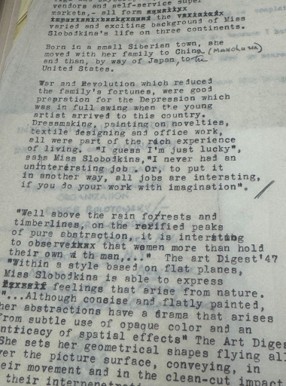
The first artist I took a look at was Esphyr Slobodkina. I knew her, as most people do, through her book Caps for Sale. But she was also a fashion designer, an interior decorator, an abstract artist, a jeweler, a sculptor, and a landlord.
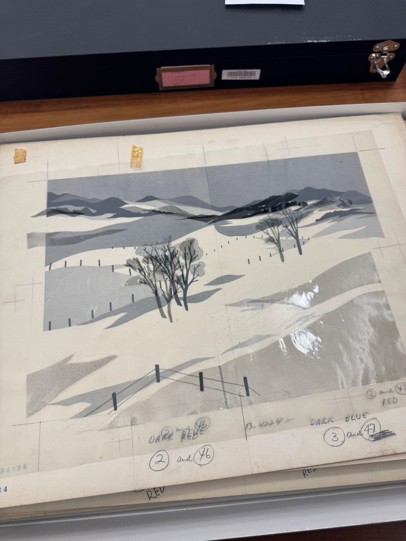
Diving into her papers was an amazing way to meet her. What she chose to keep, and how she viewed the world. She was very specific about what she liked and how she wanted things creatively. She could be biting, blunt, and hilarious in her pursuit of what she felt was right. In her letters (which she carefully saved and filed), she pitched herself as an artist, and asked (even demanded!) for respect. She didn’t back down from a fight, especially if it involved something that she’d poured her creative heart into. Among her lawsuits- a typewriter necklace she wanted to be paid for and eventually sued for the payment, and suing the city after her beloved home she built was being stunk up by a sewage plant.
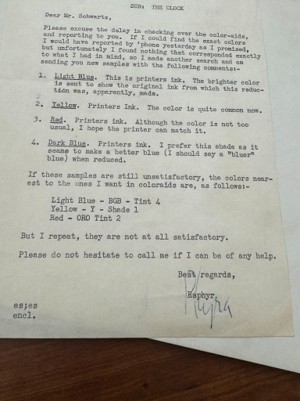
One of my favorite letters has her carefully curating ink color choices for a book, and when she offers other choices, talks about how “not at all satisfactory” it would be if they had to go that way. She just really liked things in a certain way!
One of my favorite quotes from her about jobs is “I’ve never had an uninteresting job. Or, to put it another way, all jobs are interesting if you do your work with imagination”, and I agree with her. What a joy to see someone throw themselves into different paths with as much fervor as her “main” money-making job. She truly said yes to anything!
Going through Cyndy Szekeres’ papers was equally as enthralling. I looked through a few boxes of Szekere’s work. Dummies- which are drawn up mock ups of picture books, and manuscripts, and piles and piles of idea papers. These tiny slips, on tracing paper, and even hotel notepads, speak to an artists’ habit of making due with the supplies they have. Like magpies of many tiny sketches, tapped and assembled and drawn over again.
Viewing these pencil drawings in person is astounding. She has a searching line, a way of getting down the pose for a mouse or bunny in the cutest possible way. Then she lays over more tracing paper and does it again, building up the form. When she pitches projects, she’s also always taking a commercial angle- how big will the book be, will it be a series.
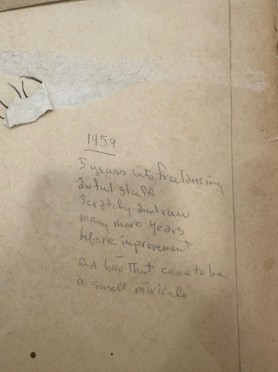
Szekeres started her work with many odd art jobs. She illustrated Babar stories for a newspaper, and left herself a note on top of the stack of papers. “Awful stuff, scratchy and raw.” While I don’t agree with her there, you can tell it was just a stepping stone for her. Some jobs are just for the money, and she eventually went on to make just her own work.
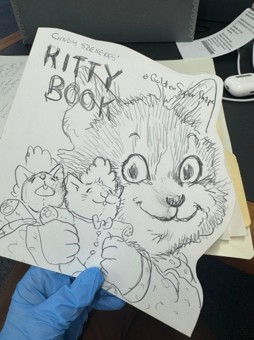
As I peek through her papers, I notice that she even designs the papers in her life, her stationary background creeping in. She includes an adorable sketch in each fax.
She has a notepad with her own art, and creates a letter stamp with her address perhaps an influence from Richard Scarry, her friend, he also did the same).
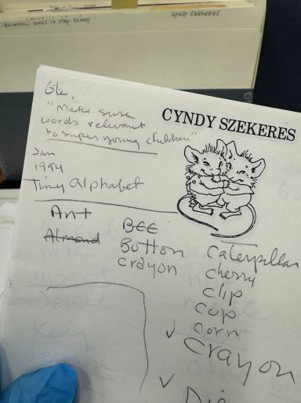
As a picture book author and illustrator, it’s rare to get a peek behind the curtain of how a book is made. We tend to be secretive, not wanting to share the messy thumbnails and ideas that go through the long process of making a picture book (sometimes years! often years). Szekeres lays her work bare, the tiny thumbnail mice glued in above text. In her notes, she writes lists, of rhymes, of emotions, and asks questions like “Should this be a baby bunny?” . These are the hard hitting quesitons of a picture book creator.
My final big adventure was with the Kate Greenaway collection. She started out in the greeting card world before moving to picture books (very early picture books- the medium was very new when she started illustrating in 1880). Her art is decorative, it feels like pre-Ralphaelite paintings with her gentle figures in watercolor and ink (she
also had a long correspondence with critic and pre-Raphaelite advocate Ruskin). Her art was what I’d think of as being more commercial. Though she illustrated scenes, they weren’t story-specific. Because of this, her art was able to be reused in a lot of different ways.
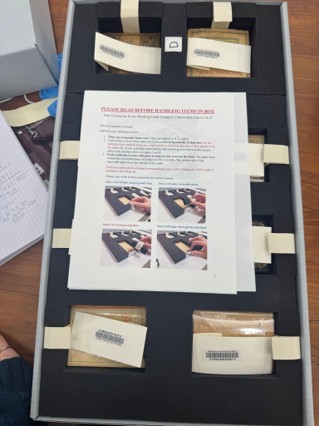
The Almanacks, which I got to look at, all lined up in their carefully-cut foam homes, were reprinted in the 1880s and again 30 years later. You have to handle these little books as carefully as original art- they are almost 150 years old!
I remember reading how Maurice Sendak called her work vapid, which, first of all rude, but second of all, I think her work was just more decorative than narrative. One thing that stands out with Kate Greenaway’s work is its long lasting appeal. Two other pieces in the collection, a pair of Time Magazines, talk about how her work is being used to inspire fashion.
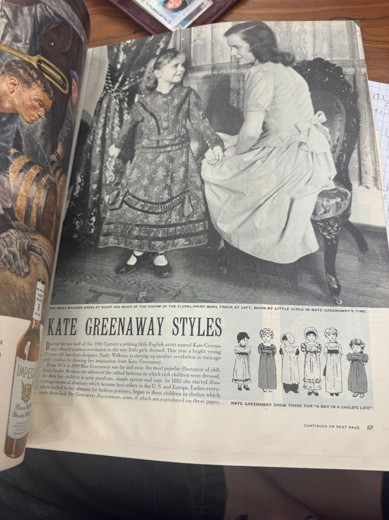
Greenaway’s mother was a milliner and it gave her an eye for greating works that were just a little out of time, traditional but fantastical. She created this idyllic view of childhood that was only just beginning to blossom (child labor laws had only just started to pass around then). She was also someone who drew on her letters, a characteristic which seems to be common among all the artists.
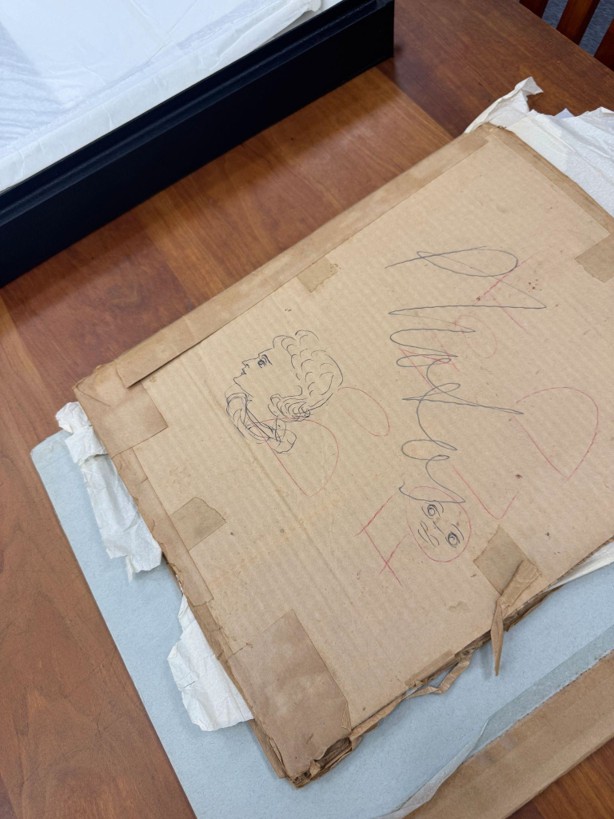
Seeing work in person is especially precious in a time like this. Digital is so easy to alter, to trim, to cut down. When I look through stacks of the “stuff” of someone’s life, I feel like I see connections easier. You can see the little comments that are too easy to erase digitally, to see empty sketchbook pages, pages with a single nose, a cardboard folder that Slobodkina drew a face on. How lovely, and how even many years later I feel like I am sharing the space and moment with her.
As I explore these artists of many careers, I’ve been saying I have a patchwork quilt of jobs. My mom is a quilter, and she’s really instilled in me the love of looking at a quilt and seeing all the fabrics that come together to make a whole. Even though this new world is daunting, and we’re having to do a lot of scrounging to make it work, maybe there is some joy in the new things that we’re doing. It affects our practice in new, wonderful ways, that you can’t always tell until many years later. If you can hold onto some of the little fires that keep you creating, even if it feels like there’s no money it, you can stoke them, let them grow, make something new even as you have to go off to do something else for a little bit. That’s what makes us artists.
As I look at the breadth of these artists’ careers in the Archives, I’m struck by how much they worked the business side of art as much as the creative. The creative oozed into everything, for sure, in letters and dummies and sketches, but as much as there was creativity there was business and setting up how to pitch things to make a living. To dive through the papers of someone’s life is to see how they made things work, and how they survived. Slobodkina, Szekeres, and Greenaway not only survived, but had long, successful careers doing many different things!