Postcard Poems in the Archives

Stephanie Anderson is a PhD candidate in English at the University of Chicago and the recipient of a 2013 Strochlitz Travel Grant. Travel grants are awarded bi-annually to scholars and students to support their travel to and research in the Dodd Research Center’s Archives and Special Collections. 

These days, when I’m thinking of a friend, I usually toss off a quick text or email.  But a few weeks ago I stumbled upon a postcard image of Robert Burns’s cottage, and I had to send it to my mother, a Burns fan.  The simple act of addressing and sending the postcard reminded me what a joy postcards can be; my mother would know right away why I had sent the card.  Postcards anticipate some sort of response, even if it’s not a written one. In that regard, they are like poems – often understated, yet capable of signifying a great deal; sometimes intended for a particular addressee yet also circulating, exposed, in public. And like poems, their text is not their only means of signifying; it is generally only one component of the entire “message.” 

The postcard’s other marks of distance – foreign stamps, the obtrusive postmark, the image on the front (which, as with the postcard to my mother, may be more “private” than the text on the back, as it can represent a mental placement of the addressee in the sender’s position or thoughts for reasons that an over-hearer/reader may not be able to intuit) – can be just as weighty. In other words, often it is the entire object or one of its components that signifies more than the epistolary text. As Derrida says, “What I prefer, about post cards, is that one does not know what is in front or what is in back, here or there, near or far, the Plato or the Socrates, recto or verso. Nor what is the most important, the picture or the text, and in the text, the message or the caption, or the address.”[1] The postcard tracks the movement of the sender, and confirms the fact that the other is still in the world.

Members of the group of poets known as the “Second Generation New York School” (active from about 1960 to the present) used postcards as a primary form of communication. The cards were printed en masse to advertise readings; they were handwritten en masse as invites to parties and celebrations. Presses printed individual poems on them to advertise books. For the artist Joe Brainard as well as others, they suited his interest in assemblage and his reclamation of kitsch. He tirelessly sent vast numbers of postcards, such that their saturation became, for their recipients, a form of articulating presence – and as evidenced in a letter from Bill Berkson, Brainard even considered starting a postcard company.[2] We can assume that for the group, the exchange of postcards can be seen as a form of playful conversation.

At the Dodd Research Center’s Archives and Special Collections this summer, I had the berkson_notleycard1pleasure of looking through archives of several “Second Generation New York School” participants, including Bill Berkson, Ted Berrigan, and Larry Fagin. A chapter of my dissertation examines the epistolarity of Ted Berrigan’s The Sonnets, and so I was very excited to come upon letters and postcards throughout these archives.
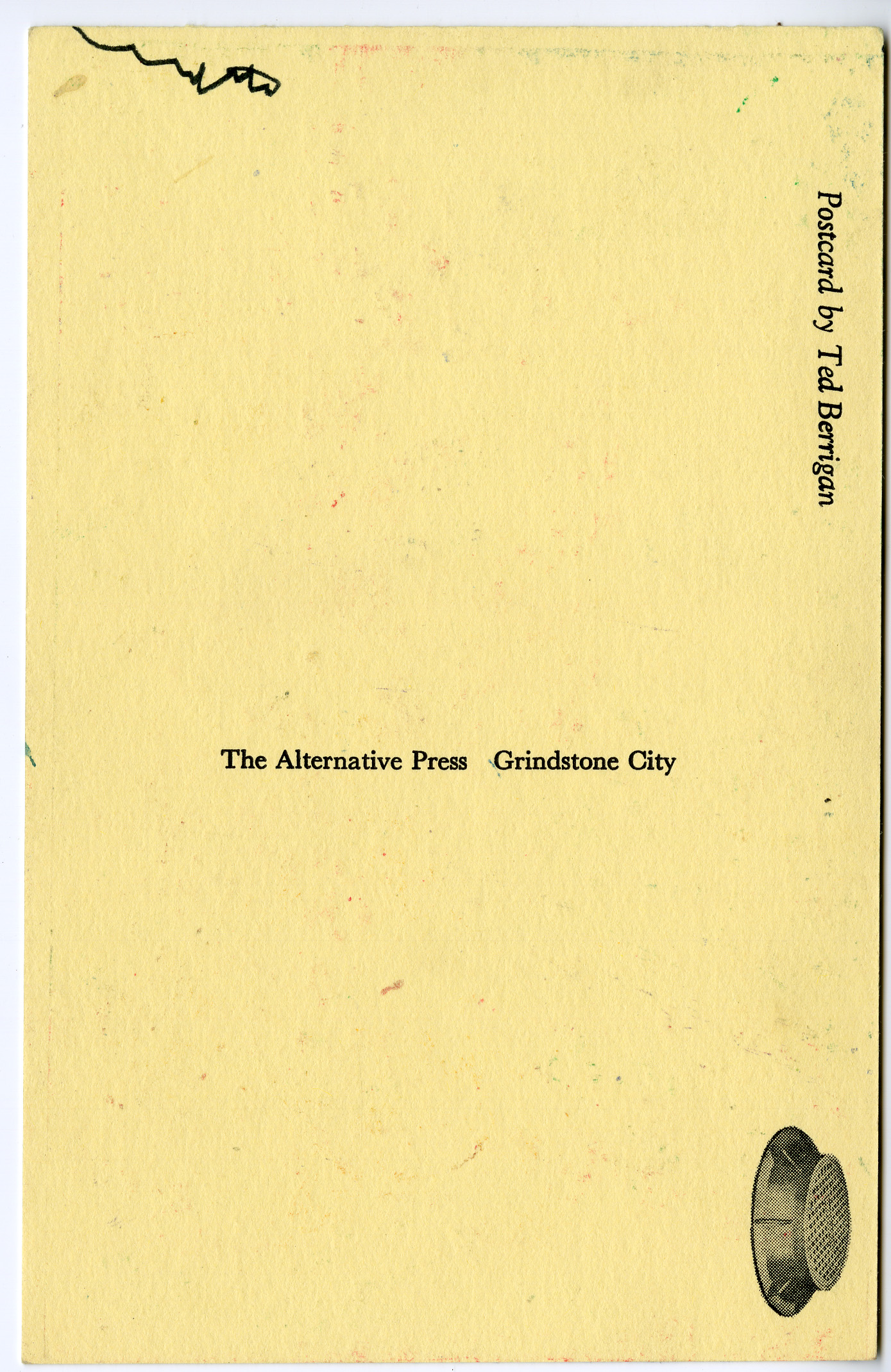
Berrigan wasn’t a prolific letter writer, but he did like postcards quite a lot; at the time of his death in 1983 he was working on a series of poems written on postcards. The poet and Berrigan’s widow Alice Notley reports that though these blank postcards were printed by the Alternative Press, they were 4½ by 7 inches, distributed in groups of 500, and given to other artists and writers as well.[3] The appeal of the postcard, Notley suggests, is its materiality; it is a “block”-like unit.[4] She explains how Berrigan used the postcard:

The postcard poem was a form dominated by the size of the card, though a relatively longer poem could be written on a card if Ted shrank his handwriting. Ted immediately used semi-collaboration as a way into the poems, inducing everyone he knew to write a line or draw an image on a postcard. He later eliminated the names of the “facilitators,” except for the occasional dedication. The poems are often epigrammatic, but are just as likely to be longer; they chronicle, not so explicitly, a difficult year…[5]

The Bill Berkson papers contain one beautiful example of such a collaborative postcard, which has a “trillium” in the background painted by Notley (the back is empty). According to a note in his papers, Berkson received the postcard in 1983, after Berrigan’s death. berkson_notleycard2re The smooth and luscious lines of Notley’s watercolor flower provide an interesting contrast to the card’s text, which begins (after listing the address to situate the card’s production) “I stand in the dock in judgement / literally already condemned, but am / here to be informed…” The second slash is actually present in the text, insinuating that Berrigan conceived of the lines as poetry but perhaps a poetry still in a nascent or draft state.
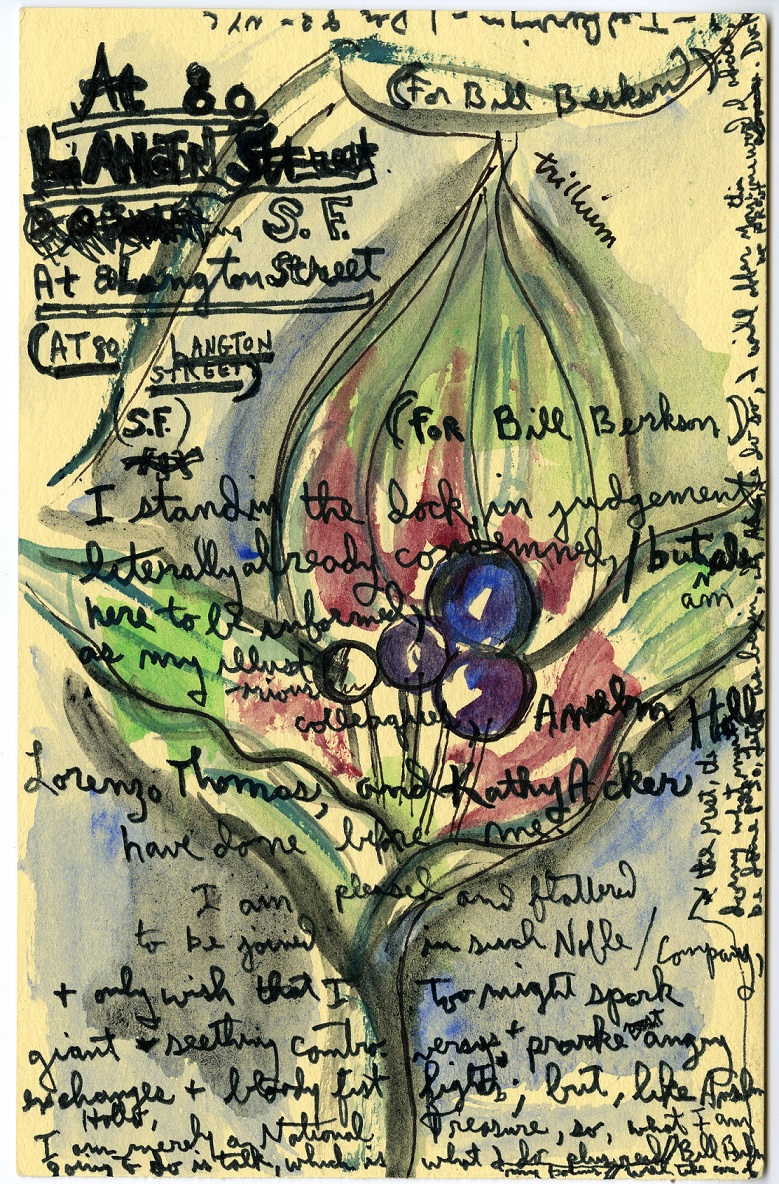
The remainder of the text goes on to question groupings such as the “Second Generation New York School” tag that I employed above.  Berrigan was at this point seen as central to the “group,” and here he name-drops other artists (Lorenzo Thomas and Kathy Acker) to poke fun at his placement vis-à-vis the public perception of the “group,” suggesting that aligning his own work with that of Lorenzo Thomas and Kathy Acker is a mistake. One aspect of their work’s reception, he says, is its ability to “provoke angry / exchanges + bloody fist fights,” an end his work cannot accomplish. He will, instead, simply attempt to communicate: “…so, what I am / going to do is talk, which is what I do plus read / my poems.” His “one word of advice” to Berkson, scrawled almost illegibly in the upper right-hand corner, is “Duck,” perhaps partially intended to pun on predictability. The image of the flower contains an upward trajectory in its lines, some of which guide the eye toward this right-hand corner, but semantics of the word hiding there suggest the opposite movement. “Duck,” as a verb: keep your head down, keep moving, don’t get hit by the incoming “bloody fist[s].”

I don’t take this statement to be apolitical, or against aesthetic provocation; I read it instead as a wariness of generalizing about groups and group labels. It is desirable to be included – or to have others included with you – in such grouping, even with the tongue-in-cheek tone (“I am pleased and flattered / to be joined in such noble / company,” he writes). But as in a boxing match, one can only avoid being knocked out (critically pigeon-holed and labeled, we might say) by remaining unpredictable, both in aesthetics and in perceived group affiliations. Hand-delivered to Berkson, it has a specific addressee, yet the suggestions Berrigan makes about aesthetic groupings seems directed toward a larger audience. Of course, he couldn’t have anticipated that 30 years later, a budding scholar would be thumbing through his correspondence looking for clues about his work and milieu – yet the postcard felt like it was intended to be overread by a recipient exactly like myself, in order to complicate and nuance conceptions of poetic form and coterie labeling

– Stephanie Anderson


[1] The Post Card: From Socrates to Freud and Beyond (Chicago: University of Chicago Press, 1987), 13.

[2] “United Artists Papers,” Archive (UCSD, n.d.), Box 1 Folder 9, MSS 0012, Mandeville Special Collections Library, UCSD.

[3] The Collected Poems of Ted Berrigan (Berkeley: University of California Press, 2005), 12–13.

[4] “It’s a very graspable, manageable unit.” (See the introduction to A Certain Slant of Sunlight (Oakland, CA: O Books, 1988), n.p.)

[5] The Collected Poems of Ted Berrigan, 13.
Remembering the New England Hurricane, September 21, 1938

[slideshow_deploy id=’3997′]

The New England Hurricane of 1938 was one of the most famous of weather disasters in the region’s history and for many years the standard upon which all other hurricanes were held.  The devastation was enormous: after making landfall as a Category 3 hurricane on September 21 it is estimated to have killed between 682 and 800 people, damaged or destroyed over 57,000 homes, and caused property losses estimated at $306 million ($4.7 billion in 2013).

For Private Eyes Only: Why Write Diaries Anyway?

Rebecca D’Angelo is a senior undergraduate student in History and Anthropology. In her blog series For Private Eyes Only she will study various diaries available in the Dodd Research Center’s collections to explore the history of journal writing and reasons why we write journals.

I have a confession to make: I’ve been reading other people’s diaries.

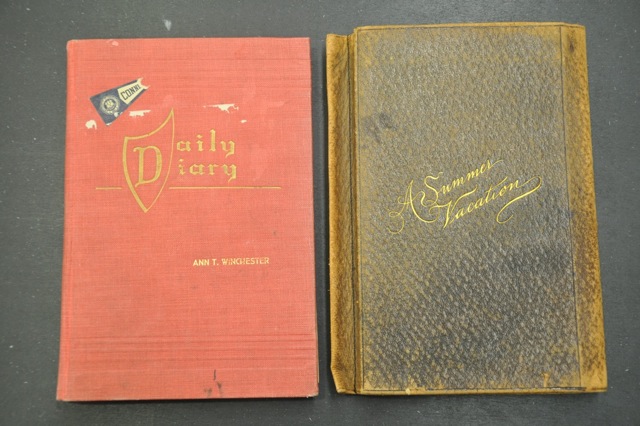
I didn’t feel guilty about it at first. The diaries I’ve been reading are part of the Dodd Center’s Diaries Collection. Most were written over one hundred years ago. Unlike other collections which tend to be organized by donor, the Diaries Collection houses an eclectic mix of personal diaries, daybooks, copybooks, and ledgers, many written by New Englanders. The collection spans one hundred years of journal writing, the earliest diary in the collection dating to 1851. Two diaries, which both date to 1943, are the latest in the collection; both were written by Connecticut women, one, a painter with the surname Whitlock living along the Connecticut shoreline, and the other, a University of Connecticut student named Ann T. Winchester who was studying to be a nurse during her time at UConn.

diariesAt first I viewed the diaries in the Dodd Center’s collection purely as sources. I was interested in the stories they could tell me about the past and about the people who occupied it. I was also interested in the quite literal range of forms and colors present in this collection. Some, like Ann Winchester’s are handwritten in a book printed with “Diary” on the front. Hers is bright red. Others are written in tiny notebooks, and others in leather-bound volumes. Some only include personal entries. In others, notes on the writer’s day are included alongside general musings and business records.

Then I saw this message, inscribed on the inside cover of one diary written by S.E Warren, a young Massachusetts man training to become a school teacher in the 1850s. It read:

“All of my journals[,] To be read by no one but my parents in case of my death as a single man or widower. Others may see the index only, and may have such portions read to them as are not marked Private. Or else my relict or heirs only shall see them as above directed.”

 Suddenly I felt like one of those TV sitcom dads who gets caught snooping through his daughter’s diary. The person who wrote this diary didn’t intend for me to read it. As a historian, I tend to forget that sources are generally not written for me. It’s true that some historical accounts or objects are created “for future posterity.” But generally, artifacts are the surviving residue of a past life, lived day-to-day, with little concern for what a history student writing about them in a blog would think about them one hundred years down the line. After all what is a diary, if not something extremely personal, a continuous letter to self? I’m guessing that S. E. Warren didn’t intend for future historians to read his journal. Then again, he clearly anticipated that someone other than himself, his parents, or his heirs might pick it up. Why else would he have included such a preface?

As I continued browsing through these journals, I started thinking about my own journal-writing. I keep several irregular journals to explore my thoughts. I imagined S.E. Warren, Whitlock, and Ann T. Winchester each had their own similar motivation for writing in their respective journals. I thought back to other historical journals I had read. Growing up, I valued Anne Frank’s diary for the story it told and for the perspective it offered me into the lives of Jewish German nationals forced to flee Germany during World War II. Now I began to wonder: Why did Anne value her diary? Realizing that I read other people’s journals even though I barely go back and read my own, I started wondering why I kept mine. Why does anyone write in a diary or journal?

Today, psychologists and writers extol the benefits of journal-writing. A quick internet search on “why we write diaries” reveals a laundry list of blog articles encouraging me to keep a journal for various reasons – to reflect, to project, or simply to practice writing. In 2007, the New Yorker published a fabulous review piece that pondered this very question. “Diaries,” the author suggests, “are exercises in self-justification.” He ultimately concludes, “We write to appease the father. People abandon their diaries when they realize that the task is hopeless.”

I am no psychologist and will not pretend to be one, but I am a historian and I’m interested in these questions – why did we write diaries in the past? Why do we continue writing them today? I intend to use this blog series to help me answer these questions. By reading, researching, and analyzing the range of diaries available through the Dodd Center’s Diaries Collection I hope to explore the different forms diaries take on, the stories and details we entrust them with, and the function they serve in our lives.

How a Filmmaker Researches the Past

Fred Ho

from Steven De Castro’s film
Fred Ho’s Last Year

— Steven De Castro is a recipient of a Rose and Sigmund Strochlitz Travel Grant to use the Fred Ho Papers held by Archives & Special Collections at the Thomas J. Dodd Research Center.  A description of his research experience appears below.

Most folks visiting a library are doing so to write a book or a paper. But a library preserves not only the papers of our culture, but also its sights and sounds. And these audio and visual records are of particular interest, not just to writers, but to filmmakers.

Research on a historical film is similar to researching a book or paper. The director John Sayles, before producing Amigo (his drama set during the Philippine-American War), read over 100 books on the subject. The difference in documentary filmmaking is that after engaging in the scholarly work, one has to then engage in the business of negotiating and purchasing the rights to the video you have unearthed.

As a filmmaker, I have found Archives & Special Collections invaluable in my research for the upcoming documentary film, Fred Ho’s Last Year.

ABOUT THE FRED HO PAPERS

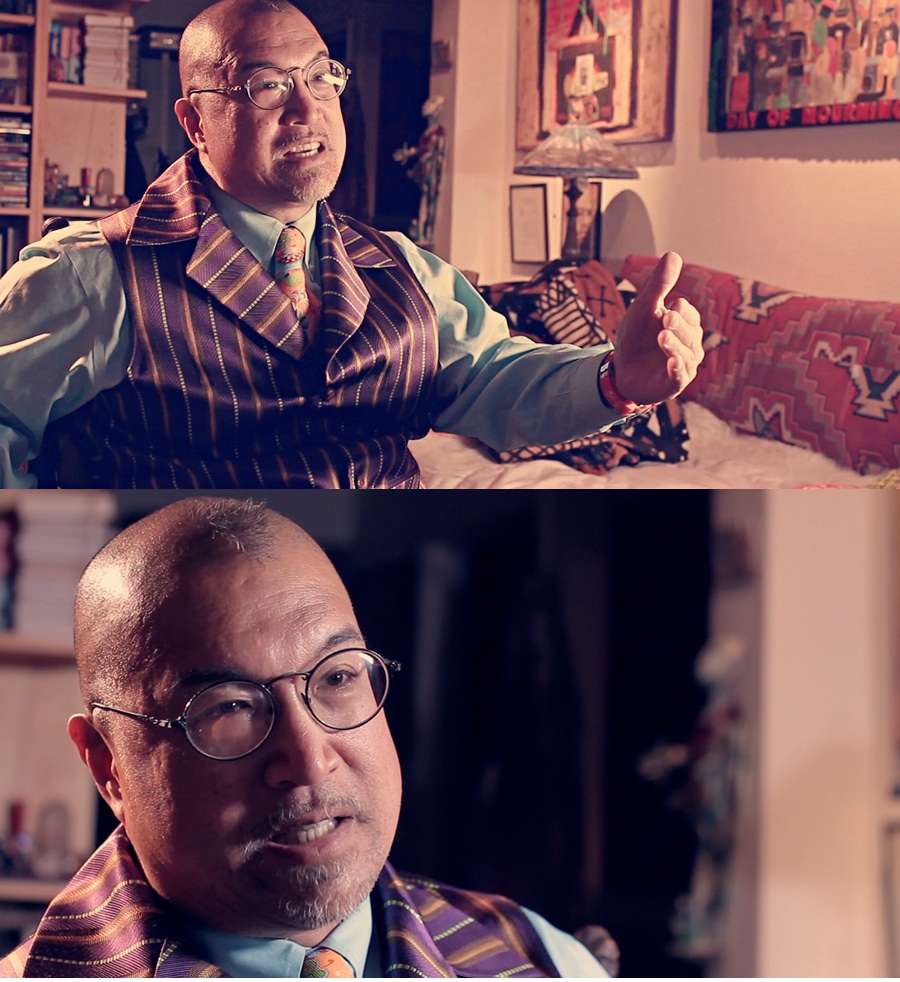
Enclosed within the walls of the Dodd Research Center’s archives are the sights and sounds created by one of the greatest avant-garde jazz artists of his generation – a prolific composer, a committed Asian American activist and public intellectual – Fred Ho (b. 1957).

Fred Ho is a 6-time Rockefeller Fellow, a Guggenheim Fellow, a 2-time National Endowment of the Arts recipient, the winner of an American Book Award and a Harvard Arts Medal. Despite these accomplishments, most people – even in the field of contemporary music – have never heard of him. Whether it is because of the fact that he is an outspoken Asian American (a rarity in the music industry), or whether it is because he infuses his own brand of leftist politics in most of his work, is anyone’s guess.

Perhaps the most compelling reason why such a prolific artist is not more widely known is that he refuses to be categorized. His music is too challenging to attract a popular fan base, and yet it embraces (and remakes) so many popular styles of music that it is not “out there” enough for other avant-garde musical cliques.

One of the most important facets of Fred’s art is that if you are buying his albums and enjoying his music, you are experiencing only a portion of his creative work. Fred is not only a musician, but an operatic composer whose works are meant to be both seen and heard at the same time. The only way to experience this, short of attending a performance, is through audio/visual media. The central repository of audio/visual records of Fred Ho’s work and public statements is in the Fred Ho Papers held by Archives & Special Collections.

Fred’s artistic and political direction profoundly changed when, in 2006, he was diagnosed with colon cancer. Currently Fred’s condition is terminal and he has refused further chemotherapy. Incredibly, Fred still continues his work. As of this date, he has a concert with his orchestra at the Brooklyn Academy of Music and an upcoming book. The significance of the Fred Ho Papers to the fields of Asian American studies, art, and music is difficult to quantify, both for this generation of scholars and for future generations.

Most of the video within the Fred Ho Papers is undiscovered and unplayed. Video is (quite understandably) not of interest to scholars whose main interest is to publish papers and books. And although the video is quite visually fascinating and intellectually provocative, much of it is stored on magnetic tape that degrades with each passing year.

BRINGING THE ARCHIVES TO THE MOVIE SCREEN

Through my research at Archives & Special Collections, I am able to tell a more comprehensive story of Fred Ho’s life and work on a greatly expanded timeline, through the use of archival video. The video shows Fred performing and speaking many years ago, before I began shooting. Through the skills of documentary storytelling, this material comes alive and brings the art and thought of Fred Ho to undiscovered audiences.

And yet, finding the material is only a first step. Under the Fair Use exception to the Copyright Act, a university is allowed to play these videos to a classroom of students. However, a filmmaker is not allowed to incorporate these materials into a film without authorization. So I had found the videos. Now what?

In addition to being a filmmaker, I am a lawyer. Through weeks of calls and internet searches, I was able to track down these rights holders for a release. The television production companies had their own release forms, but in one instance, I drafted the release for the company representative to sign.

Licensing of archival video footage for a film is expensive. Generally, institutions have different rate plans for licensing, which eases the cost for independent producers such as myself. Thankfully, one institution and most individuals I have asked have released their rights for free.

Due to the age of the material, many rights holders failed to locate the original high-quality versions of the footage within their own archives. Therefore, some of the video archives in the Fred Ho Papers turned out to be the only existing copies. In those cases, my research allowed me to acquire these materials and negotiate their release even when they were lost by the production company that made them.

When a video is made, it is usually made for a short term purpose. Production companies cover an event to place on the evening news. A performer may videotape his own performance for the purpose of reviewing it the following day. The maker of the video rarely intends to create a lasting archive. And yet, as a historical documentary filmmaker, I depend on the archival video at Archives & Special Collections – sometimes stored in archaic analog formats – to bring the subject alive.

Steven De Castro, J.D., is the Producer and Director of the upcoming feature documentary, Fred Ho’s Last Year. His research is made possible by the University of Connecticut’s ASIAN AMERICAN STUDIES INSTITUTE, ARCHIVES & SPECIAL COLLECTIONS AT THE THOMAS J. DODD RESEARCH CENTER, FRED HO FELLOWSHIP, and STROCHLITZ TRAVEL GRANT. You can contact him at decastro@credibilitymedia.com.

Northeast Conference on British Studies

Lion_Rampant_TitleOn October 4th and 5th, the red coats are coming to UConn!  This years annual meeting of the Northeast Conference on British Studies, organized by Prof. Brendan Kane of UConn’s History department, is working collaboratively to promote historical research in archival collections.  The Dodd Center and Archives & Special Collections will be on display the evening of October 4th for the initial day’s reception.  Archives & Special Collections will have materials on display from the early modern period to anti-colonial struggles of the late twentieth century.