The Death of Gardner Dow

[slideshow_deploy id=’8896′]

On September 27, 1919, Connecticut Agricultural College student Gardner Dow, class of 1921 and 20 years old, was looking forward to the first football game of the season, an away game to be played at New Hampshire State College. The football team and the CAC student body were particularly looking forward to the game because it signaled an end to the suspension of the team during the years of World War I. Dow, who played center, was originally not slated to play the game due to an ankle injury, but he rallied and thus traveled with the team up to Durham with high hopes of coming back to Storrs as the victors.

What happened at the game was well told in the October 3 issue of The Connecticut Campus, the CAC student newspaper:
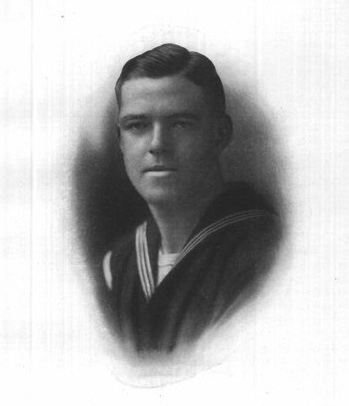
Gardner Dow

“It  was during the last quarter that the tragedy occurred. Hopwood punted to Farmer, New Hampshire’s Right Half-back, who started down the field and was tackled by Voorhees, who caught him by one ankle and tripped him, but he regained his feet and plunged forward, coming in contact with Dow who had rushed in to tackle him. Dow was knocked unconscious and, after vainly trying to bring him to, for a few minutes, a doctor was called. The doctor had him moved from the field into the office of the Athletic Director, where he worked over him until the close of the game, when he was removed to the A.T.O. fraternity house.

It was thought at first that he had received a solar plexis blow, as the doctor was unable to find any injury on his body. Later, however, the doctor found a bump on his head and the patient seemed in a deeper stupor than he had been at first, so an ambulance was called for his remove to the Dover Hospital. He passed away before the ambulance arrived in spite of all that could be done to revive him. The body was removed at once to an undertakers establishment in Dover where it was prepared for subsequent removal to Dow’s home in New Haven.”

The football team returned to Storrs in stunned silence, unable to believe that a treasured teammate was gone. For the next three days all activities on campus of “light amusement, ” including the Freshmen dance, were canceled or postponed while the students mourned their loss. Students took up a collection for flowers and undertaking expenses for Dow’s family.

On Tuesday, October 1, at the time that Dow’s funeral was taking place in New Haven, all afternoon classes were canceled and the entire student body, faculty and staff assembled in the Armory for a ceremony to honor Dow. President C.L. Beach described Dow as “a friend, a scholar and a gentleman.” Others spoke of “our College Hero;” the members of the football team placed a spray of flowers on a vacant seat.

Less than a week later the Athletic Association voted to name the college’s athletic field the Gardner Dow Field. The field extended from the rear of Hawley Armory westward toward what is now Hillside Road. For five decades following Dow’s death it was the home court for the CAC/University of Connecticut’s football, baseball, soccer, field hockey and track teams. By the 1970s building on campus overtook the field, with Homer Babbidge Library, the School of Business and the Information Technology Engineering buildings now on the site.

A plaque that had been placed at the field was moved to Hawley Armory, where it stands today.

The 1920 yearbook was dedicated to Dow and the college posthumously granted him a varsity letter which was sent to his family. Dow’s father Arthur wrote to the campus community on October 16, 1919, expressing his appreciation for the “sympathy extended in our sorrow,” confirming “the love that Gardner had for his college, and our one hope is that you will all work for it as he did, until the very end, thereby making it better and bigger as the years go by.”
Day-Glo & Napalm: Conflicted Sixties

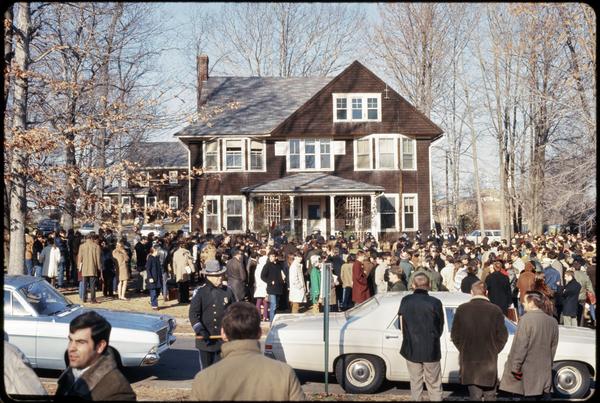
The following guest posts by Asst. Prof. Charlie Brover and Alumnus John Palmquist (’71) are in conjunction with the current UConn Archives exhibition Day-Glo & Napalm: UConn 1967-1971 guest curated by George Jacobi (’71). The exhibition is on display until October 25th with an evening reception on September 19th, from 6-8pm in the Thomas J. Dodd Research Center.

Guest Post by Asst. Prof. Charles Brover:

My Lear year reflection: Was it pissing in the wind?

I will be 80 in September. I’m King Lear’s age. (“Fourscore and upward, not an hour more nor less”). Some 50 years ago in my course on Shakespeare’s tragedies, we talked about how much easier it was to identify with Hamlet, that flashy student on spring break from Wittenberg, than the benighted old man who hath ever but slenderly known himself. Lear began his education at 80, and one hell of an education it was—a fierce warning against the unreflected life. So now in the fifth act of my own education I am grateful to my old comrade Larry Smyle for reaching out to me and to George Jacobi and Graham Stinnett for the opportunity to reflect on those superheated days at UConn 50 years ago. Were they formative in my life? Were they just an episode of frothy anti-authoritarian rebellion?

Continue reading

Resources in the Archives on Naturalists and Environmental History in New England

[slideshow_deploy id=’8854′]

In Circle of the Seasons: The Journal of a Naturalist’s Year, famed naturalist Edwin Way Teale writes, “The long fight to save wild beauty represents democracy at its best. It requires citizens to practice the hardest of virtues—self-restraint…To provide protection for wildlife and wild beauty, everyone has to deny himself proportionately. Special privilege and conservation are ever at odds.” As relevant today as when his book was first published in 1953, Teale’s message of the necessity of conservation lies at the core of the study of environmental history. Defined generally, the study of environmental history examines the interaction between humans and the natural world over time. Naturalists contribute to our understanding of environmental history through their fieldwork, where they observe and comment on the behavior of species within their natural environments. As described by author John Terres, a naturalist is “a lover,” different from the scientist, who is “an investigator.”

Archives & Special Collections holds the writings of several influential New England naturalists. These include Edwin Way Teale (1899-1980), John K. Terres (1905-2006), and Margaret Waring Buck (1905-1997). Continuing in the august tradition of Henry David Thoreau, Teale and his fellow naturalists helped facilitate a discovery and interest in the natural world among a variety of audiences, including children. For example, Teale’s book The Strange Lives of Familiar Insects encourages an appreciation for the insect world by drawing attention to often overlooked and misunderstood creatures. The collections of these naturalists housed in the archive include field notes, diaries, photographs, illustrations, letters, publications, and artifacts. These materials allow for an examination into the mentality and practices of people who devoted themselves to the documentation and preservation of the natural world, which has furthered the study of environmental history.

Edwin Way Teale Papers: Born in Illinois in 1899, Teale was interested in nature from an early age. After earning degrees at Earlham College and Columbia University, Teale pursued a career writing articles for the magazine Popular Science. Teale left the magazine in 1942 in order to work full-time on his own books. In 1959, motivated by a desire for a more bucolic way of life, Teale and his wife purchased seventy-five acres in Connecticut. Teale wrote thirty-two books throughout his lifetime, and won the Pulitzer Prize in 1966. Teale and his wife donated their land to the Connecticut Audubon Society. His papers at the Archives & Special Collections include field notes, drafts for his books, magazine and newspaper articles, letters, family documents, photographs, and his personal library. The finding aid is available at https://archivessearch.lib.uconn.edu/repositories/2/resources/788
To find a digitized copy of Teale’s “Trail Wood Journal” from 1962-1965, go to http://hdl.handle.net/11134/20002:860204261

John K. Terres Papers: Award-winning author and naturalist John Terres was born in 1905 in Pennsylvania. He attended Cornell University and New York University before becoming a field biologist for the Soil Conservation Service in 1936. He wrote and edited more than fifty books concerning natural history, and became well known for his books on North American birds. One of his best-selling books, Songbirds in Your Garden (1968), teaches readers how to attract and feed birds in their own backyards. Another acclaimed book, The Audubon Society Encyclopedia of North American Birds (1980), earned Terres the Merit Award of Art Directions Club of New York and the Silver Medal and Citation from the German government. The collection includes Terres’ professional and personal correspondence, research notes, publications, photographs, and manuscripts of his work.The finding aid is available at https://archivessearch.lib.uconn.edu/repositories/2/resources/700

Margaret Waring Buck Papers: Buck was a Connecticut-based naturalist and artist. She illustrated a variety of books on the natural world, including Where They Go in Winter, published in 1968, and Animals Through the Year, published in 1979. Buck also practiced and wrote about physiognomy, the study of face reading. Her papers contain original artwork and manuscript items for several of her books. The collection also holds her personal papers, including photographs, notebooks, and newspaper clippings. The finding aid is available at https://archivessearch.lib.uconn.edu/repositories/2/resources/276

We invite you to view these items in the reading room in Archives & Special Collections. Our staff is happy to assist you in accessing these and other collections in the archives.

This post was written by Alexandra Borkowski, a UConn PhD student and student assistant in Archives & Special Collections.

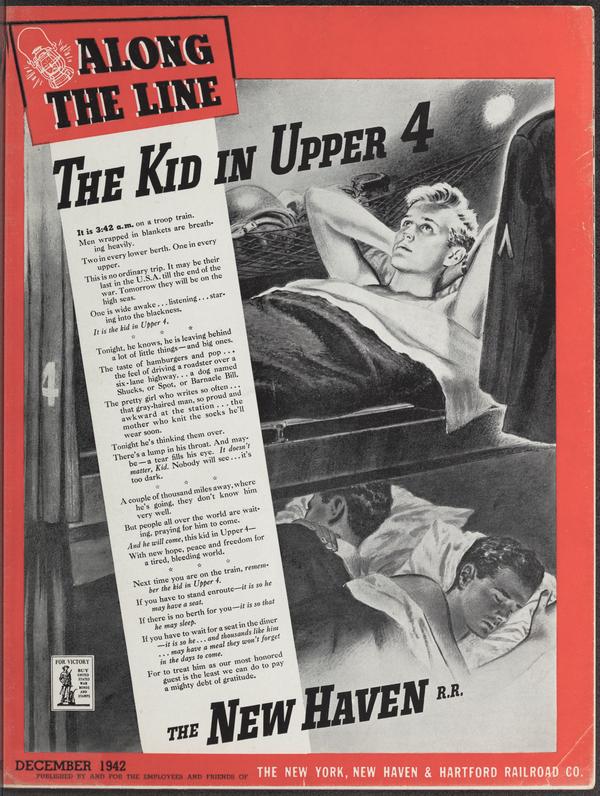
The Kid in Upper 4, a wartime advertising campaign of the New Haven Railroad

The first in The Kid in Upper 4 advertising campaign, reprinted in the December 1942 issue of the New Haven Railroad’s employee magazine Along the Line.

[slideshow_deploy id=’8836′]

During World War II the New Haven Railroad, which provided passenger and freight service to southern New England including New York City and Boston, found that despite wartime stresses on the railroad company the riding public would consistently and constantly complain about poor service. The railroad suffered during the Great Depression but had a resurgence during the war, which began in December 1941. Its efforts to transport troops, munitions and other wartime supplies to the ports, which were then shipped to the various war fronts in Europe, North Africa and Asia, strained the railroad’s limited resources and resulted in fewer seats and trains available for the general riding public.

The railroad soon turned to its advertising agency, the Wendall P. Colton Company of Boston, to find a way to mollify the complaints and griping. The agency’s first efforts tried to educate the public about the important role played by the New Haven Railroad in the country’s efforts to win the war and defeat fascism. Two ads, “Right of Way for Fighting Might,” which ran in newspapers in New York City and New England in October 1942, and “Thunder Along the Line,” which ran in November 1942, were marginally effective and the complaints continued.

In late 1942 the advertising company gave control of the campaign to Nelson Metcalf, Jr., a 29-year-old Harvard graduate who was fairly new to the advertising profession. Metcalf decided that the best approach was to talk directly to the readers of the ad and play at their emotions. At that time the war touched virtually every citizen of the country, and almost every rider of the railroad had a father, husband, brother or son in the military. Metcalf’s approach played on the thoughts of one soldier, to which all could relate, going to the front on a troop train.

The ad included an image of a fresh-faced young man lying awake in a berth in a sleeping car, and the prose of the ad could not be more compelling. Here is the text in full:

It is 3:42 a.m. on a troop train.
Men wrapped in blankets are breathing heavily.
Two in every lower berth. One in every upper.
This is no ordinary trip. It may be their last in the U.S.A. till the end of the war. Tomorrow they will be on the high seas.
One is wide awake … listening … staring into the blackness.
It is the kid in Upper 4.
Tonight, he knows, he is leaving behind a lot of little things – and big ones.
The taste of hamburgers and pop … the feel of driving a roadster over a six-lane highway … a dog named Shucks, or Spot, or Barnacle Bill.
The pretty girl who writes so often … that gray-haired man, so proud and awkward at the station … the mother who knit the socks he’ll wear soon.
Tonight he’s thinking them over.
There’s a lump in his throat. And maybe – a tear fills his eye.
It doesn’t matter, Kid. Nobody will see … it’s too dark.
A couple of thousand miles away, where he’s going, they don’t know him very well.
But people all over the world are waiting, praying for him to come.
And he will come, this kid in Upper 4.
With new hope, peace and freedom for a tired, bleeding world.
Next time you are on the train, remember the kid in Upper 4.
If you have to stand enroute – it is so he may have a seat.
If there is no berth for you – it is so that he may sleep.
If you have to wait for a seat in the diner – it is so he … and thousands like him … may have a meal they won’t forget in the days to come.
For to treat him as our most honored guest is the least we can do to pay a mighty debt of gratitude.

The ad ran first in the New York Herald Tribune, on November 22, 1942. It was immediately obvious that the ad struck a chord with not just the railroad’s ridership but across America. The railroad and the ad agency immediately started fielding calls and receiving letters with positive responses from the public, other businesses in the industry, and government offices. The ad was soon running in newspapers around the country, as well as Life, Newsweek and Time magazines.It was used to raise money for the Red Cross, to sell U.S. War Bonds, and by the U.S. Army to build morale among servicemen.

As noted by Charles Pinzon and Bruce Swain in their Journalism History article of Fall 2002 about the ad campaign, “by the end of January 1943 even competing railroads had hung full-color posters of the advertisement in their terminals. Within four months of its publication a radio station had dramatized the ad, [famous comedian and actor] Eddie Cantor had read the copy over the air on his hit radio show, a popular song had been written and MGM was in production on a film short.” By March 1943 55,000 reprints had been requested.

The New Haven Railroad was delighted by the ad’s success and ordered the ad agency and Metcalf to create similar “Kid” ads. Although the additional ads, for “The Kid in the Convoy,” “The Kid in the Ward Car,” and others, were similar in tone, none had as much of an impact as the original “Kid” ad. The agency and Metcalf received multiple journalism awards and the railroad was able to guilt the riding public into ceasing their complaints about bad service, at least for a while.

James Twitchell’s book 20 Ads That Shook the World, published in 2000, lists “The Kid in Upper 4” among the most successful campaigns in American history but notes that its success was based on the fact that unlike the typical advertisement it was not selling anything but was “drawing attention away from the client’s lousy product.”

The “Kid” ads shown above are those published in the New Haven Railroad’s employee magazine Along the Line, which can be found in our digital repository at the following links:

December 1942, first ad, “The Kid in Upper 4”: http://hdl.handle.net/11134/20002:860594914

January 1943, about success of The Kid ad: http://hdl.handle.net/11134/20002:860603629

March 1943, “the Kid in the Convoy”:  http://hdl.handle.net/11134/20002:860603782

June 1943, “The Kid and his Letter”: http://hdl.handle.net/11134/20002:860603877

September 1943, “The Kid in the Ward Car”:  http://hdl.handle.net/11134/20002:860603968

October 1943, “The Kid Takes Over”: http://hdl.handle.net/11134/20002:860603662

Other wartime ads:

October 1942, Right of Way for Fighting Might!: http://hdl.handle.net/11134/20002:860594848

November 1942, Thunder along the Line: http://hdl.handle.net/11134/20002:860594877

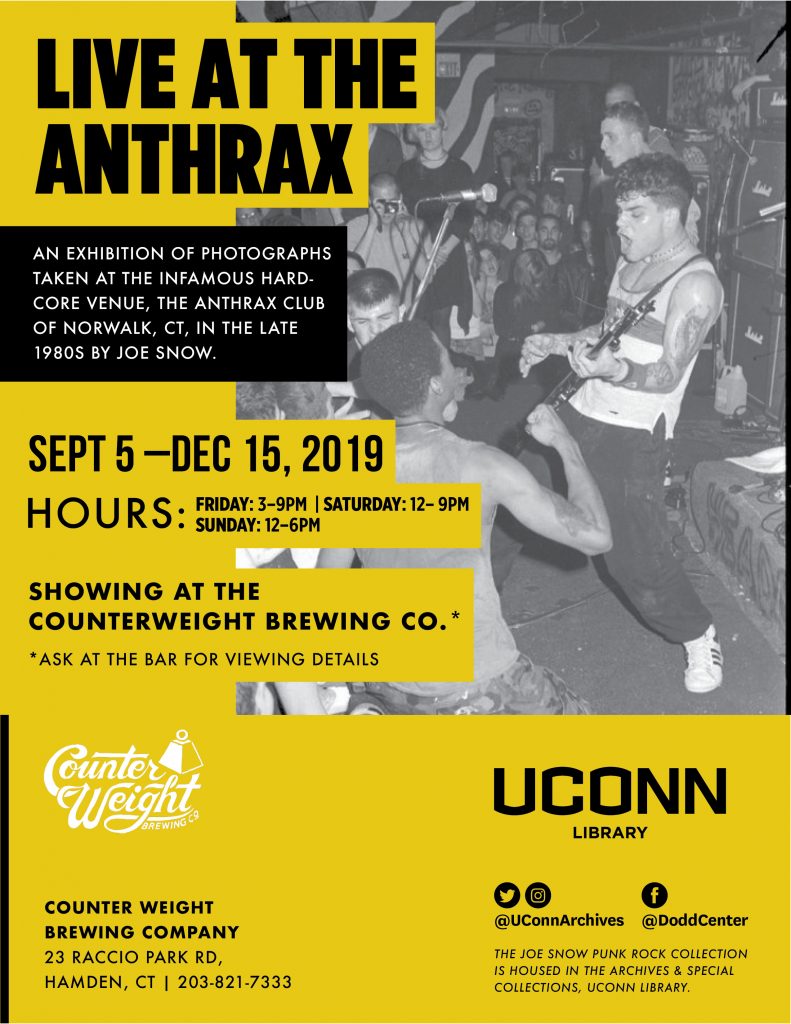
UConn Archives Punk Photography at Counter Weight Brewing Co.

The next installation of the traveling exhibition, Live at The Anthrax, is currently hosted at Counter Weight Brewing Co. in Hamden, CT and will run from September 5th-December 15th, 2019. This exhibition features 20 black & white photographs from the Joe Snow Punk Rock Collection, taken by Joe in the late 1980s during the final years of The Anthrax club in Norwalk, CT.  Bands featured in the selection include local CTHC staples such as Wide Awake and NY Hardcore bands Up Front and Absolution to seminal acts such as Fugazi.  This curated exhibition highlights the dedication, energy and lived values of those who formed the hardcore scene and turned it into a community.  This exhibit seeks to expose the public to archival collections outside of a traditional archives setting in order to promote access to rich cultural materials like those of the Joe Snow Punk Rock Collection in everyday spaces like record stores, breweries and community spaces. This exhibition is free and open to the public.