In Search of Walt Dropo

Image

The following is a guest blog post by Rebecca A.R. Edwards, Professor in the Department of History at Rochester Institute of Technology. Dr. Edwards was recently awarded a Rose and Sigmund Strochlitz Travel Grant to conduct research in Archives and Special Collections. Her research supports a book project tentatively titled Play Ball: Sport, Community, and Memory in Connecticut,” a microhistory that “utilizes local sports history to explore the formation of community identity, social capital, and public memory.”

Sometimes, historical projects get personal. I am a historian at the Rochester Institute of Technology in Rochester, New York. I teach, among other things, the history of baseball and have a long-standing interest in sports history. I could say that my current project is a sports history, and that would be true, but it is also a family history. When I was a girl, growing up in southeastern Connecticut, my paternal grandfather, Danny Rourke, was famous. He played both semi-professional basketball and semi-professional baseball in the state, from 1935-1955. In this way, he was like so many other men in Connecticut in those years, as I have been discovering in the course of my research for a book on this lost sporting world of eastern Connecticut.

We have lost the category of “semi-professional athlete” today. These were men who played organized, competitive sports, largely without long-term professional aspirations. Their basketball was not played to lead to them to the NBA; their baseball was not a road to the MLB. It was an end in itself. Forrest C. ‘Phog’ Allen, the celebrated University of Kansas basketball coach, argued that their play was, in fact, professional. In 1937, he wrote, “The professional—paid or unpaid—plays to win at any cost. Herein lies the significant difference between amateurism and professionalism, whether it be independent or collegiate. When competition becomes a business, it becomes professional. By such interpretation professionalism is not determined by the acceptance of money. The tenor of most independent teams who play outside schedules is professional in spirit, for their stress is on winning and not on the sport for the sport’s sake.”(i) He continued, “The universally accepted definition for a professional player is one who receives compensation for athletic skill or knowledge. If we interpret ‘compensation’ to mean either fame or money or its equivalent, this definition holds.”(ii)

In this way, my work seeks to recover the hidden history of these local professionals. These independent teams that my grandfather played on no longer exist, teams like Pep’s Flashes, the Shymas, and the Danielson Elks. And yet these were teams that attracted hundreds of fans, garnered lots of local press coverage, and brought their players lasting fame. And sometimes, though comparatively rarely, they produced a professional athlete from their ranks.

My research brought me into contact with what one might call the pre-history of one of those athletes. He is pictured in the photograph, from the Norwich Bulletin of 31 March 1941, below.  He really is famous. Find him yet? He is a very young Walt Dropo, then in his senior year of high school. He is in the back row, all the way to the right. Dropo was the youngest member of Pep’s Flashes, pictured here after winning the Norwich Bulletin-Record basketball tournament.
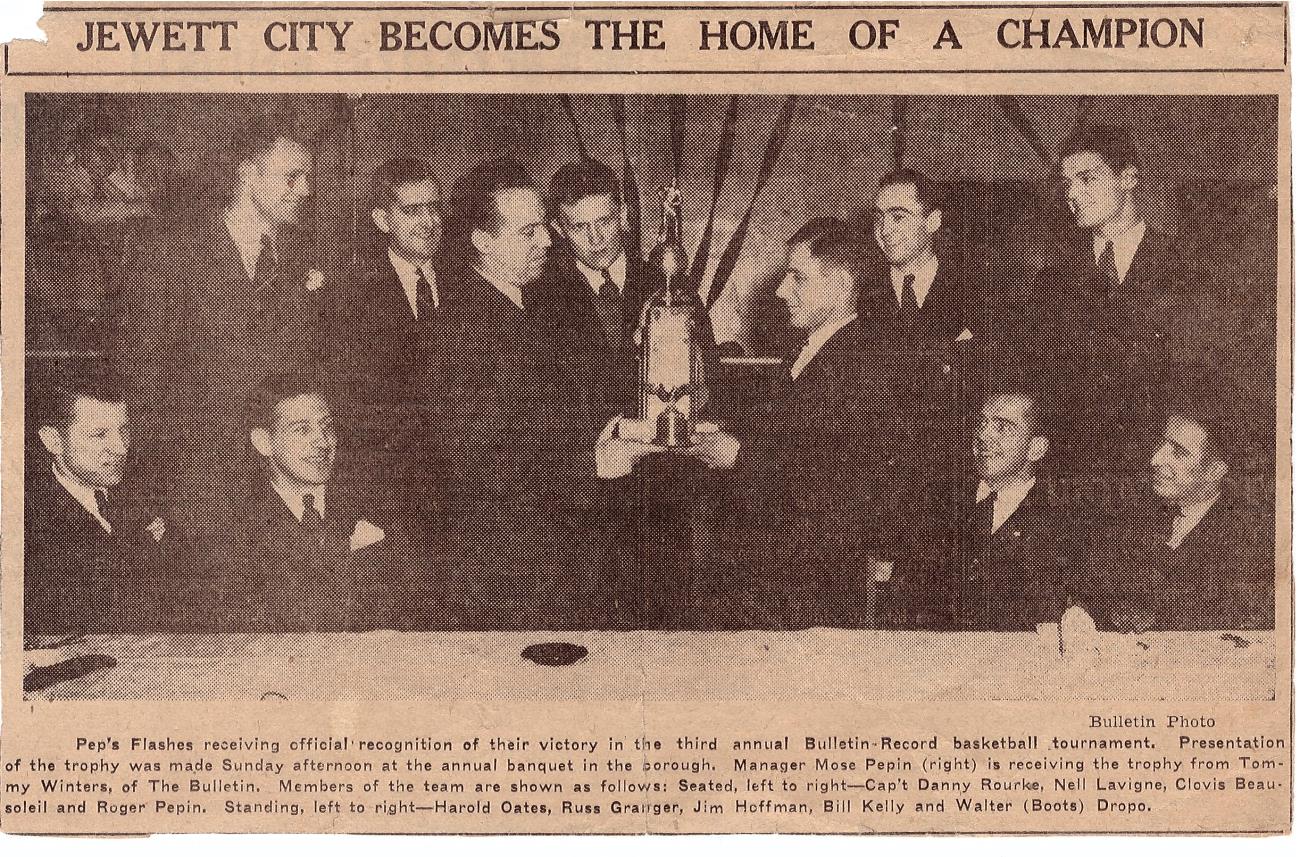
The captain of the team was my grandfather, seated at the far left. The Sunday sports page announced the news of their victory. “Pep’s Flashes Win Bulletin-Record Tournament, 48-37; Jimmy Hoffman and Danny Rourke Are the Stars.” The game was played before a “packed house of about 450 noisy customers…making it the third night that the games were played before a capacity audience.” Pep’s led the entire way, and though the “game was never close enough to get the fans steamed up…it was bruising, tough basketball from start to finish and nobody was disappointed.” The Norwich Record praised the team, saying, “Pep’s really looked the part of champions. Their passing and their shooting was a beautiful thing to watch and were altogether too classy” for their opponents, the Doco Eagles of Norwich. Hoffman was the game’s high scorer, while Rourke played “a marvelous floor game.” They had help from ‘Boots’ Dropo, who contributed nine points.(iii)

‘Boots’ Dropo, as he was then known, would go on from Plainfield High School to attend the University of Connecticut, as probably everyone already knows. Upon Dropo’s death in 2010, Coach Dee Rowe called him “the greatest all-around athlete this school has ever seen.” Dropo played football, basketball, and baseball for the Huskies. He was drafted by the Chicago Bears in the 9th round of the 1946 NFL draft. He was drafted in the first round of the 1947 BAA (Basketball Association of America, a pro-league pre-NBA) draft by the Providence Steamrollers. But he turned it all down to sign with the Red Sox organization in 1947.

In 1950, Walt Dropo was the American League Rookie of the Year, the first Red Sox to be named Rookie of the Year. He finished sixth in the AL MVP race. His .583 slugging percentage that year was second only to Joe DiMaggio (.585). “New England was full of Walt Dropos then,” Bill Reynolds writes, “small town kids who stole the hearts of their communities because of the way they played this New Game.”(iv) But that was still ahead of him. As late as 1946, you could have seen Walt Dropo playing basketball in a 200 seat auditorium in southeastern Connecticut with my grandfather.

By then they were both playing for the Shymas, who would also win the Norwich Bulletin-Record title. Dropo is seen here, in the semi-finals of the tournament.
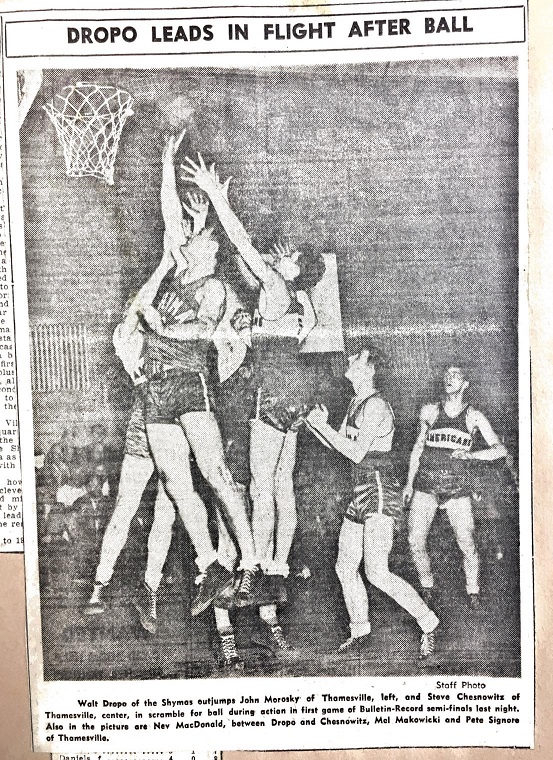
The press coverage noted that Dropo and Rourke were key members of the team. “The Shyma club five of Taftville steamrolled to a 65 to 49 victory over the Windham Packards of Willimantic at the Norton Gym Saturday night to win the eighth annual Norwich Bulletin-Record basketball tournament before a capacity crowd of better than 600 fans….The Packards held the lead twice in the opening minutes of play, 2 to 0 and 4 to 2, but after that point they didn’t stand a chance as the Villagers swept down the floor time and again using the height of MacDonald and Walt Dropo and the floor work of Bill Kelly and Danny Rourke to great advantage. Besides giving a brilliant offensive exhibition throughout the contest, the Shyma put up a tight defense that the Willimantic combination had plenty of trouble cracking.”v Another account concluded that, in winning the tournament, the Shyma had demonstrated that they were “the outstanding hoop combination in eastern Connecticut during the past year.”(vi)

Dropo left for the Red Sox farm system the following year, in 1947. But he left having already played for two different championship basketball teams in Connecticut. As we remember his sports history today, we largely assume it starts with the Red Sox. His time in college sports is seen as a prelude to his professional career. My work allows me to see that he brought a champion’s play to UConn with him. He had been playing alongside semi-pro athletes since he was in high school. That was the drive he brought with him to Storrs.

The distance between the professional world of sports that Dropo would enter and the semi-professional levels of sport he was leaving behind was not very wide. Professionals were a part of their local communities then and semi-professionals were treated with much the same reverence and respect. October 14, 1950, was Walt Dropo Day in his hometown of Moosup, Connecticut. Dropo came into town with a barnstorming baseball team, the Birdie Tebbett’s All-Stars. George ‘Birdie’ Tebbett’s was a catcher with the Red Sox. Also barnstorming with Tebbett’s team that fall were Phil Rizzuto and Johnny Pesky.

They faced a home team, put together for the occasion, called the Connecticut All-Stars. Walt’s brother, Milt Dropo, himself a star athlete at the University of Connecticut, managed the All-Stars. Playing for them in right field was Danny Rourke. He was at that point playing for the New London Raiders in the Class B Colonial League, an effort to revive minor league baseball in southern New England. The original Colonial League had folded in 1915. This Colonial League was formed for the 1947 season; its last season was 1950. Walt Dropo Day was the last time that Dropo and Rourke took a field together.

Dropo’s career brought him to the MLB. Rourke’s career ended in Class B. Yet, the two men shared an athletic journey together that dated back to 1941. My grandfather is still remembered in some circles in southeastern Connecticut today, where I still sometimes meet old fans who call me “Danny Rourke’s granddaughter.” So I know sporting memories can be long. I had wondered, as I came to the Archives to search for images of Dropo’s college career, how well he was remembered on campus today. I worried a bit as the young archivist, whose name will remain unmentioned to protect the guilty, admitted that he had never heard of him until I started asking for files to be pulled. (He was brave to admit that to me and he was otherwise a perfectly nice professional, just to be clear.)
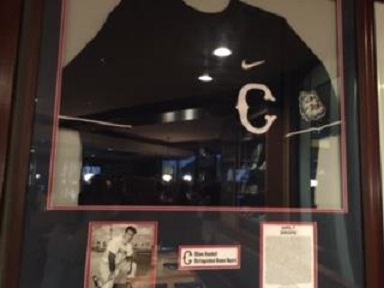
I was worried for nothing. As I settled into the Nathan Hale Hotel, I stopped at their pub for a beer, after a long day in the archives. I glanced over my head and found that I had taken a seat under Walt Dropo.

‘Boots’ Dropo. Still here, after all these years.


– Rebecca A.R. Edwards


Notes:

i  Forrest C. Allen, Better Basketball: Technique, Tactics, and Tales (New York: McGraw-Hill, 1937), 7. ‘Phog’ Allen coached at Kansas from 1919-1956. He coached the Jayhawks to victory in the NCAA tourney in 1952, the same year that he coached the Olympic basketball team to a gold medal at the Helsinki games. He was inducted into the Basketball Hall of Fame in 1959.
ii  Allen, 8.
iii  All coverage from “Third Annual Bulletin Record Tourney.” Undated clipping. Potts family scrapbook.
iv  Reynolds, Our Game, 7.
v  “Shymas Take Bulletin-Record Tourney With 65-49 Win,” Norwich Record (March 31, 1946), 13. From Rourke family scrapbook.
vi  “Bulletin Record Tournament Won By Shyma Club.” Undated press clipping. Rourke family scrapbook.
Storrs Girl and Her Classmates Earn Jeep Rides!

[slideshow_deploy id=’7657′]

The March 9, 1944, issue of the Hartford Courant had this news story:

Girl’s War Loan Letter to President Wins Jeep Ride for Storrs Pupils

As the result of a letter to President Roosevelt, in which Geraldine Hall of Storrs Grammar School told him of the good work her schoolroom did in the Fourth War Loan Drive, the 39 children in that room were given rides in jeeps Wednesday [March 8, 1944] and the rest of the school will be taken on similar rides Thursday [March 9, 1944].

Geraldine’s room comprises the fifth and sixth grades at the school. Boys and girls in the room brought more than $3500 worth of war stamps and bonds during the drive, enough to pay for three jeeps. The sum they raised was more than one fifth of the $15,000 quota for the town of Mansfield.

In the whole school there are 135 students and their total contribution to the Fourth War Loan Drive was $8000, more than half the town’s quota. When the officials who sent the jeeps here primarily to give the fifth and sixth grade students rides learned the fine record of the whole school, it was decided they would come back again Thursday and see that all students in the school get rides.

Geraldine’s letter brought an answer from the White House praising the record of her school room and said that if the answer were taken to the nearest Army post her classmates would be given rides in a jeep. She displayed the letter to Major Michael F. Moffitt at the University of Connecticut and the two jeeps were sent out from Hartford.

Geraldine Hall is a daughter of Mr. and Mrs. Burton C. Hall. Her father is first selectman for the town of Mansfield.

We are fortunate that UConn professor and photographer Jerauld Manter took photographs of the children and their jeep rides on that day in March 1944.  These photographs are in the University of Connecticut Photograph Collection and can be found here: https://collections.ctdigitalarchive.org/islandora/search/jeep?type=dismax

Metanoia at UConn

This post was written by Shaine Scarminach, a UConn History Ph.D candidate who is a student assistant in Archives & Special Collections. All photographs are from the University of Connecticut Photograph Collection.

Metanoia. A curious word with multiple meanings. Most trace its origins to the Greek, though its definition varies. Some have said it means repentance or reorientation. Others have argued it means to change your mind, or even further, to change your way of life.

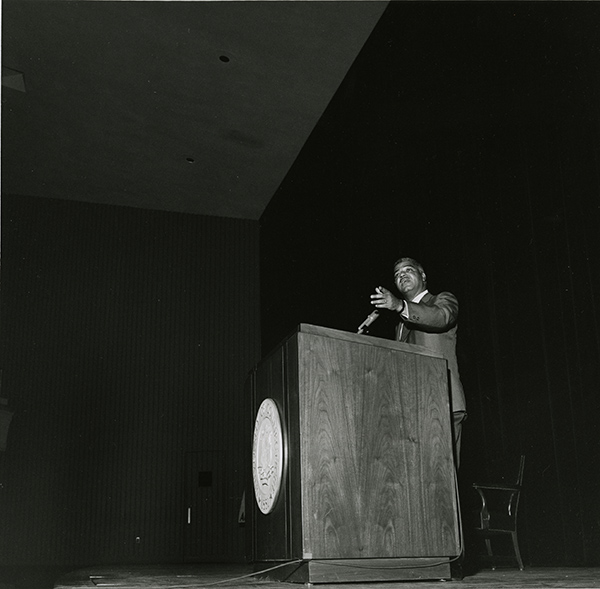
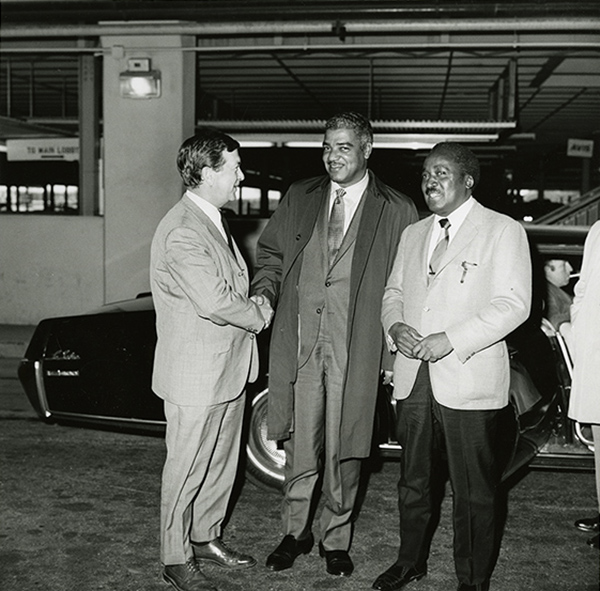
National Urban League President Whitney Young meets UConn President Homer Babbidge, 1970.

For the University of Connecticut, metanoia has been the name for a time of “meditation and reflection” on an important issue to the campus community and the wider world.

The idea (and word) originated with former UConn President Homer Babbidge in the fall of 1969, and the first Metanoia was held on May 6, 1970. It sought to increase “racial awareness, racial respect, and racial sensitivity” on campus.

Since that first occasion, University by-laws have included provisions for holding a Metanoia whenever necessary. Any group on campus has the right to petition for a Metanoia day, and once approved by the administration, an ad hoc committee of faculty and students is formed to plan the day’s activities.

National Urban League President Whitney Young speaks at the first Metanoia in May 1970.

Metanoia events usually include speakers, panels, workshops, and other activities planned by the ad hoc committee with support from other campus groups. Classes have often been canceled in observance of the day’s activities, and some Metanoia have even stretched beyond a single day.

In keeping with its origins, issues of race have been a frequent subject of Metanoia days at UConn.

In 1979, a series of racist incidents against black students on campus, combined with a shocking incident in which a female graduate student was severely beaten while jogging

UConn students practice a whirling dance reminiscent of Sufi ceremonies at Metanoia in 1987.

on Separatist Road, spurred the University to hold a Metanoia day in early October.

Speaking on the occasion, former UConn President John A. DiBiaggio told a crowd of faculty and students that “each violent event ripples through the campus.” But feelings of anxiety and fear must be coupled with action. In the bitter days of the Reagan era, it seemed to DiBiaggio that “society at large may be moving to a posture of indifference to its members.”

Issues beyond campus have also prompted Metanoia days over the years. One in 1972 focused on the American war in Vietnam, while another in 1974 on constitutional crisis and the presidency reflected the Watergate scandal then-engulfing President Richard Nixon.

UConn students practice a whirling dance reminiscent of Sufi ceremonies at Metanoia in 1987.

Metanoia days have regularly featured notable guests. National Urban League President Whitney Young spoke at the first Metanoia in May 1970. Held amid tense discussions over a planned student strike against the Vietnam War, Young told students to fight for their beliefs but not to close the universities.

A Metanoia day on world peace held in April 1987 included a musical performance by folk singer Mary Travers along with speeches by Linus Pauling, the Nobel Prize-winning chemists and Barry Rosen, one of the 52 Americans held prisoner at the U.S. embassy in Tehran, Iran.

Students on a candlelight walk from the Student Union to Mirror Lake, which ended the 1987 Metanoia dedicated to world peace.

Perhaps more significant than the famous speakers have been the campus activities organized around Metanoia days. At the first Metanoia in 1970, groups of three—a black student, a white student, and a faculty member—visited each residence hall to hold frank and open discussions on issues of racism and education.

A Metanoia held in March 1975 focused on the world food crisis. For one of the day’s activities, around 2,000 students fasted to “sensitize” themselves to the deprivations of hunger. They also donated the money they would have normally spent in the dining halls to charities working to eliminate hunger around the world.

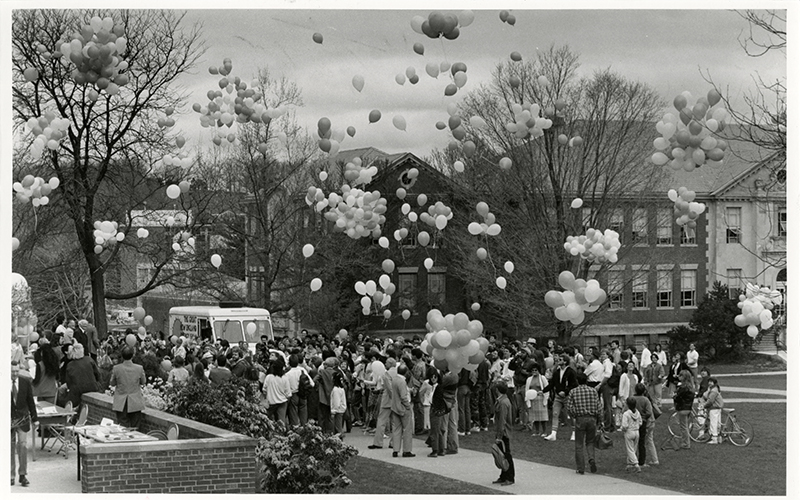
Students release balloons to celebrate the opening of Metanoia in April 1987. Linus Pauling, the Nobel Prize-wining chemist who spoke that day, is pictured at the bottom left.

Metanoia has sometimes come under criticism, most often because of its name. In a faculty survey before the first Metanoia in 1970, one respondent wondered if “metanoia” might be confused with “paranoia.” A 1979 committee report suggested keeping the event but changing the name. “Time spent explaining the term,” they wrote, “results in a tremendous loss of energy.”

Nevertheless, Metanoia lives on at the University of Connecticut. The tradition continues in 2017 under the banner “Together: Confronting Racism.” This year’s theme reflects the perennial problem of racism in American life. But it also signals the campus community’s continued desire to set aside time to confront that essential fact.

Reflecting on the idea of Metanoia, the late-Irving Cummings, a former Professor of English at UConn, perhaps put it best: “I find the term Metanoia both appropriate, humane, and risible—a disease, maybe? Metanoiacs of the world, unite!”

25th Annual Connecticut Children’s Book Fair THIS Weekend – With Exhibition on View

For 25 years, the Connecticut Children’s Book Fair has welcomed families, collectors, teachers, students and librarians to UConn to meet and to hear talented, award-winning authors and illustrators discuss their work.  This weekend on November 4 and 5, we are excited to once again foster the enjoyment of reading among Connecticut’s youth with two days of dynamic programming. The Book Fair takes place at the Rome Commons Ballroom on the UConn campus — visitor information can be found on the event website.

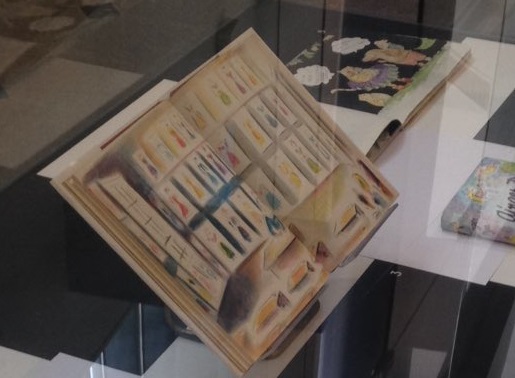
Archives and Special Collections celebrates the Connecticut Children’s Book Fair in this milestone year by featuring the collections of authors and illustrators found in the Northeast Children’s Literature Collection (NCLC). The Book Fair is also an opportunity to highlight recent research conducted in the papers and archives of NCLC authors and illustrators.

The following is an excerpt of an exhibition essay by Nicolas Ochart, Student Exhibitions Intern in Archives and Special Collections, for an exhibition currently on view in the McDonald Reading Room in the Thomas J. Dodd Research Center. This semester, Nicolas is responsible for conceiving and developing small-scale exhibitions that highlight archival material found in the collections. He hopes to pursue professional curatorial work in an effort to promote the work and experiences of marginalized and underrepresented communities in the United States. In December, Nicolas will receive his B.A. in Art History from the University of Connecticut.

The Northeast Children’s Literature Collection was developed in 1989 to collect and preserve the history of children’s literature and illustrations, and comprises the archives of over 120 notable authors and artists. Among completed editions of beloved children’s books, the collection also includes countless preliminary sketches, letters, dummies, manuscripts, notes, and correspondence with family, editors, and other writers and artists.

The collection’s extensive holdings have made the University of Connecticut a nexus for scholars and children’s book writers and illustrators across the nation interested in studying the literary and aesthetic qualities of the form. In an effort to support and encourage study of the Northeast Children’s Literature Collection, Archives and Special Collections have developed a number of awards for researchers, including the Billie M. Levy Travel and Research Grant and the James Marshall Fellowship. Grantees and Fellows have written on such varied topics as queer American Jewishness in the art and writings of Maurice Sendak, as well as influences of modernism and fashion design in the work of Esphyr Slobodkina. Aspiring and established authors and illustrators have also looked at papers by James Marshall, Natalie Babbitt, Tomie dePaola, and Eleanor Estes for guidance in their own practice.

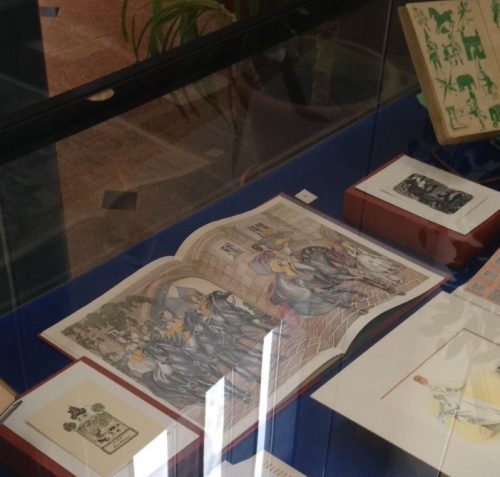
The objects on display in Archives and Special Collections represent just some of the archival materials past Fellows and Grantees have found noteworthy in their research. These objects also dialogue with others in Archives and Special Collections, and together offer rich and surprising stories of classic tales.

The collection’s extensive and cross-historical nature provides a visual and narrative mapping of the perseverance of certain character types and situations. One of the most persistent topics of interest in children’s literature concerns problems that arise from class conflicts, and the tensions between members of the aristocracy, bourgeoisie, and working class communities. Where a character is from and the spaces they are permitted to navigate reveals much about their personality, goals, and interactions with other characters in their environment. These works show desire and punishment, as characters’ morality largely dictates whether they are granted social mobility or afflicted with poverty or other penalties.

Even if clear moral distinctions between classes are not drawn, the picturing of difference is almost always apparent. The objects displayed in Archives and Special Collections represent a sampling of the visualization of class and “otherness” in popular children’s fables and fairy tales, as well as the ways in which characters’ bodies, properties, and reputations are threatened by these factors.

We encourage exploration of the Northeast Children’s Literature Collection, or explore the blog for Archives and Special Collections, to learn more about scholarship conducted by visiting academics, writers, and artists.

– Nicolas Ochart