
Augustus Storrs Hall

[slideshow_deploy id=’8161′]


It will surprise no one with even a remote connection to the University of Connecticut that Augustus Storrs was an important person in the history of our state university. Born on June 4, 1817, in Mansfield, Connecticut, to a family that came to America six generations earlier, Augustus Storrs was the son of farmer Royal Storrs. Augustus started a store in the Gurleyville section of Mansfield when he was just 22 years old. He moved to Hartford in 1841 and by the time he moved to Brooklyn, New York, in 1851 he was a well-established businessman.

In 1875 Augustus bought the family home in Mansfield and developed a stock farm of nearly 1000 acres where he raised thoroughbred cattle and horses. That same year an orphanage that had been established in 1866 for the children of Civil War soldiers was closed down, and Augustus brought that property, which had been situated next to the farm.

In December 1880 Augustus offered 170 acres of land — the former orphanage property — with buildings to establish an agricultural college in Mansfield. Augustus’s brother Charles made a generous offer of $5000, and with these two gifts the Connecticut General Assembly, under the authority of the federal Morrill Land Grant Act of 1862, established the Storrs Agricultural School to train boys in farming. The school opened its doors to twelve students on September 28, 1881. In 1888 a post-office was placed near campus, thus establishing the section of town of and near the campus as Storrs.

Augustus Storrs died on March 3, 1892. He and many other members of the Storrs family are buried in the cemetery on campus off of North Eagleville Road.

Augustus Storrs Hall was built in 1906 and was the first brick building on campus. It was initially a men’s dormitory with 66 two-man rooms but within two years each room held three students. In 1952 it was renovated for offices and classrooms. It is now home to the School of Nursing.
A New Perspective on The U. Roberto Romano Papers

Marijane Ceruti, Assistant Archivist of the U. Roberto Romano Papers, is a 2014 BFA graduate of the UConn School of Fine Arts. Since graduation, she has worked as a freelance photographer and photography assistant in addition to exhibiting and gaining notoriety for her fine art photography work. She has an extensive technical background in addition to her knowledge of the history of photography.

My first day on the job as the Assistant Archivist of the U. Roberto Romano Papers was a good one. I was handed the torch by fellow UConn alumnus and friend Brooke Foti Gemmell who was taking a different position within the UConn library through her work here. “The first couple of weeks will be intimidating, but you’ll get the hang of it” were words that I heard come out of her mouth more than once. As I got settled in and took the time to dive into the collection I began to realize I shared a lot with the photographer whose work I would be getting to know. Robin and I were both Italian-American photographers who spoke French, liked crass humor and made a lot of the same choices in photography. Robin cited the greats like Henri Cartier-Bresson and Robert Frank as some of his inspirations and I too could count them as some of my own.


[slideshow_deploy id=’8128′]


As I sifted through memory card after memory card of born digital images in the first couple of days, I started to notice that Robin and I made the same aesthetic decisions in our work. Photographers holding their subjects hostage in front of the lens until finally giving into the moment, making corrections to posture and hair as shoots progressed and even down to equipment choices. Without being prompted I found myself collecting my favorite images of Robin’s in a  folder on my desktop titled “Notable Images”. Now the folder is 600 images strong and I’m sure it will continue to grow. As I look at them, I am reminded of how unique of a person Robin was as he exhibited  equal parts compassion and ruthlessness, humility and prestige, documentarian and artist. These traits are necessary and rare in someone that captures such emotionally charged scenes and shares them with the world. I look forward to sharing this information with the public so that they can see the truth behind child labor, the life of an artist and the complexities that come with processing such a large and vast collection that spans a revolution in photography.

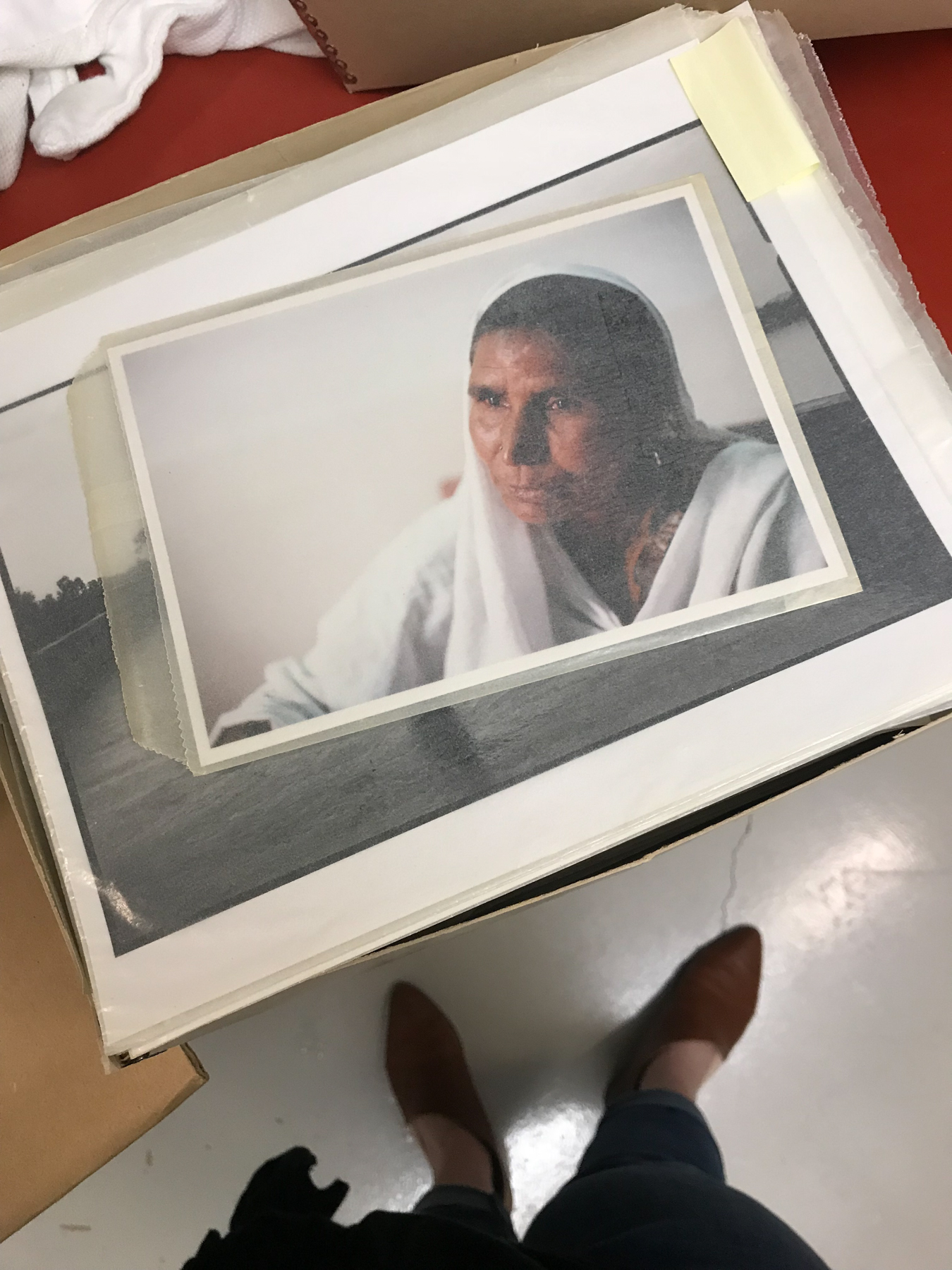
Marijane sorting through prints from Robin’s early work in Pakistan

Now that I have been in this position for 6 months, I am starting to get comfortable curating and archiving with Robin’s voice in mind. I see the choices he made and feel confident that I can respect his vision as well as his compassionate and strong voice when representing the collection. I am so grateful that I was given this opportunity to take a peek inside the collection of such an empathetic and talented photographer. I feel blessed that I get to hold a position that is important and valued within the university and the world alike. I hope that I am able to share Robin’s work in the way in which he intended, care for it in the way that it deserves and bring my talents of exhibiting and marketing to the  collection for students and scholars to learn from and enjoy.

I’m proud to say I will bring pieces of Robin’s work into my own as an artist. In a world that is hurting, I am honored to be able to represent a body of work that was founded by the desire to end suffering.

Thank you to the University of Connecticut Library for this opportunity and to everyone that donated to the Robin Romano Foundation to make this position possible.

Wilfred B. Young Building

[slideshow_deploy id=’8088′]

Since its founding in 1881, the University of Connecticut has undergone many changes, and the Wilfred B. Young Building perfectly embodies this dynamic history. In the years after World War II, a surging student population spurred a raft of new construction under the tenure of President Albert N. Jorgensen. The building that later became known as the Young Building appeared during this period, officially opening in the fall of 1953.

Along with the growing student population, the building also reflects the changing academic climate at UConn. When it first opened, the building housed the College of Agriculture. In the 1960s, it became home to the College of Agriculture and Natural Resources. Now it holds the College of Agriculture, Health, and Natural Resources. The multiplying specialties illustrate how the university’s educational mission has developed over the years, shifting to meet the needs and interests of students and the wider society.

The building’s namesake, Wilfred B. Young, also played an important role in UConn’s history. Born in Indiana in 1903, Young spent his early life learning agriculture and animal husbandry, as well as working in the famed Chicago stockyards. He came to Connecticut in 1931, recruited by Professor Harry L. Garrigus to teach and conduct research through the Agricultural Experiment Station. He served as Dean of the College of Agriculture and Natural Resources from 1945 to 1966. Young retired in 1966 and died in 1978. The building was named in his honor the following year in recognition of his many contributions to the university.

This post was written by Shaine Scarminach, a UConn History Ph.D candidate who is a student assistant in Archives & Special Collections. 

J. Louis von der Mehden Hall

[slideshow_deploy id=’8079′]

J. Louis von der Mehden, Jr., was born July 20, 1873, in San Francisco, California. A musician and composer, von der Mehden held several positions in San Francisco before moving east to New York City after the 1906 earthquake. He was steadily employed as a cellist or conductor with theatrical or commercial bands and worked for a year as the musical director of Herald Square Theater before becoming involved full time in the recording industry, working at different times for five different phonograph studios: U.S. Phonograph, Pathé Frère, Columbia, Lyraphone and the Victor Talking Machine Company. On some recordings he played cello in the orchestra; more regularly he would conduct performances, often arranging the music the night before the recording sessions. In 1926, von der Mehden and his wife Susan moved to Old Saybrook, Connecticut, full-time, having purchased a house in 1911.

J. Louis von der Mehden, Jr. died on August 27, 1954, in Middlesex Memorial Hospital and was buried in Cypress Cemetery at Saybrook Point.

In 1956, UConn President Albert N. Jorgensen reported to the Board of Trustees that under the provisions of the will of the late Susan Evelyn von der Mehden, who died less than one year after her husband, the University was to receive a considerable sum from the estate. There were three provisions: first, the University was to receive all of the original compositions of the late J. Louis von der Mehden; second, the University was to erect a building to be used as a concert hall in which this music could be performed; and third, the University was to provide a vault for the safekeeping of the music. The von der Mehden’s had no obvious connection to the University of Connecticut so it is unknown why Mrs. von der Mehden chose to make such a large donation to the university.

The J. Louis von der Mehden Recital Hall was completed in 1961 and has been in regular use as a recital and performance hall.

Archives & Special Collections holds Mr. von der Mehden’s papers, which consist of diaries, newspaper clippings, correspondence, notes, financial records, photographs, musical manuscripts, scores, publications, and celluloid cylinders.

Homer Babbidge Library

Homer Daniels Babbidge, Jr., was born in West Newton, Massachusetts, on May 18, 1925. His father was a captain of merchant ships and the family soon moved to New Haven, Connecticut; in 1935 the family moved again, this time to Amherst, Massachusetts. Babbidge graduated with his undergraduate and doctoral degrees from Yale University, and taught at Yale’s Department of American Studies before taking positions with the U.S. Department of Health, Education and Welfare and acting as the Vice-President of the American Council on Education.

In 1962, at the age of 37, Babbidge became the 8th President of the University of Connecticut. In his Inaugural Address on October 20, 1962, he said “The task of a public university is to wed the new spirit of democracy to the old values of learning.”

[slideshow_deploy id=’8061′]

In 1962 total enrollment at the University of Connecticut was 12,000 at the main campus in Storrs and across the regional campuses; by 1971 enrollment had grown to over 23,500. During Babbidge’s tenure he oversaw the development of a Junior Year Abroad program, the elimination of the rule that women students be forbidden to wear slacks in the Student Union, and the formation of the Benton Museum of Art on the Storrs campus, the School of Social Work on the Torrington campus, and the UConn medical and dental schools, including the UConn Health Center in Farmington. While serving as President he also taught classes in the Department of History on the History of American Higher Education.

Babbidge led the university at a challenging time. As it was on almost every campus in the country, UConn students demonstrated against the war in Vietnam and on racial discrimination. On November 26, 1968, Students for a Democratic Society (SDS) demonstrated against the recruitment on campus of students for the chemical company Olin-Mathieson. Sixty-seven students were arrested for demonstrating and Babbidge called it “the saddest day of my life.”

For what he stated was a promise he made to himself to not hold the job for more than ten years, in October 1971 Babbidge announced that he would resign from the Presidency of UConn on October 1, 1972. More than 7000 students, staff and faculty petitioned his resignation, asking him to reconsider, but to no avail.

After his time at UConn Babbidge returned to Yale as Master of the university’s Timothy Dwight College; in 1976 he became the Hartford Graduate School’s first president. He even briefly dabbled in politics, running for Governor in 1974. Babbidge died on March 27, 1984, from cancer.

During Babbidge’s tenure the UConn library gained its 1,000,000th book. Even before Babbidge left office plans were drawn up to build a new library, given that the space in the Wilbur Cross Library had exceeded the limits of the collection and library services. A study done after 1972 determined that the Wilbur Cross Library had space for just 753 students, less than 5% of the student population.

Groundbreaking for a new library costing $19 million was on July 10, 1975. The library had seven floors with a total 385,000 square feet and shelf space for 1.6 million volumes.

[slideshow_deploy id=’8060′]

The building opened in 1978, known then as simply the University of Connecticut Library. After Babbidge’s death in 1984 the name was changed to honor the university’s 8th president.