Announcing a new digital project

A new project to digitize TV interviews by Billie Levy featuring authors, illustrators, editors, and collectors in the field of children’s literature is now available . They are from the “Children’s Books: Their Creators and Collectors” series filmed at WHC-TV. Go to http://www.lib.uconn.edu/services/video/streams.php and scroll down, or go the web page at http://www.lib.uconn.edu/services/video/levy.php.  There is also a link from the NCLC’s web site at http://nclc.uconn.edu.

This project was made possible by the generosity of Susan Aller of West Hartford, in honor of our Miss Billie. The project was also made possible by West Hartford Community Television. Ms. Aller is the author of more than a dozen biographies for young people, including the stories of J. M. Barrie, Florence Nightingale, George Eastman, Louisa May Alcott, and Mary Jemison.  She has worked as a magazine editor in New York City, and her essays on a variety of topics have appeared in The New York Times, Christian Science Monitor, and other publications.  Ms. Aller is a graduate of the University of Nebraska at Omaha, and lived for extended periods in Spain and France, before coming to Connecticut in 1979.   As a collector of antique children’s books, she has been an active supporter of the Northeast Children’s Literature Collection at the Thomas J. Dodd Research Center at the University of Connecticut in Storrs.  She participates weekly in a long-standing writers’ group and is a member of the Saturday Morning Club of Hartford, a women’s writing group founded in 1876. Ms. Aller is the mother of two married sons and has six grandchildren.

–Terri J. Goldich

Book As Sculpture Exhibition Opens

Given as an assignment to a first year studio foundation art class, students were challenged to consider the function of the book and encouraged to rethink its form as sculptural object. Additionally, the students were inspired by viewing some of the diverse forms of one-of-a- kind and limited edition artists’ books housed at the Dodd Research Center.

As an art project, altering a book page is a daunting concept; reconstructing and altering the whole book is a serious challenge.  First, one is confronted with the notion that through a seemingly destructive act, beauty and new art form can be constructed. Even when using cast-off books, that are about to be destroyed, one is faced with a rather unnerving sensation when beginning this process.

Through a series of transformative gestures and repetitive actions such as folding, cutting, scoring, curling, punching, incising and shredding, the function of book as object of information is transformed into structure, sculpture. These repetitive acts, to the point of exaggeration, have created new and startling physical shapes that we take notice of first. For some of the creators, the book’s title helped prompt an action informing us of the book’s potential content.  For others, a singular process took shape without considering the book’s original intention. Irony, wit, poetic reference, and obsessive gesture push the book’s singular recognizable form into a new physical shape. Some of the pages turn, but the text is not the text of legibility. Others offer the viewer a window into the process of alteration. 

Selections from First Year Studio Foundation Course Fall 2010, Professor Deborah Dancy.  Exhibitors: Brooke Bernegger, Taylor Byrne, Brandon Campbell, Emily Campbell, Gina Croteau, Rachel Eldracher, Kelsey McKissick, Alyssa Naim, Ruth Reinwald, Natalie Sequeira, Celine St. Pierre

Book As Sculpture
April 1-30, 2011, Monday-Friday 10-4
Dodd Research Center
John P. McDonald Reading Room

Kristin Eshelman, Curator of Multimedia Collections

You asked, we listened

In a continual effort to listen to and better serve all students, faculty, staff, and researchers, we constantly review and analyze our services to see what you want and what we can do better.  We are pleased to announce new changes and additions to our reproduction service offerings. 

Self Service Photography: Free

This service is free, quick, and easy.  This is a great service to utilize. Staff will review your equipment (camera and/or tripod) and the materials you want to copy. Once approved, you may photograph with the flash off, at the reading room tables. Sorry, no acrobatics! We also have a copy stand to assist researchers in photographing materials which is available for 3 hour bookings by appointment.  To book call: 860-486-4506 or email:archives@uconn.edu.

PDFs: Paperless and Affordable

Consider going paperless with our PDF services.  Black and white PDFs are now only $.25 per scan, the same price as photocopies!  Even more exciting is the addition of a new color PDF service for those who want a higher quality but still affordable option.  Color PDFs are available for $.35 per scan.  As we test out our newly expanded PDF services, we hope to have a 24 hour turnaround time for most PDF orders. 

High Resolution Scans: Choice

We’re still offering high resolution TIFF files at 300 ppi and 600 ppi, but we’re offering JPEG files as well now.  The pricing for 300 ppi remains at $7 and 600 ppi at $10 per scan. We’ll gladly fill your request and send you a choice of a compressed or an uncompressed file. 

For more information about all our services, check out our reproduction information page.

Stay tuned for more changes to in the future.

Marisa Gorman, Assistant Archivist

March 2011 Item of the Month: Photograph from the Romano Human Rights Digital Photograph Collection

A child laborer picks cocoa pods in the Ivory Coast. Photograph by U. Roberto Romano, 2006. 
 
Image from the Romano Human Rights Digital Photograph Collection, Thomas  J. Dodd Research Center, University of Connecticut Libraries.

Photograph by U. Roberto Romano, 2006.

The West African country of Ivory Coast is the world’s largest producer of cocoa, with over 40% of the world’s production. Despite the signing of the Cocoa Protocol in 2001, child labor is still rampant in the cocoa industry, often involving the illegal trafficking of children from Mali and Niger to work in the cocoa fields of Ivory Coast. Children as young as seven work in the fields, facing dangerous tasks of cutting down cocoa pods with machetes and carrying heavy loads. Most children are never paid for their work.

American photographer and documentary filmmaker U. Roberto (Robin) Romano has documented human rights issues for advocacy organizations around the world including GoodWeave, Amnesty International, Human Rights Watch, The International Labor Organization, Stop The Traffik, The Hunger Project, The Farm Labor Organizing Committee, Council on Foreign Relations and Antislavery International.

Romano’s most recent film, The Dark Side of Chocolate (2010), co-directed with Danish journalist Miki Mistrati, documents the continued allegations of trafficking of children and child labor in the international chocolate industry, despite a voluntary protocol to end abusive and forced child labor on cocoa farms by 2005.

However, in 2005, the cocoa industry failed to comply with the protocol’s terms, and a new deadline for 2008 was established. In 2008 the terms of the protocol were still not met, and yet another deadline for 2010 was set. Meanwhile, child labor in the cocoa industry continues.

For more information, see the International Labor Rights Forum’s information on child labor in the cocoa industry.

Human rights documentation is a focus of the Archives & Special Collections at the Thomas J. Dodd Research Center. More information about the Romano Papers and other human rights collections can be found on the Dodd Center’s website.

Romano’s film, The Dark Side of Chocolate, will soon be available at the University of Connecticut Libraries as part of the Human Rights Film Collection, which contains approximately 500 films on an array of human rights themes.  An annotated listing of films is available on the UConn Libraries’ website.

–Valerie Love, Curator for Human Rights and Alternative Press Collections

African American Music Film Series Presents: The Spirit Moves


The Spirit Moves is a rare and vital social document providing a living record of the men and women who crafted American social dance styles and jazz music into an improvisational art form. The Spirit Moves is a compilation of Mura Dehn’s raw footage of directed improv from 1900-1950, previously only available for viewing at the Dance Collection of the New York Public Library. 

The film presents demonstrations of ragtime and jazz dances by artists made famous at the Savoy Ballroom including James Berry, Pepsi Bethel, Teddy Brown, Sandra Gibson, Leon James, Al Minns and Frankie Manning. Dances include the Cakewalk and Charleston Black Bottom, Susie Q, Shake Blues, Gutbucket Blues, Trunky Doo, Big Apple and some aerial Lindy Hop.


 The Spirit Moves: Jazz Dance from the Turn of the Century to 1950 


Wednesday, February 23, 2011

 4:00 pm

Konover Auditorium, Dodd Research Center


January 2011 Item of the Month

The Student Voice

Documentation of the University of Connecticut comes in a variety of formats, styles, voices and completeness.  Documentation of the regional campuses can be even more difficult.  Some of the hardest  to document are the experiences and voices of the students who have passed through the many “doors” of the University, especially those not at Storrs.  On campus for a relatively brief time, students are at the core of the University and yet they tend to take the documentation of their activities and experiences of their college experience with them when they leave.   As a consequence, the little that is left behind is even more valuable–like the student newspaper.   Thanks to a recent transfer from the Waterbury campus, the University Archives now has in its collections numerous student publications dating from the 1940s (extension courses were offered at the Waterbury YMCA in 1942).  It will take a bit for the Archives to sort through the materials but there are four or five different student newspapers alone that will illuminate the interests, concerns and activities of the students on the Waterbury campus throughout its history.  Let’s hear it for the student newspaper!

The University of Connecticut Begnalight, March 1947

A Celebration of Conn and Twain

Ken Noll and Jerry Krasser reading from “3000 Years Among the Microbes” by Mark Twain, December 6, 2010

You might have noticed that I posted last week about an exhibit a INTD class constructed about Mark Twain and Connecticut microbiologist H.W. Conn.  The exhibit depicts the work of the two men, particularly about how Conn’s work on microbes was influential for Twain’s essay “3000 Years Among the Microbes,” written in 1905.  The exhibit is currently up in the Plaza Alcove in Homer Babbidge Library until December 17.

Yesterday, in the library’s Class of ’47 room, was a celebration of the exhibit, where Professor Ken Noll acknowledged the work of the freshmen honors students of the class.  A wonderful bonus to the program was a reading of Twain’s essay, by Prof. Noll and Emeritus Professor of Dramatic Arts Jerry Krasser.

The local NPR affiliate interviewed Prof. Noll prior to the event and taped the reading, and information about the event was aired this morning on WNPR out of Hartford.

The Book Fair is coming, the Book Fair is coming!

November 13-14, 2010, on the Storrs Campus of the University of Connecticut at the Rome Ballroom

The Connecticut Children’s Book Fair is two days of fun for the whole family, featuring presentations and book signings by well-known authors and illustrators, and tons of books for sale. Enjoy storytelling, crafts, holiday shopping, balloon animals on Saturday and a puppet show, City of Hamburgers, on Sunday. Maisy, Danny the Dinosaur, Biscuit, and of course Clifford the Big Red Dog will be visiting throughout the Book Fair.  There will also be a special teen panel on Sunday: “Giving Teens a Voice: Writing and Editing Teen Fiction” led by David Levithan with guest speakers Eliot Schrefer, Samantha Schutz, and Natalie Standiford.  

Go to the Book Fair’s web site at http://bookfair.uconn.edu for complete information.  

See you at the Fair!

November 2010 Item of the Month

Las Hijas de Eva, Puerto Rican women magazine

An issue of Las Hijas de Eva, Semanario consagrado al bello sexo: Literatura, Música, Teatro, Noticias, Modas y Anuncios.

The Thomas J. Dodd Research Center through the years has developed  a very unique collection of Latin American and Caribbean materials that support the research of the Latin American and Caribbean studies program on campus. One of the collecting areas has been on Puerto Rico.  The Puerto Rican Collection consists of two different acquisitions– the Geigel family library and the Puerto Rican Civil Court Documents. The Geigel family library, which is the core of the Puerto Rican Collection,  includes over 2,000 volumes of books, pamphlets, government documents (mainly from the US government) and some periodicals, that document the social, economic, political and literary history of Puerto Rico during the late nineteenth century and early twentieth century.

The collection was acquired from the Geigel Family from Puerto Rico in the early 1980s by the recommendation of the then UConn history professor Dr. Francisco Scarano. Owed privately by Doña Luisa Geigel de Gandía, resident of Santurce (San Juan, Puerto Rico), this library represents the collecting efforts of three generations of Geigel family members.

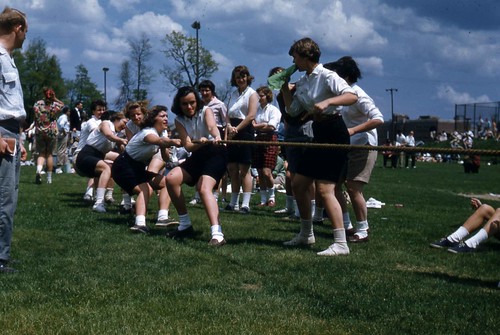
Geroglífico

A pictorial riddle

The collections time span covers from 1800 – 1977 but the bulk of the collection is from 1850-1950. The collection includes many first editions of literary books and rare printing of newspapers and magazines from the late 19th century.

For the item of the month, I am showcasing a very unique title, the periodical Las Hijas de Eva (1880), a late 19th century women magazine edited by many well-known Puerto Rican writers and intellectuals, both men and women, such as Alejandro Tapia y Rivera, Lola Rodríguez de Tío, Manuel Tavárez, etc… The magazine followed the same stylistic format found in 19th century Spanish women magazines  and it was digitized as part of a bigger project, the Spanish Periodicals and Newspapers: Women’s Magazine Digital Collection. What make this magazine unique is the fact that it had many women contributors writing articles and poetry which was unusual in late 19th century Puerto Rican society. This weekly magazine includes articles (written by men and women authors), poems, travel accounts and word games and puzzles.

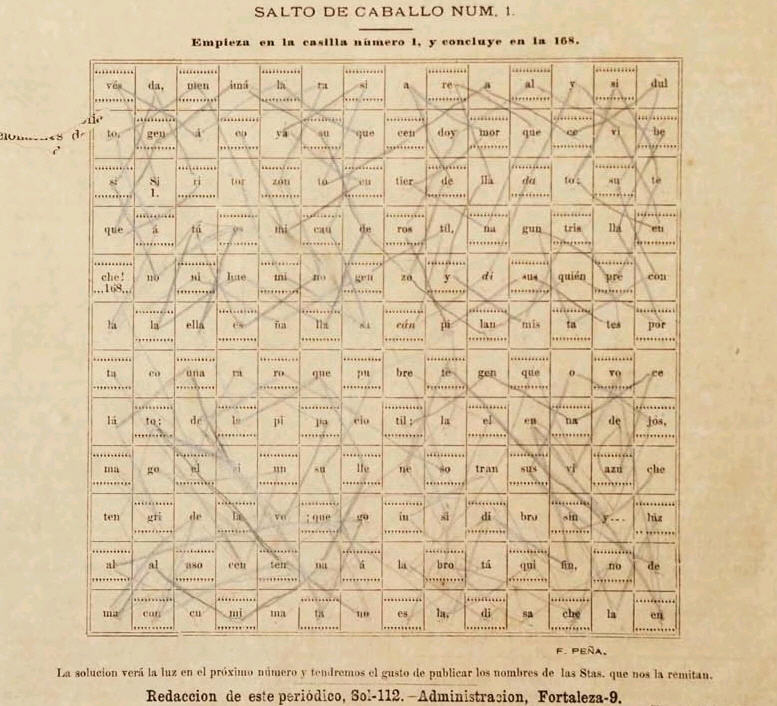
Salto de Caballo--crossword game

Another type of word game, Salto de Caballo.

To find the books and periodicals in the Puerto Rican Collection, you can search for individual titles using the UConn Library catalog HOMER.

For further information about these materials, contact Marisol Ramos, Curator for Latin American and Caribbean Collections.   More information about the Thomas J. Dodd Research Center and using the archival collections can be found here.