Geomorphology, Classical Mechanics, and Theories of Time: Reading the Manuscripts of Poet J. H. Prynne

by Ed Luker

luker1

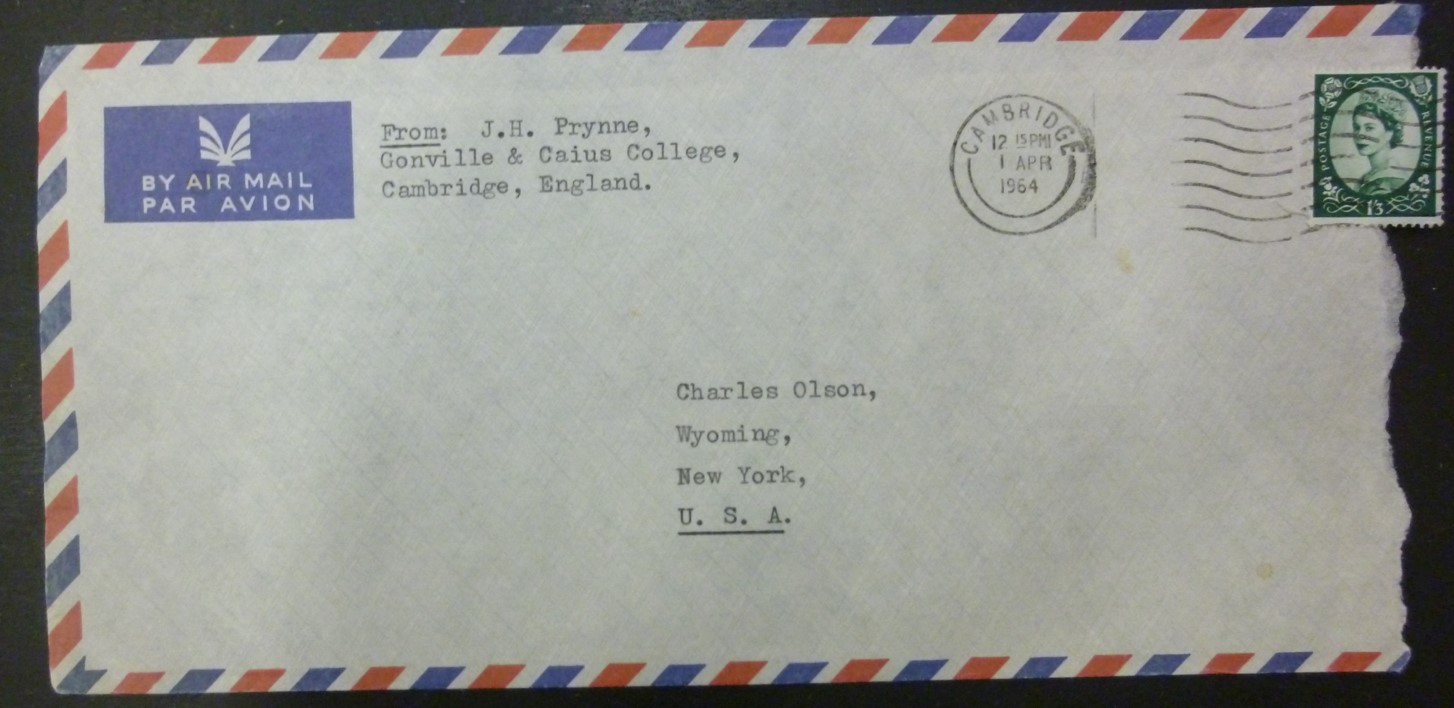
Envelope of letter from Prynne to Olson.

The name J. H. Prynne signifies a strange clash of scale in the collective imagination of readers of British poetry. He is monumental enough to be canonized in The Cambridge Guide to Literature in English (ed. Dominic Head), and has been described by the critic Peter Ackroyd as “without doubt the most formidable and accomplished poet in England today”. However, side glances at the mention of Prynne’s name in most of the broadsheet press in the UK would lead one to believe that he was a minor figure, something of a mandarin, and -like all entities too small to take care of themselves- suffering from a hermetic self-diminution.

It would be much more apt to state that whilst many readers of poetry are in some sense familiar with a certain received idea of his work, it is much less likely that those familiarities connote careful engagement. This is in part due to his lack of inclusion within university reading lists (perhaps concomitantly with the daunting thickness of the yellow brick – the collected works), but also due to the truism that his poetry forces a huge strain on readers’ habituated patterns of verse cognition. A recent essay on a late Prynne collection, Acrylic Tips, by the poet Timothy Thornton published online by Hix Eros describes a frustration of such disruptions, particularly the inability of image clusters to remain continuous:

The image tests the pattern, coaxes from us an instinct of its threshold, but then breaks it or crosses it or falls short, perhaps as a glint beginning the generation of a whole new topology or network; or perhaps merely as an unilluminating collision, the image simply glancing off and coming to seem to us inexplicable, redundant, even objectionable.

If one were to consider the ludicrous metaphor that each of Prynne’s books resembles a climbing wall, the attempt to transition from one book to the next would leave the climber with the bolt-on under hand disappearing from grip whilst the wall itself shifts in rotation. My own research is currently attempting to cling on to the relatively early under-hang at the base of Prynne’s oeuvre between The White Stones and Brass.
luker2

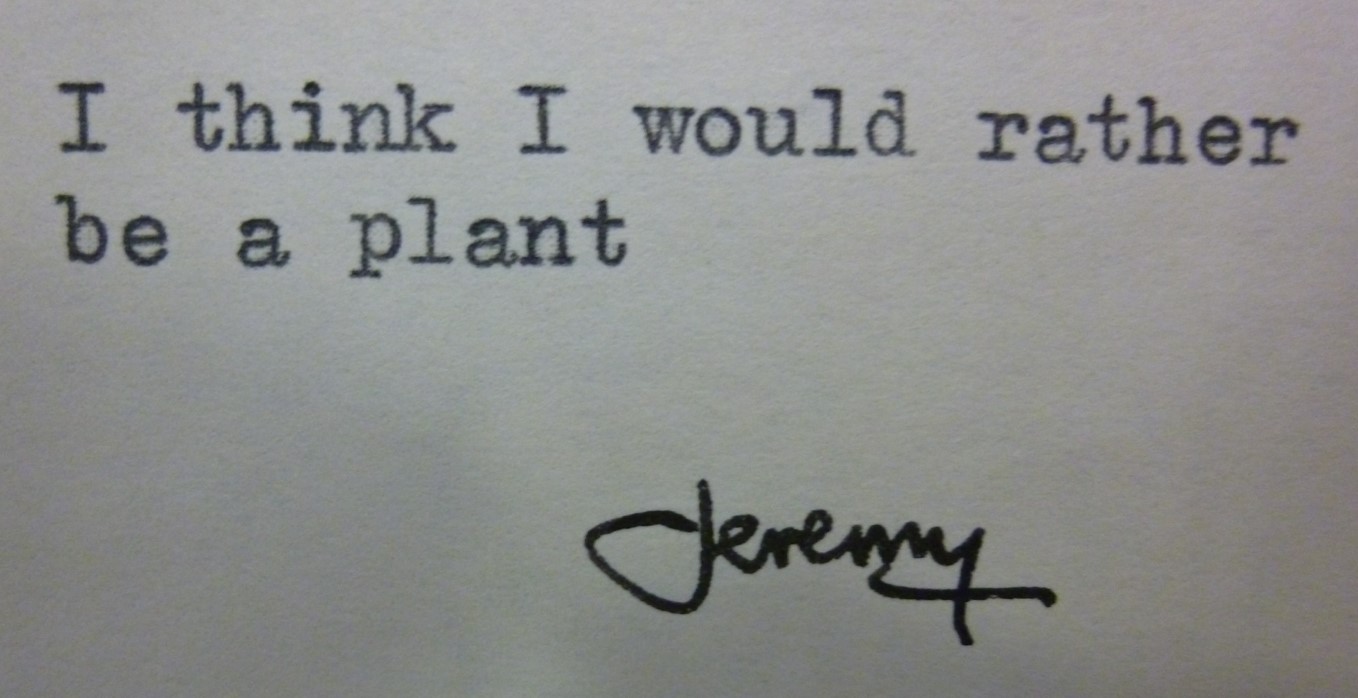
Jeremy Prynne signing off a letter to Ed Dorn.

The former of which was written across the mid to late sixties and published in 1969, the latter was published in 1971. The transition between these two books is arguably the largest shift in Prynne’s oeuvre due to the move away from a style in The White Stones that holds a certain familiarity for readers familiar with the poetry of Charles Olson and Ed Dorn. That shift into Brass was a shift into a voice that was distinctively Prynne’s own, divesting itself of a lyric sentimentality and excoriating a form ambition based on the figure of The Poet.

Although published over forty years ago, what makes the task of writing about The White Stones and Brass so equally exciting and daunting is that it feels like the development of Prynne criticism is still in a nascent stage. The number of single author studies on his work barely amounts to a handful. The amount of information on his work by the author is also acutely scant. Thus, the archives at the Dodd Center contain a set of valuable commodities in his letters to Olson and Dorn.
luker3

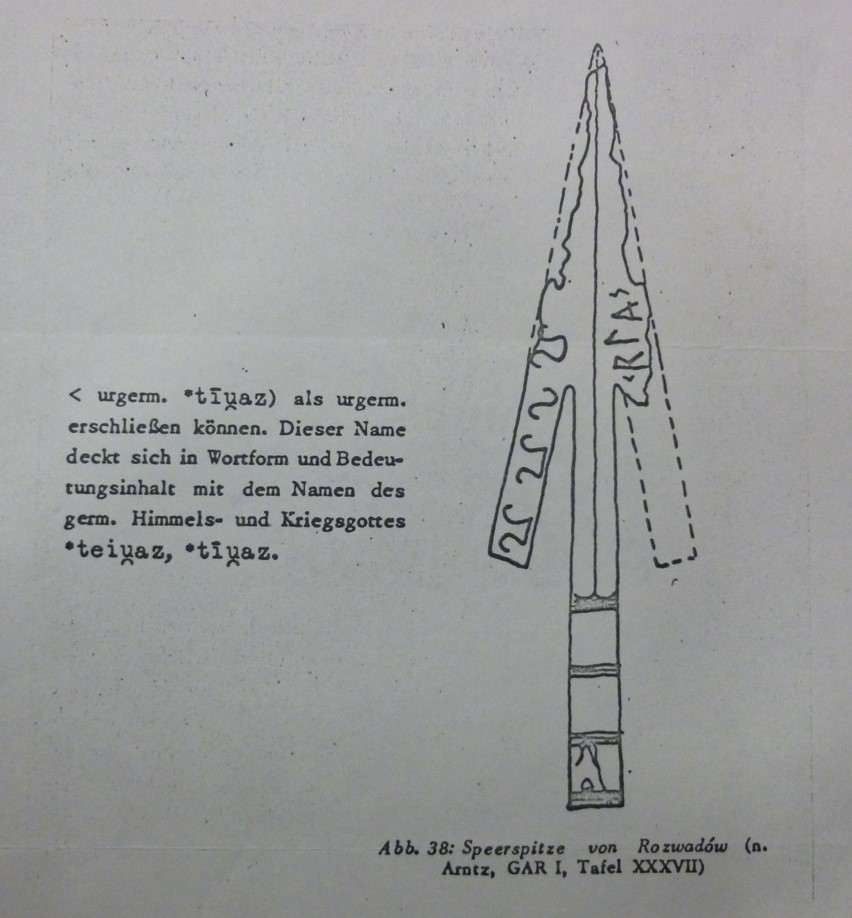
Photocopied image in letter to Charles Olson from Prynne.

Exhibiting the reflections and considerations of a young poet in a formative stage of his artistic career, the first thing to note about the letters is that they helped to confirm certain suspicions. The letters to Olson make it clear that Prynne was a ravenous and catholic reader. They contain references to the etymology of English place names, continental phenomenology, definitional Anglo-American analytic philosophy, a host of work on North European folklore, Christian theology, an anthropology of shamanism, as well as collations of classical mechanics, theories of time, and geomorphology. Many of the letters appear to be responses to Olson’s requests for information about matters for Olson’s poetry, such as economic history of shipping and trade between New England and the old world.

Olson wished to know more about the most significant traders in Gloucester, presumably for his Maximus poems. I had not known that Prynne worked as an informal researcher for Olson in such a close manner. Reading the letters really highlighted how in awe of Olson the British poet was, confirming that the poem ‘Lashed To The Mast’, which opens “Thus you have everything, at this | moment, that I could ever | command” was written in direct address to Olson, sent to him before it was ever published elsewhere.

To give a more concrete example of how the archives assisted my project, one thing I had been pondering over for a while was what the word ‘love’ might mean within The White Stones. To pick out one particular example, first of all from ‘Song in Sight of the World:

luker4

The poetic voice is resolute to express its message, “I will tell | you”, yet the separation of the first person pronoun from the ‘you’ is maintained alongside the inability of the deictic ‘this’ to be conjoined with ‘love’. Consequently ‘love’, the message the poetic voice wills to commit to, is still suspended from the ‘I’. This threefold separation is grounded in the overall separation from ‘the world’ hanging suspended, a satellite in stasis lingering at the end. I had a feeling that this outline of ‘love’ was not romantic or erotic but something more akin to a Christian agape. I had been reading the writings of the theologian Paul Tillich and felt that there was a tangible similarity between his arguments about the separation from the ‘Ground of Being’ to certain arguments within The White Stones.  For example in his sermon, later republished in The Shaking of the Foundations, ‘You are accepted’ Tillich writes:

He who is able to love himself is able to love others also; he who has learned to overcome self-contempt has overcome his contempt for others. But the depth of our separation lies in just the fact that we are not capable of a great and merciful divine love towards ourselves. On the contrary, in each of us there is an instinct of self-destruction, which is as strong as our instinct of self-preservation. In our tendency to abuse and destroy others, there is an open or hidden tendency to abuse and to destroy ourselves.
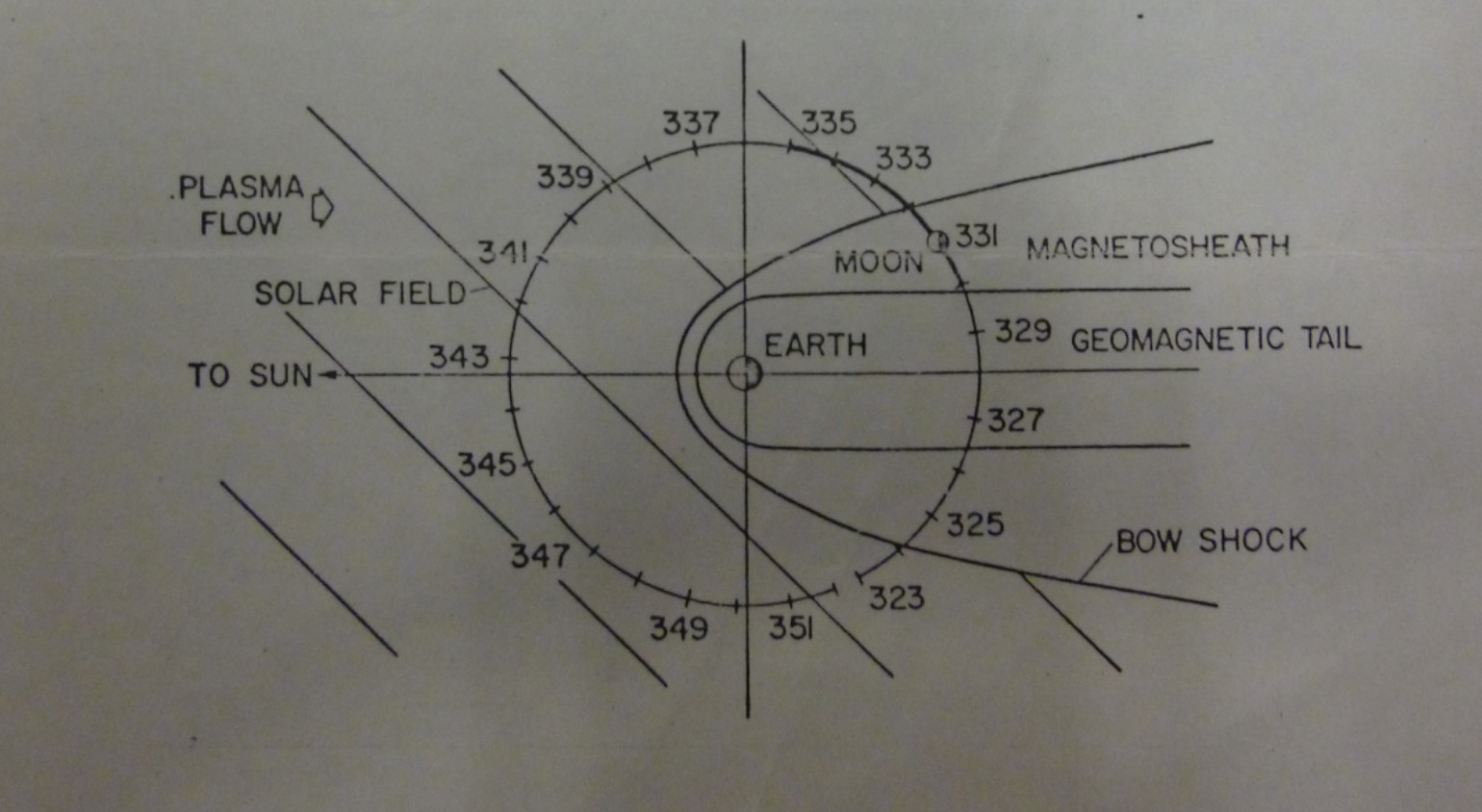
 

Image from letter from Prynne to Ed Dorn.

Image from letter from Prynne to Ed Dorn.

Whilst the separation of love from the world as a ‘Ground of Being’ mirrors that in operation in ‘Song in Sight of the World’, it also reminds me of Prynne’s argument about desire and compulsion in ‘Star Damage at Home’, that “we must have the damage by which | the stars burn in their courses”, and also, with Christological implications “there should be | torture in our midst”. What is also significant about comparing Tillich to Prynne is that it made me think of an apparent paradox in Prynne’s conception of alienation in his poetry of the sixties. On the one hand in ‘Questions for the Time Being’ Prynne writes “when almost everything is exactly that, the | mirror of a would-be alien who won’t see how | much he is at home”, this seems like a very dismissive argument about self-estrangement. On the other hand poems in The White Stones insist that “we live here and must mean it, the last person we are”, but what this nagging insistence implies is that the ‘we’ who currently lives here does not mean it and lives ‘here’ in ignorance of that fact. The ‘we’ is not at home in its home.

Whilst I had been milling over these considerations before I arrived at the Dodd Research Center, one thing I was pleasingly surprised to uncover from looking at Prynne’s letters to Ed Dorn was that he had read Paul Tillich. In the first box of materials to Dorn there is an undated document that appears to be a reading list entitled ‘Some Works Containing Discussions Of Scientific And Christian Time, History, And Causal Explanation’. Although one cannot be certain of the compiler, it contains many typographical features that share a resemblance to the typed materials that were sent to Olson by Prynne in the mid sixties. Amongst the list there are four texts listed by Tillich. The extent to which Tillich was an influence on Prynne’s thinking is something I will have to consider further, especially considering the sheer breadth of materials Prynne was reading at the time.
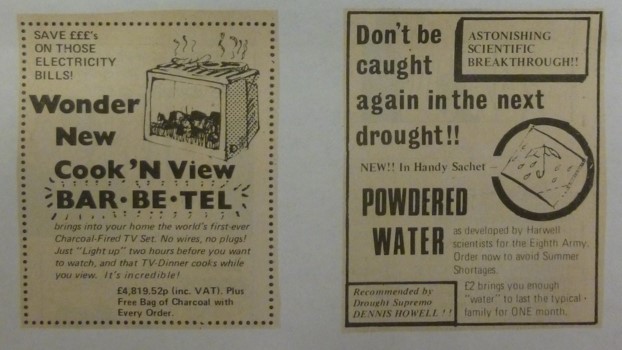
Newspaper cuttings sent from Prynne to Dorn.

Newspaper cuttings sent from Prynne to Dorn.

The Archives at the Dodd Center have enabled me to uncover what Prynne was reading within identifiable time frames. Most of the discoveries of how that reading relates to the poems are still to come. For the last few days I have been reading ‘Cosmogonies of our Fathers: Some Theories of the Seventeenth and the Eighteenth Centuries’, by Katharine Brownell Collier, recommended to Olson in a letter dated 7th January 1964. This has lead me to consider a noun phrase I had previously overlooked in ‘Star Damage at Home’,  “That some star | not included in the middle heavens should | pine in earth”. I had previously failed to notice that ‘middle heavens’ would indicate a transition within Christian cosmology from the influence of pre-Christian cosmology (which here may well be of Babylonian origin, or so A. Y. Collins argues in her book Cosmology and Eschatology in Jewish and Christian Apocalypticism) that trouble our modern idea of there being merely a heaven and an earth. What the significance of a middle heaven might mean for the rest of the poem, or what the relation of importations of various mixed cosmologies means as a whole is work still to be uncovered.

Ed Luker is a PhD candidate in English Literature at University of Northumbria.  He was awarded a Rose and Sigmund Strochlitz Travel Grant by Archives and Special Collections at the University of Connecticut to support his ongoing research on the poets J. H. Prynne, Charles Olson and Ed Dorn whose papers reside in the Archives. 


Unpublished Seuss manuscripts rediscovered

Random House announced yesterday that it will publish What pet should I get? which features the brother and sister from One Fish Two Fish Red Fish Blue Fish.  The manuscript and sketches were found in a box along with the original materials for at least two other books.  Random House will announce the publication dates for the other new releases later.

(The cover of a previously unknown Dr. Seuss book titled, What Pet Should I Get?)

Dr. Seuss’s widow, Audrey Geisel, set the box aside after her husband’s death in 1991, during a renovation of their home.  She and a longtime friend recently rediscovered the box, explaining in a statement to Random House:  “Ted always worked on multiple projects and started new things all the time — he was constantly drawing and coming up with ideas for new stories.”

ABC’s Good Morning America announced the story this morning as well as USA Today. 

What fantastic news for fans of Dr. Seuss.


Rollin Charles Williams, UConn’s first African-American professor

Faculty and staff at UConn's School of Social Work, ca. late 1950s

The first African-American professor at the University was Dr. Rollin Charles Williams, who was served as a professor in the School of Social Work from 1957 to his retirement in 1985.

Born in 1922 in Kansas City, Missouri, Dr. Williams was raised in Tulsa, Oklahoma, graduating from high school as its valedictorian and solo violinist in its orchestra. He graduated from Howard University and served in the U.S. Army during World War II, where he earned the rank of sergeant major. He earned his master’s degree in social work from Boston University and then worked as a medical and psychiatric social worker for the U.S. Department of Veterans Affairs. Dr. Williams was the first psychiatric supervisor at Norwich State Hospital. Soon after that he was recruited by UConn to do field training for the School of Social Work, and asked to join the faculty in 1957.

Upon his retirement in 1985 Dr. Williams returned to his first love – music, particularly classical and operas. When he died in September 2012, at the age of 90, UConn President Susan Herbst wrote that he “exemplified the highest ideals of service, scholarship and integrity, and [left] a legacy that we can all strive to emulate.”

This photograph, from the late 1950s, shows Dr. Williams third from the right. The man who is third from the left is Harleigh Trecker, dean of the School of Social Work from 1951 to 1968.

Dr. Kate Capshaw launches new book

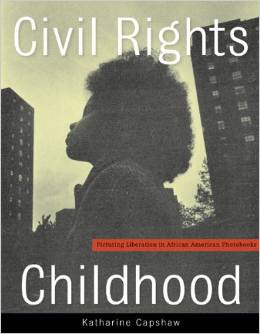
Civil Rights Childhood: Picturing Liberation in African American Photobooks (University of Minnesota Press).

Civil Rights Childhood: Picturing Liberation in African American Photobooks (University of Minnesota Press).

From Cathy J. Schlund-Vials, Ph.D., Director, Asian and Asian American Studies Institute Associate Professor of English and Asian/Asian American Studies:


On February 12, 2015 (at 4 PM) the UConn Co-op (in Storrs Center) will be hosting a book launch for Kate Capshaw’s recently published book, Civil Rights Childhood: Picturing Liberation in African American Photobooks (University of Minnesota Press). What follows is a brief description of the book and a link:

Civil Rights Childhood explores the function of children’s photographic books and the image of the black child in social justice campaigns for school integration and the civil rights movement. Drawing on works ranging from documentary photography and popular historical narratives to coffee-table and art books, Katharine Capshaw shows how the photobook-and the aspirations of childhood itself-encourage cultural transformation.  (https://www.upress.umn.edu/book-division/books/civil-rights-childhood)

Katharine Capshaw

Dr. Katharine Capshaw


This event is sponsored and hosted by the University Co-Op. For more information, please feel free to contact Cathy Schlund-Vials (cathy.schlund-vials@uconn.edu<mailto:cathy.schlund-vials@uconn.edu>).


2015 Youth Media Awards Announced

Congratulations to all of the American Library Association award winners!  The 2015 Youth Media Awards were announced on Monday, Feb. 2 during ALA’s Midwinter Meeting in Chicago.  Several of our friends won major awards.  A donor to the Northeast Children’s Literature Collection, Weston Woods Studio, Inc., received the Andrew Carnegie Medal honoring the most outstanding video productions for children released in the previous year.  The winners are Paul R. Gagne and Melissa Reilly Ellard, producers of Me…Jane, the adaption of Patrick McDonnell’s Caldecott Honor book for 2012 about Jane Goodall.

University of Connecticut’s Professor Emerita Marilyn Nelson received the Coretta Scott King (Author) Honor Book Award for How I Discovered Poetry, illustrated by Hadley Hooper and published by Dial Books.  Donald Crews, who participated in the CT Children’s Book Fair in 1997, is the winner of the Laura Ingalls Wilder Award, which honors an author or illustrator who had made “a substantial and lasting contribution to literature for children.” (ALA.org).

Natalie Lloyd’s first novel, A Snicker of Magic, was a hit at the 2014 CT Children’s Book Fair as was Natalie herself.  The audiobook produced by Scholastic Audiobooks was awarded the Odyssey Award, for being one of the best audiobooks produced in English in the U.S.  Another Book Fair participant from 2003, Ann M. Martin, was awarded the Schneider Family Book Award for Rain Reign.  The Schneider Family honors books embodying “an artistic expression of the disability experience.” (ALA.org).

Mo Willems, another member of the NCLC and Book Fair family, won a Theodor Seuss Geisel Honor Award for his Waiting is not Easy! published by Hyperion Books for Children.  Len Vlahos presented at the Book Fair in 2014 and was a finalist for the 2015 William C. Morris Award, given to a first-time author writing for teens.  NCLC donor and Book Fair participant Emily Arnold McCully was a finalist for the YALSA Award for Excellence in Nonfiction for Young Adults for her work Ida M. Tarbell: the Woman who Challenged Big Business-and Won!

For a complete listing of the 2015 Youth Media Awards, visit the American Library Association’s site.  Congratulations, everyone!


Reading Room Closed December 22, 2014 to January 4, 2015

The Archives and Special Collections Reading Room in the Dodd Research Center will be closed December 22, 2014 through January 4, 2015.  The Reading Room will re-open on January 5, 2015 with regularly scheduled hours Monday through Friday, 9:00a.m. to 4:00p.m.

For more information about Reading Room hours and policies, contact the Reference Desk in Archives & Special Collections at 860.486.2524 or email us at archives@uconn.edu.


Farewell to Norman Bridwell, creator of Clifford the Big Red Dog, dead at 86

Article by The Martha’s Vineyard Times Dec 16, 2014

Norman Bridwell poses with his beloved creation, Clifford the Big Red Dog.

Norman Ray Bridwell of Edgartown, who brought delight to millions of readers young and old as the author of Clifford the Big Red Dog series of books, died on Friday, December 12, at Martha’s Vineyard Hospital. He was 86.

Norman Bridwell in his Edgartown studio. File photo by Ralph Stewart.

Norman Bridwell was born in Kokomo, Indiana, in 1928, according to a biography by Scholastic Books. He studied at the John Herron Art Institute in Indianapolis and Cooper Union Art School in New York before working as a commercial artist for 12 years.

In 1962 Mr. Bridwell found himself having to support a wife and infant daughter on extra money he picked up doing freelance artwork. He considered supplementing his income by illustrating picture books. An editor at Harper & Row advised him that he might find success by writing a story about one of his pictures. Because of his young daughter, Bridwell chose to write a story about an illustration he had made of a little girl and a big red bloodhound. He decided to make the dog very big and more of a general, all-around dog instead of a bloodhound. Mr. Bridwell wanted to name the dog Tiny, but his wife thought the name too boring. She suggested the name Clifford, after an imaginary play friend from her own childhood. With that settled, Norman Bridwell decided to name the little girl in his book after his own daughter, Emily Elizabeth, and within a few days he completed his story. Three weeks after submitting his story and illustrations to Scholastic Books, the publishers called with an offer to publish his work.

Forty titles and 60 million copies later, Clifford the Big Red Dog is a well-known and beloved character to the preschool set.

Norman Bridwell gave generously of his time and was an annual contributor to the Possible Dreams auction, the major fundraiser for Martha’s Vineyard Community Services, the Island’s social services umbrella agency.

He was the husband of Norma (Howard) Bridwell and father of Tim Bridwell and Emily Bridwell Merz. A memorial service will be held in the summer of 2015 and a complete obituary will follow in a future edition of The Times.

Arrangements are under the care of the Chapman, Cole and Gleason Funeral Home, Edgartown Road, Oak Bluffs. Visit www.ccgfuneralhome.com for online guest book and information.

Janet Lawler’s last post: It’s all about story

IT’S ALL ABOUT STORY

When I began my research on the relationship between text and art in picture books, I was hoping to uncover the “secrets” of some of the author/illustrators whose work is housed in the Northeast Children’s Literature Collection archives. I studied a number of different collections, and I am leaving with many ideas of how to improve my craft. My writing process will now include consistent creation of picture book mock-ups (dummies), and I have a greater understanding of specific approaches to writing text that “leaves room” for an illustrator.

Interestingly, though, I conclude my research with one overriding thought. The very best picture books—whether written by an author and illustrated by someone else, or created by an author/illustrator—have at their heart a good story. So authors and author/illustrators have equal opportunity to begin their creative picture book journeys in the same place – at the deep well of great stories we each have within us, stories about memorable characters who change as they solve problems or encounter conflict.

Revising text plays an important role in refining such stories (although the author/illustrator also revises art to strengthen his or her work). But always, it is the story that is the starting point. I will share a fine example:

WINGS: A TALE OF TWO CHICKENSby James Marshall

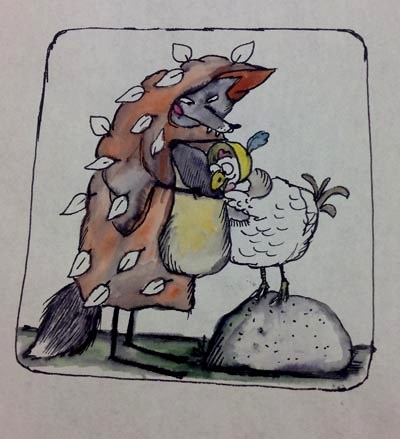
The kernel of this story appears to have been James Marshall’s vision of an old, hungry fox trying to outwit foolish fowl to find a meal. A preliminary sketch shows the disguised fox tricking a chicken into a bag.


insert_1 smallMarshall, James. WINGS: A Tale of Two Chickens. Sketch of fox bagging chicken. Series I, Box 12: Folder 217 of James Marshall Papers. All rights reserved. No reproduction of any kind allowed.

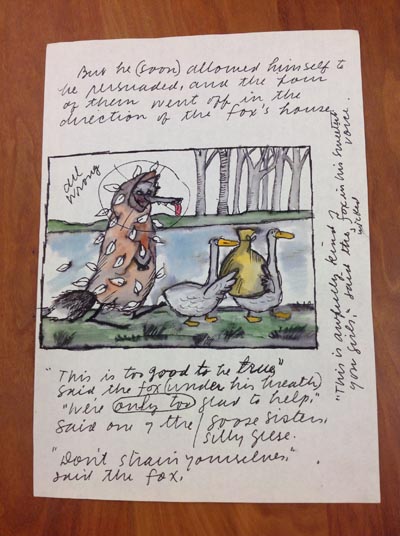
When two silly geese sisters offer to help transport the heavy bag, the fox says, “This is too good to be true.”


insert_2 smallMarshall, James. WINGS: A Tale of Two Chickens. Sketch of fox and geese, in Series I, Box 12: Folder 217 of James Marshall Papers. All rights reserved. No reproduction of any kind allowed.

An incomplete, early dummy of this story line shows a “chicken crossing” sign and a fox hiding behind a tree:


insert_3 smallMarshall, James. WINGS: A Tale of Two Chickens. Untitled, incomplete dummy, p.3. Series I, Box 12: Folder 216 of James Marshall Papers. All rights reserved. No reproduction of any kind allowed.

The text on this opening page reads:

At a spot where chickens were

frequently known to cross the road,

a hungry fox came to stand and wait.

As he was no longer young

and agile, he had learned

to rely more heavily on his wits.

And for this occasion, he had come

in disguise.

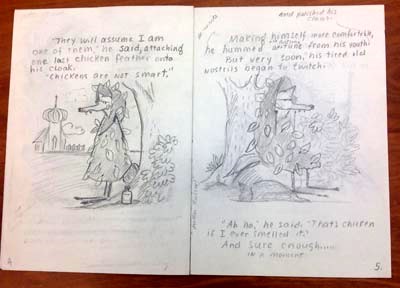
The focus on the fox as protagonist continues in this version of the story, where we see the fox waiting in his chicken disguise:


insert_4 smallMarshall, James. WINGS: A Tale of Two Chickens. Untitled, incomplete dummy, pp. 4–5. Series I, Box 12: Folder 216 of James Marshall Papers. All rights reserved. No reproduction of any kind allowed.

However, it appears that James Marshall soon decided he could tell a better story from  another angle (the incomplete dummy ends on page 6).

The first complete dummy reveals that the plot has taken a very different turn. Marshall completely switches the beginning to focus on two chickens who are close friends (maybe the two silly goose sisters in his preliminary sketches inspired this turn); the fox still plays a key role, but he is no longer a protagonist.

The title of the book, shown on this hand-drawn dummy cover, is:

WINGS

A TALE OF TWO CHICKENS


insert_5 smallMarshall, James. WINGS: A Tale of Two Chickens. Sept. ’85 dummy, cover. Series I, Box 12: Folder 215 of James Marshall Papers. All rights reserved. No reproduction of any kind allowed.

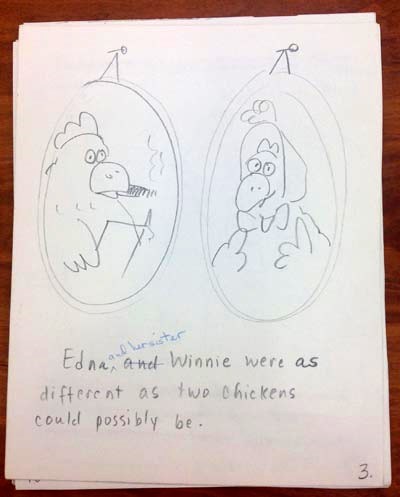
Two chickens, with parasols, stand side by side at the edge of a precipice, and a fox hides in bushes in the background. The reader immediately knows this is a story of friendship and danger, and the first line of the dummy introduces Edna and Winnie (Harriet and Winnie in the published version) who are “as different as two chickens could possibly be.”


insert_6 smallMarshall, James. WINGS: A Tale of Two Chickens. Sept. ’85 dummy, p.3. Series I, Box 12: Folder 215 of James Marshall Papers. All rights reserved. No reproduction of any kind allowed.

The first page in the published book shows the two good friends sharing tea:


insert_7 smallMarshall, James. WINGS: A Tale of Two Chickens (New York: Viking Kestrel, 3. Photo taken from CLC C38, Archives and Special Collections at the Thomas J. Dodd Research Center, University of Connecticut Libraries.

Edna (Harriet) loves reading and hobbies. Winnie would “rather swat flies than read” and is easily bored. Marshall sets up this pair of friends immediately, and when the disguised fox appears and offers foolish Winnie a ride in a hot air balloon, Edna (Harriet) fears for Winnie’s safety. A whole series of events follows, with the dastardly fox ultimately outwitted by Harriet, disguised as a fox. The plot twists and understated text are hilarious, and readers cheer for the friends right up until the closing page, when Harriet tucks Winnie into bed.

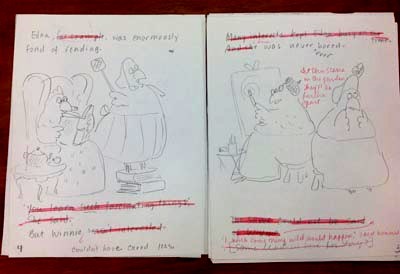
Marshall revised and refined his text zealously—on the top of the cover of his Sept. ‘85 draft (see above) there is a parenthetical note he wrote to himself in blue pen, “too wordy.”  The following pages are replete with red pencil cross outs and revisions, to pare the text of this story. For example:


insert_8 smallMarshall, James. WINGS: A Tale of Two Chickens. Sept. ’85 dummy, pp.4–5. Series I, Box 12: Folder 215 of James Marshall Papers. All rights reserved. No reproduction of any kind allowed.

Marshall clearly thought about pacing and forward movement as he revised. The above page 5 has a crossed-out, bracketed note he wrote to himself: [Some lead in here for story?]. He created that lead-in by penciling in the line spoken by Winnie just before the hot air balloon floats into the garden:

 “I wish something wild would happen,” said Winnie.

And the story takes off from there. James Marshall continued to revise his text to strengthen his story and characters throughout that first complete dummy, a second dummy, a final dummy, and various pages of text revised within some of his sketchbooks.

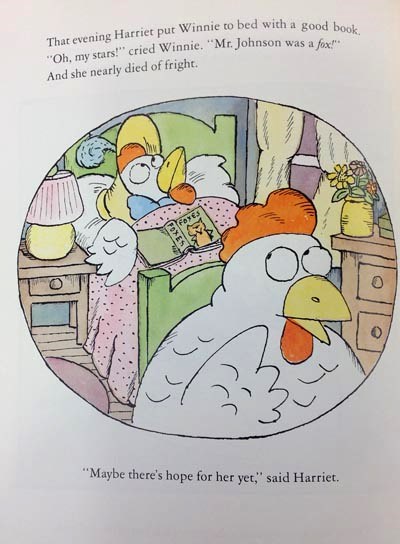
As for character growth? Winnie is at last reading a book— about foxes. She exclaims, “Mr. Johnson was a fox!” Meanwhile, Harriet hasn’t given up on her friend. “Maybe there’s hope for her yet,” said Harriet. 


insert_9 smallMarshall, James. WINGS: A Tale of Two Chickens (New York: Viking Kestrel, 32. Photo taken from CLC C38, Archives and Special Collections at the Thomas J. Dodd Research Center, University of Connecticut Libraries.

INSPIRATION

 I am concluding my research at the Northeast Children’s Literature Collection greatly inspired.  For several months, I have been working on a picture book, Chipmunk and Robin, about two close friends who are very different. As I polish and revise this story, I will draw on my new knowledge of how some of the best picture book story tellers (who happen to also be illustrators) craft character, crisis, and resolution into a full and satisfying story arc. Even though it will be a lot of work, the real secret is—it will be a lot of fun!

Connecticut History

Connecticut History Online

Connecticut History Online

Launched in 2001, Connecticut History Online has grown in thirteen years and has now evolved into Connecticut History Illustrated (CHI).    CHI is an aggregation of digital primary resources about Connecticut contributed by Libraries, Archives, Museums, Galleries, Historical Societies, and other Cultural Heritage institutions in Connecticut. It contains material as varied as the history of the state, from documents to images, from maps to audio and video covering the entire spectrum of work, play, and life in Connecticut.

CHI currently contains content from three of the original CHO partners (UConn, Connecticut State Library and the Connecticut Historical Society) and migration continues while new partners (Trinity College and Fairfield Museum and History Center) have expanded the content available for research and discovery.  New content and partners are being added regularly

Great News from Barbara McClintock

Congratulations, Barbara McClintock! Where’s Mommy, written by Beverly Donofrio, has been named one of New York Times Best Illustrated Books for 2014. The NYT website reports:  “Every year since 1952, the Book Review has convened an independent panel of judges to select picture books on the basis of artistic merit. The winning books are chosen from among thousands for what is the only annual award of its kind.” Fantastic news, Barbara!