

Through the Lens of an Anthropologist: The Freshman Beanie

Carey MacDonald is an undergraduate Anthropology major and writing intern.  In her new series Through the Lens of an Anthropologist, Carey analyzes artifacts found in the collections of Archives and Special Collections. 

Sociocultural traditions pervade the human experience and provide a reliable mechanism for social cohesion.   It is commonly thought, though, that traditions are strictly old manifestations of an earlier cultural context, when, in actuality, they evolve and create a distinct reality for each successive generation.
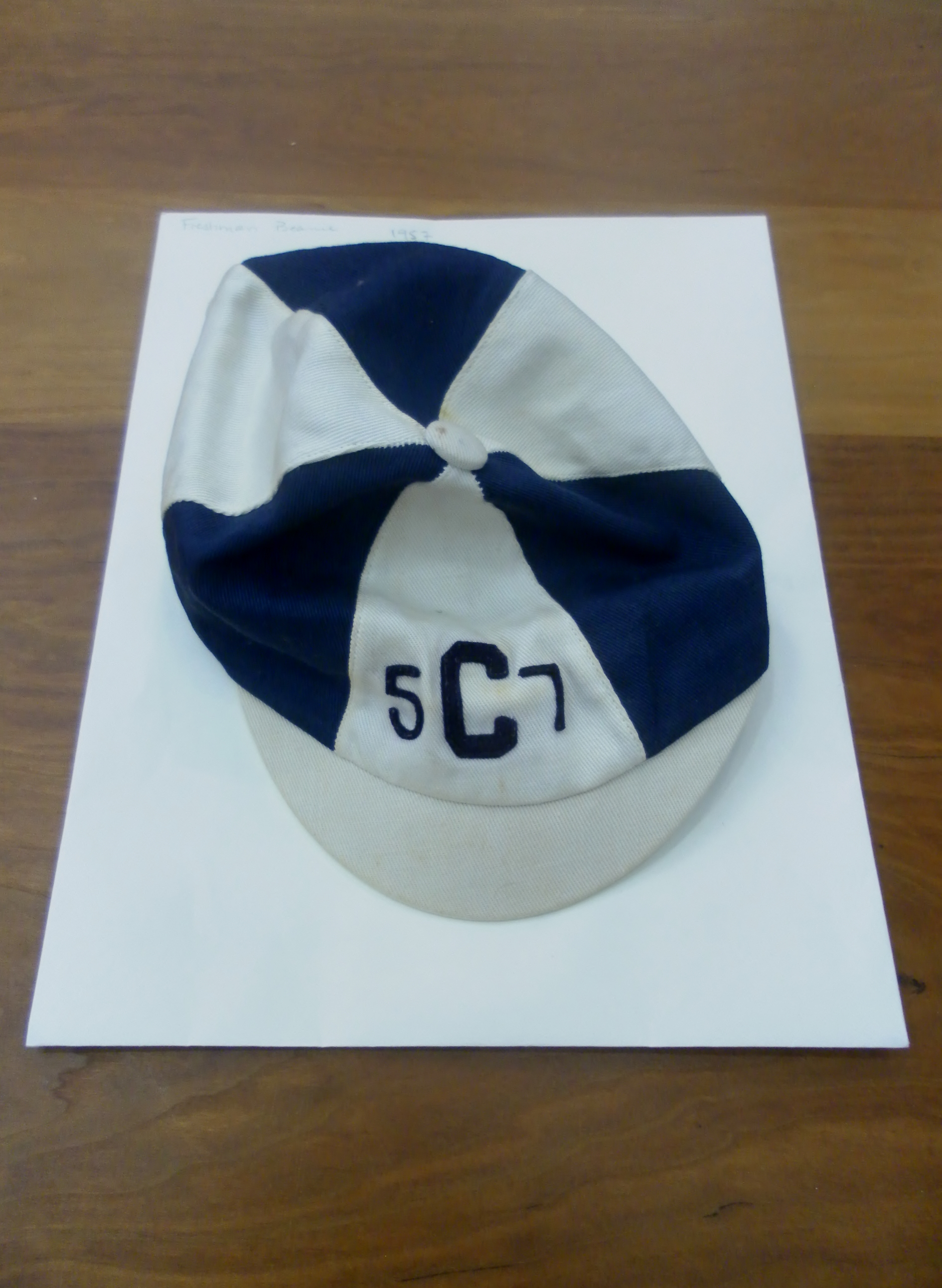
Yet traditions only evolve and persist for as long as their adherents maintain, reproduce, and reinforce them in their culture.  Such is the case of the college freshman beanie, a colored cap that freshmen were required to wear as a form of initiation into the greater university social setting.  According to the University Archivist Betsy Pittman, the tradition of wearing this cap was ubiquitous among American universities during the late nineteenth and twentieth centuries.  For younger generations though, this tradition no longer exists in the form that it once did, although there certainly exist other freshman initiation rites, particularly within the scope of Greek life, honor societies, and sports teams.  An example of the UConn freshman beanie tradition comes from the University Memorabilia Collection.

The crown of this beanie resembles a circus tent: it is patterned by six alternating blocks of navy blue and white (university colors) and is held together in the center by a white fabric-covered fastener.  An insignia of ‘5 C 7’ is embroidered on the front of the cap above the narrow, white brim.  ‘5’ and ‘7’ are placed on either side of ‘C’ in a thin, navy blue felt font and represent that freshman class’s graduating year – in this case, the class of 1957.  ‘C’ is sewn in a larger, thicker, navy blue felt font and most likely represents Connecticut.  Also important is the name Eugene H. Starger, which is handwritten in what appears to be thin permanent marker or black pen on the inside rim of the hat.  It seems that Eugene got a lot of use out of his beanie since it is stained; it is apparent that he wore this beanie more than once, as it was a necessary part of his attire for at least some time.

We see the first evidence for the freshman beanie tradition in a student handbook from the academic year of 1921-22 called The Handbook of Connecticut Agricultural College.  In the handbook’s “Message of ’24 to ’25” – as it was written by the class of 1924 to the incoming class of 1925 – we see abrupt, intimidating, student-to-student language used to enforce the university’s traditions:

As your infantile brain could not possibly assimilate the significance of a proper beginning, tradition places the burden of guiding you through this, your first year at C.A.C. on the broad, capable shoulders of the Class of 1924…Transgress sacred College Tradition and never…will the haunting memory cease to picture that terrible night when you so unexpectedly disturbed the Waters of Swan Lake.

This message is clearly intended to ensure that no freshman would ever “transgress sacred College Tradition,” capital letters and all, because if they did, they’d be punished and thrown into the lake.  The handbook continues by giving freshmen explicit instructions for using the beanie.  They were to wear this distinct cap and conform to the rules.  Sophomores were to distribute the caps and enforce the rules.

Thirty-two years later, the student-written Husky Handbook of 1953-54 – the same year that Eugene H. Starger was a freshman – requires freshmen to wear their purchased beanie until the ‘season’ is over.  The season ended if the freshmen won the Frosh-Sophomore Rope Pull contest across Mirror Lake during the first month of school, but if the sophomores won, then the freshmen would have to wear their beanies until Thanksgiving break.

Most importantly, the handbook explains the overall significance of wearing the beanie: the upperclassmen wanted to know who the freshmen were so that they could meet and help them more easily. Interestingly, this section ends by saying, “Wear your Beanie with pride, because we are proud to number you as ‘one of us.’”  Betsy Pittman expands on this notion by describing that the ‘controlled ritual’ of wearing the freshman beanie signaled to others one’s commitment to the university, its culture, and its people.  She also remarks that since the upperclassmen had to wear a beanie during their first year too, the student body in general had this experience to which they could all relate.  This would, in effect, foster a beneficial sense of community, and ultimately, as Pittman says, the “beanie is a physical manifestation of that community.”

Carey MacDonald, writing intern

Planning in advance for (another) nor’easter

COSTEP-CT, a group based in Connecticut that encourages disaster preparedness and recovery in the state by individuals as well as organizations, has developed some basic guidelines for recovery efforts for storm damaged family heirlooms and antiques.

The guidelines describe basic activities for  cleaning and drying water-damaged materials including paper based items, framed artwork, photographs, textiles, leather, bone/ivory, metal and sound and video recordings.  COSTEP-CT also provides contact information for materials requiring more than basic care.

Betsy Pittman, University Archivist

Through the Lens of an Anthropologist: Abbie Hoffman’s Socks

In her new series Through the Lens of an Anthropologist, undergraduate Anthropology major and writing intern Carey MacDonald will analyze artifacts found in the collections of Archives and Special Collections.  ‘By asking a set of questions, I intend to reveal and highlight many intricate patterns of human behavior, such as social actions and customs, and the ways in which those patterns of behavior are represented in certain artifacts.” — Carey MacDonald

Clothing, as a fundamental, human form of expression, is symbolic of our cultural, social, and physical environments, as well as of our experiences and beliefs. T-shirts, jerseys, hats, pins – these things are worn as distinct symbols of an individual. But what about a pair of socks?

Abbott “Abbie” Hoffman, the Massachusetts-born activist and co-founder of the Youth International Party, or the Yippies, of the 1960s and ‘70s, is best known for his unabashed and public criticism of American government policies and politicians. He used calculated political theater to engage young people in the political and social issues of the time and to organize them in the effort to reform the government and the nation. Hoffman’s revolutionary ideology manifested itself in his own self-expression; he publicized his ideas by way of media coverage of his demonstrations, as well as through the very clothes he wore on his body.

In the collection of the Hoffman Family Papers we see that Jack Hoffman, Abbie’s younger brother, maintained regular correspondence with Abbie throughout his years of activism.  Jack later gained many of Abbie’s possessions, such as the aforementioned t-shirts, political pins, and, naturally, a dirty, well-worn pair of red, white, and blue socks that resemble the American flag. The socks’ knitting is worn away in the toes, heels, and calves, indicating their habitual use. Since he frequently wore them and kept them long enough for them to eventually reach his brother, these red, white, and blue socks must have meant something to Abbie. And they certainly mean something to us today about his life and his activism.

At the 1968 Democratic National Convention in Chicago, Abbie and eight other leaders and their Yippie followers held a demonstration against the war in Vietnam and pushed for social and political reform in Washington. In an amateur video taken of Abbie discussing the forthcoming demonstration in Chicago, he articulates his plan to take social action at the Convention for the exact purpose that there would be extensive media coverage of the goings-on. He expected that every hour or so during the televised Convention the cameras would cut from the politicians’ speeches to the Yippies’ demonstration, and the viewers would immediately be interested in what they were doing. In preparation for the demonstration, the mayor appeared on television constantly and stationed police forces and Secret Service agents in the city. In interviews with journalists prior to the event, Abbie likened the whole scene to an exciting football game, like the Rose Bowl. By implementing dramatic, theatrical tactics to capture the public’s attention, Abbie and his Yippie friends could deliver their message in the spotlight.

However, to the Mayor and politicians, the demonstration at the DNC was viewed as a violation of the Anti-Riot Act that had been established in April 1968 after the assassination of Martin Luther King, Jr. Similarly, the American flag t-shirt that Abbie wore during the ensuing trial of the demonstration leaders, who were known as the Chicago Seven, was perceived by the judge as a desecration of the flag, a national symbol that is meant to be revered.  By practicing these forms of political theater, Abbie Hoffman managed to create “an advertisement for revolution,” as he calls it in his 1968 book, Revolution for the Hell of It. As for his red, white, and blue socks, it is very possible that he wore them to be viewed as a defilement of the flag. Or, after he was acquitted of conspiracy in 1973, he may have worn them during the years that he was on the run after jumping bail for his arrest for cocaine possession.

Yet it is also conceivable that he wore them to promote his image of a new, reformed America. He could have been expressing his patriotism and hope to his fellow Yippies and Americans, and since he personally knew he was wearing them, they could have symbolized, for himself, his idealism and belief in social change.

Carey MacDonald, writing intern
Katie Davis exhibit opens at the Dodd Center

The Katie Davis exhibit is up and running in the Dodd Center Gallery.  Original materials from the Davis Papers for her books The Curse of Addy McMahon, Party Animals, Mabel the Tooth Fairy, Who Hoots and Who Hops are featured as well as books and some great “Scared Guy” items.  The exhibit runs from October 29, 2012 to February 22, 2013.  There will be a reception and gallery talk by Katie on Saturday, Nov. 10, from 2-4 in the Dodd Center.  Her books will be for sale at the Book Fair.  For more information to go bookfair.uconn.edu.

Katie Davis exhibit, Dodd Center Gallery

Katie Davis exhibit, Northeast Children’s Literature Collection

Resources for Disaster Recovery

As we all recover from the effects of storm Sandy, we are spreading the word about advice hotlines and grants for salvaging public records and cultural heritage materials affected by the storm.  Below are links and pointers to regional orgs:

Disaster Assistance Hotline (Northeast Document Conservation Center)

Grants and Funding (CT Coordinated Statewide Emergency Preparedness)

Disaster Planning and Recovery for Libraries, Historical Societies and Home  Collections (Connecticut State Library)

Disaster Recovery Resources and Grants (Metropolitan New York Library Council)

Disaster Relief Fund (Mid-Atlantic Regional Archives)

Hurrican Sandy Resources (American Institute for Conservation of Historic and Artistic Works)

National Disaster Recovery Fund (Society of American Archivists)

Melissa Watterworth Batt, Curator of Literary, Natural History and Rare Books Collections

Bravo! Writing Award-Winner Daniel Allie

In today’s Daily Campus, read about the Annual Aetna Writing Prize Program and the presentation of writing prizes to UConn students including Daniel Allie, who was awarded the Kathleen Gibson McPeek Scholarship for his essay “What does not change: Charles Olson’s Projective Verse and The Kingfishers”.  Daniel Allie is an undergraduate English major who, prior to his becoming a student employee here, conducted extensive research in the papers of poet Charles Olson held in Archives and Special Collections.  Congratulations Daniel!

Melissa Watterworth Batt, Curator of Literary Collections

National History Day, “Turning Points,” and connecticuthistory.org

In the years that I have been a curator here in Archives & Special Collections I have been fortunate to work with a wide array of researchers, from academic scholars, graduate and undergraduate students, and genealogists to railroad fans, lawyers and preservationists, but I admit to you all right here and right now that I get the most satisfaction when I work with middle school and high school students, those who are at the early point of discovering the wonder and power of primary sources.   And one of the ways we get to work with young students is to help them find the resources they need for National History Day projects.

Never heard of National History Day?  Here is the description of the contest from the website at http://www.nhd.org/:

“Each year, more than half a million students, encouraged by thousands of teachers nationwide participate in the NHD contest. Students choose historical topics related to a theme and conduct extensive primary and secondary research through libraries, archives, museums, oral history interviews and historic sites. After analyzing and interpreting their sources and drawing conclusions about their topics’ significance in history, students present their work in original papers, websites, exhibits, performances and documentaries. These products are entered into competitions in the spring at local, state and national levels where they are evaluated by professional historians and educators. The program culminates in the Kenneth E. Behring National Contest each June held at the University of Maryland at College Park.”

Thomas J. Dodd at the Nuremberg Trials, 1945-1946, from the Thomas J. Dodd Papers

We here in Archives & Special Collections are collaborating with connecticuthistory.org by choosing materials from our collections and providing these sources and essays for students to use for their NHD projects.  Two of the essays are currently online (with more to come), which include:

Connecticut Lawyer Prosecutes Nazi War Criminals at Nuremberg, which describes the work of Thomas J. Dodd, who served on the Executive Trial Council at the Nuremberg Trials following World War II, and the tragedy of Kristallnacht, a turning point that unleashed the persecution of European Jews by the Nazi regime.

Reporting News of Pearl Harbor, which tells of how Andre Schenker, a professor of history at the University of Connecticut and a commentator for Hartford radio station WTIC in the 1940s, reported this shattering world event — a turning point in history if there ever was one — to his Connecticut listeners.

There are more “Turning Points” to come, so stay tuned.  Also, if you haven’t tooled around connecticuthistory.org then spend a few minutes with this extraordinary resource, reading the essays and looking at the unique photographs and documents.  There is a lot to learn there about the history of Connecticut!

Laura Smith, Curator for Business, Railroad and Labor Collections

Happy 60th Birthday!

Student Union

The University of Connecticut Student Union opened its doors to the UConn community sixty years ago today.  Since 1952 the students and building have changed a bit, but the Student Union is still physically in the center of campus and serves as the “center of activity for students, faculty and staff…designed to enhance the quality of student life, support co-curricular activities and contribute to the University’s educational mission.”

–Betsy Pittman, University Archivist

October is Archives Month

Connecticut Archives Month, October 2012

The poster for Connecticut’s recognition of Archives Month highlights the fragility of our documentary and cultural heritage.  Repositories throughout the state, like Archives & Special Collections at UConn, actively acquire materials that document events, actions, individuals and organizations that are Connecticut and its residents to protect, preserve and make it accessible into the future.  During Archives Month, everyone is encouraged to visit a repository and learn more.  A list of activities being held in the Dodd Research Center, where Archives & Special Collections is located, can be found online.

–Betsy Pittman, University Archivist

Tomie dePaola receives Society of Illustrators’ Lifetime Achievement Award

CongrOliver Button is a Sissy (pg. 5)atulations, Tomie!  According to the Society’s home page, “The Lifetime Achievement Awards were established in 2005 by past chairs of The Original Art. Nominees must be judged to have a body of work that documents an innovative and pioneering contribution to the field of children’s book illustration, and final selection is made by artists whose work has been juried into the previous year’s show. ”

From an early age, Tomie and his parents knew he would be an artist. He received his Bachelor of Fine Arts degree from the Pratt Institute in Brooklyn, New York where he studied Art. His Master of Fine Arts degree was received from the California College of Arts and Crafts in Oakland, California. He has also been awarded three honorary Doctorate degrees from separate Universities and Colleges.

Tomie’s Tomie dePaolacareer as a professional artist and designer, former teacher of art, children’s author and illustrator is expansive. He has designed greeting cards, posters, magazine and catalogue covers, record album covers, and theater costumes and sets. He has illustrated over two hundred books, and written over seventy. Tomie has won numerous awards, including the prestigious American Library Association’s Caldecott Honor Award for Strega Nona (1976), the University of Minnesota’s Kerlan Award (1981), the Catholic Library Association’s Regina Medal (1983), and the Smithsonian Institution’s Smithson Medal (1990).

Tomie’s books have been published world-wide in fifteen different languages and he has over five million copies in print. Many of his books are largely autobiographical such as Nana Upstairs, Nana Downstairs, Tom, and The Art Lesson. Tomie currently resides in New Hampshire.

The Tomie dePaola Collection contains artwork, sketch books and paintings from the beginning of his career, as well as many different editions from each book he wrote or illustrated, including foreign editions. Some of the languages represented are Portuguese, Swedish, Finnish, French Canadian, German, Afrikaans, and even Zulu. Original Little Tomieillustrations from books, as well as paintings and other art work spanning from his childhood years are included. The Collection also contains marketing items from his books, such as towels, porcelain jewelry containers, music boxes, paper goods (wrapping paper, cups & plates), quilts from schools, and a large selection of Christmas tree ornaments designed by Tomie for the Marshall Fields Christmas trees in Chicago.

Well done, Tomie!

–Terri J. Goldich, Curator, Northeast Children’s Literature Collection

Tomie dePaola receives Society of Illustrators’ Lifetime Achievement Award

Congratulations, Tomie!  According to the Society’s home page, “The Lifetime Achievement Awards were established in 2005 by past chairs of The Original Art. Nominees must be judged to have a body of work that documents an innovative and pioneering contribution to the field of children’s book illustration, and final selection is made by artists whose work has been juried into the previous year’s show. ”

Oliver Button is a Sissy (pg. 5)

From an early age, Tomie and his parents knew he would be an artist. He received his Bachelor of Fine Arts degree from the Pratt Institute in Brooklyn, New York where he studied Art. His Master of Fine Arts degree was received from the California College of Arts and Crafts in Oakland, California. He has also been awarded three honorary Doctorate degrees from separate Universities and Colleges.

Tomie’s career as a professional artist and designer, former teacher of art, children’s author and illustrator is expansive. He has designed greeting cards, posters, magazine and catalogue covers, record album covers, and theater costumes and sets. He has illustrated over two hundred books, and written over seventy. Tomie has won numerous awards, including the prestigious American Library Association’s Caldecott Honor Award for Strega Nona (1976), the University of Minnesota’s Kerlan Award (1981), the Catholic Library Association’s Regina Medal (1983), and the Smithsonian Institution’s Smithson Medal (1990).

Tomie dePaola

Tomie’s books have been published world-wide in fifteen different languages and he has over five million copies in print. Many of his books are largely autobiographical such as Nana Upstairs, Nana Downstairs, Tom, and The Art Lesson. Tomie currently resides in New Hampshire.

The Tomie dePaola Collection contains artwork, sketch books and paintings from the beginning of his career, as well as many different editions from each book he wrote or illustrated, including foreign editions. Some of the languages represented are Portuguese, Swedish, Finnish, French Canadian, German, Afrikaans, and even Zulu. Original illustrations from books, as well as paintings and other art work spanning from his childhood years are included. The Collection also contains marketing items from his books, such as towels, porcelain jewelry containers, music boxes, paper goods (wrapping paper, cups & plates), quilts from schools, and a large selection of Christmas tree ornaments designed by Tomie for the Marshall Fields Christmas trees in Chicago.

Little Tomie

Well done, Tomie!

–Terri J. Goldich, Curator