Ashlyn Anstee, Emmy-nominated Canadian-American director, artist, and writer, is the recipient of a 2026 Billie M. Levy Fellowship. She is a member of IATSE 839, and is a collaborator with The Center for Scholars and Storyteller. She also sits on the Associate Board of 826LA, and is a frequent workshop leader at museums, non profits, and libraries around Los Angeles. She holds a Bachelors in Applied Arts: Animation from Sheridan College, and a certificate in Early Childhood Education from UCLA.
I had the pleasure and privilege of spending a week at the Archives and Special collections at UCONN, peeking through children’s literature papers to research how many artists have different jobs as a part of their whole creative practice.
First, if you haven’t visited an archive before, it’s a little different than a regular library. You request the papers you want to see in advance (and UConn has a handy dandy system for that).
When you arrive at the library, they wheel out what you’ve requested. You might think you know what you’re requesting, but it’s not until it comes out that you get to see just what awaits you. These are originals after all, so sometimes things are in different sizes (little torn off pieces of papers) or not made of paper at all (some artists work on vellum, a thick sort of plasticky paper). The papers come in boxes and folders, sometimes big (like for original art) and sometimes banker box-sized with many folders for letters, papers and faxes. It’s like a beige brown Christmas.
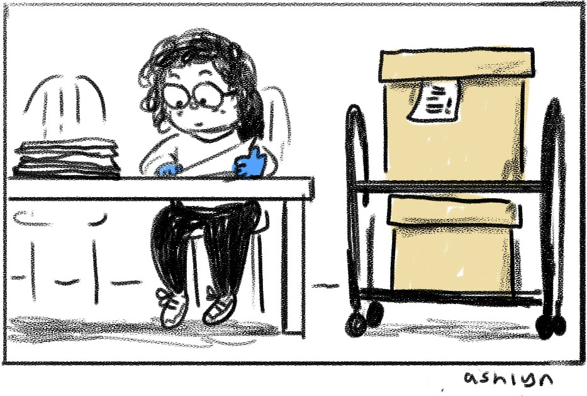
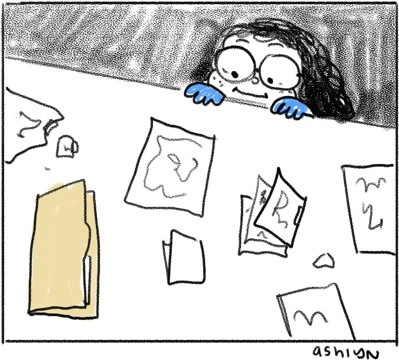
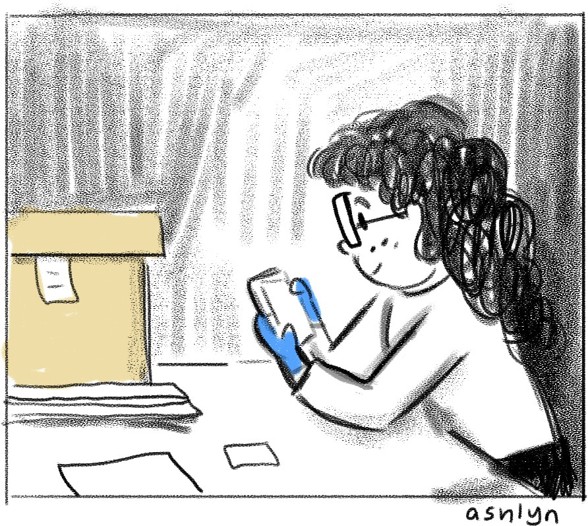
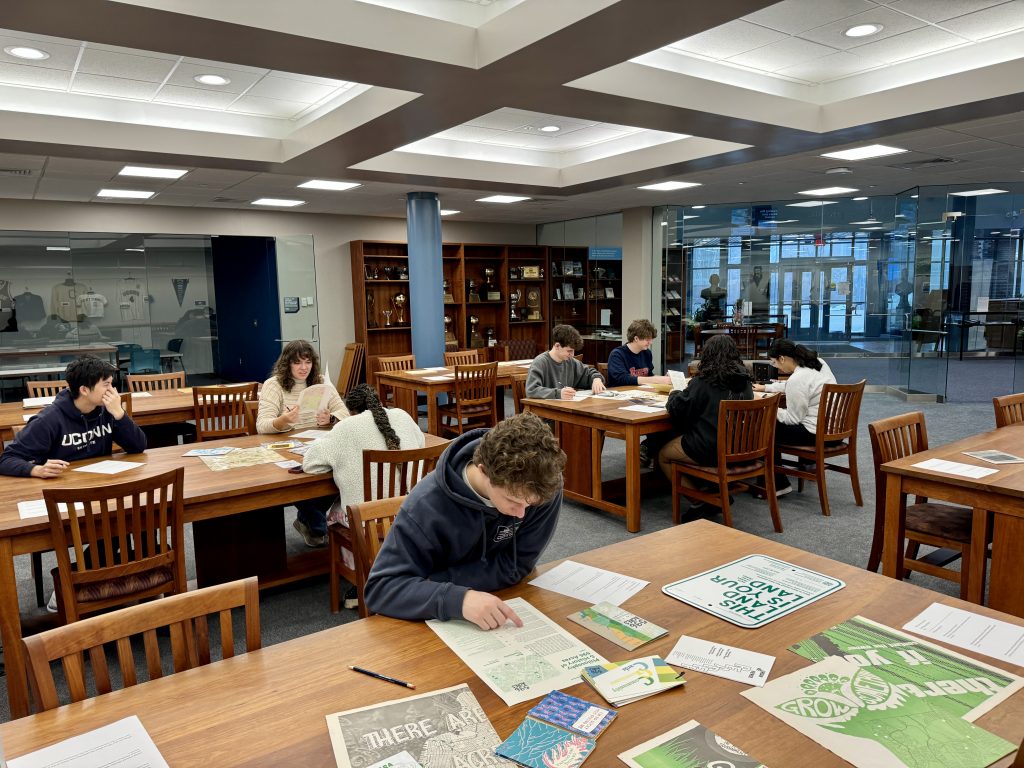
The artist explores papers at UConn.
You sit at a table and gently explore. And I really mean explore. You put on gloves to go through more delicate objects, like art or photographs.
I was focusing on three artists–Esphyr Slobodkina, Cyndy Szekeres, and Kate Greenaway. They each had wildly different collections.
Esphyr Slobodkina has papers, intimate corrospondence, and even several lawsuits. Cyndy Szekeres was a mass of sketches and dummies (rough versions of picture books made to sell projects), and Kate Greenaway’s collection was bits of paper ephemera (printed postcards, magazines, and almanacks).
I had a little bit of an idea of what I wanted to write about for my project, which is a multi-part newsletter on my substack. I’ve been ruminating on the role of money and jobs and arts- why artists take on different creative jobs, and how it affects their artistic practice. I’m a multi-hyphenate, a little by choice (there’s just so many interesting things to learn!) and partly for survival. Arts can be tough to make a living, and having a swiss army knife of skills and conctracts can keep you afloat through fallow periods.
I started my career in animation, and have a bachelor’s in Applied Arts in Classical Animation from Sheridan College in Canada, I started my career in early animated greeting cards, before jumping over to TV animation. There, I started in storyboards, but then went onto writing and directing, and consulting. I’m Emmy-nominated for writing on Adventure Time: Distant Lands, and have hopped around working for most of the major studios. But I also write and illustrate books for children. My picture book Hedgehog! was in Dolly Parton’s Imagination Library. But wait,that’s not all! I’m also an adjunct professor at The College for Creative Studies and I teach teens and kids art too. I’m tired just writing that all out. But the fact is that they’re all bits of a whole, parts of a creative practice and they all inform eachother. My animation work has made me a more narrative storyteller for books, and my role as a teacher has made me more capable of directing and managing others.
This sort of creative chaos is more normal than not for artists, and my trip to the Archives showed it in spades.
The first artist I took a look at was Esphyr Slobodkina. I knew her, as most people do, through her book Caps for Sale. But she was also a fashion designer, an interior decorator, an abstract artist, a jeweler, a sculptor, and a landlord.
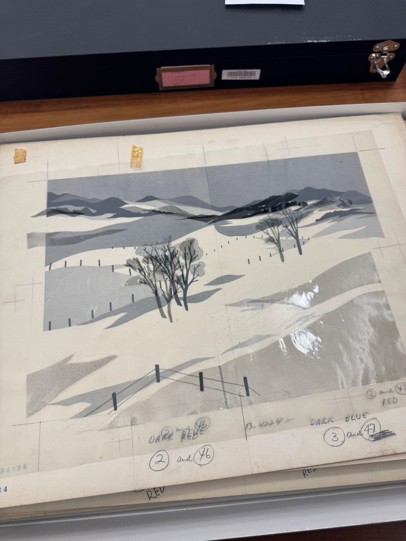
Original color-separated art by Esphyr Slobodkina.
Diving into her papers was an amazing way to meet her. What she chose to keep, and how she viewed the world. She was very specific about what she liked and how she wanted things creatively. She could be biting, blunt, and hilarious in her pursuit of what she felt was right. In her letters (which she carefully saved and filed), she pitched herself as an artist, and asked (even demanded!) for respect. She didn’t back down from a fight, especially if it involved something that she’d poured her creative heart into. Among her lawsuits- a typewriter necklace she wanted to be paid for and eventually sued for the payment, and suing the city after her beloved home she built was being stunk up by a sewage plant.
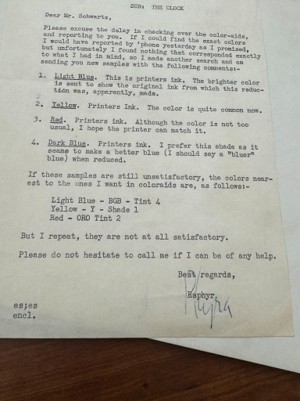
“But I repeat, they are not at all satisfactory.”
One of my favorite letters has her carefully curating ink color choices for a book, and when she offers other choices, talks about how “not at all satisfactory” it would be if they had to go that way. She just really liked things in a certain way!
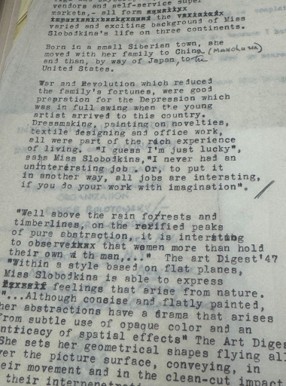
One of my favorite quotes from her about jobs is “I’ve never had an uninteresting job. Or, to put it another way, all jobs are interesting if you do your work with imagination”, and I agree with her. What a joy to see someone throw themselves into different paths with as much fervor as her “main” money-making job. She truly said yes to anything!
Going through Cyndy Szekeres’ papers was equally as enthralling. I looked through a few boxes of Szekere’s work. Dummies- which are drawn up mock ups of picture books, and manuscripts, and piles and piles of idea papers. These tiny slips, on tracing paper, and even hotel notepads, speak to an artists’ habit of making due with the supplies they have. Like magpies of many tiny sketches, tapped and assembled and drawn over again.
The blue gloves are mandatory for photographs and original art.
Viewing these pencil drawings in person is astounding. She has a searching line, a way of getting down the pose for a mouse or bunny in the cutest possible way. Then she lays over more tracing paper and does it again, building up the form. When she pitches projects, she’s also always taking a commercial angle- how big will the book be, will it be a series.
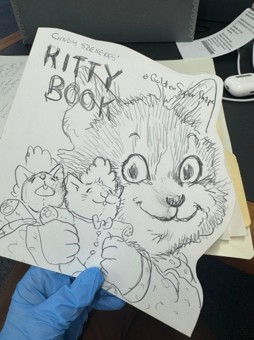
This kitty book was a series of animal-shaped books pitched by Cyndy Szekeres.
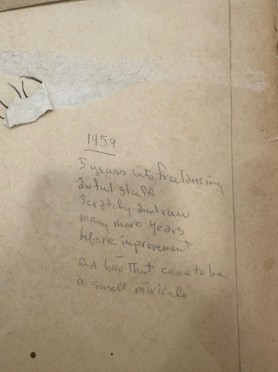
Szekeres started her work with many odd art jobs. She illustrated Babar stories for a newspaper, and left herself a note on top of the stack of papers. “Awful stuff, scratchy and raw.” While I don’t agree with her there, you can tell it was just a stepping stone for her. Some jobs are just for the money, and she eventually went on to make just her own work.
“many more years before improvement, and how that came to be a small miracle.”
As I peek through her papers, I notice that she even designs the papers in her life, her stationary background creeping in. She includes an adorable sketch in each fax.
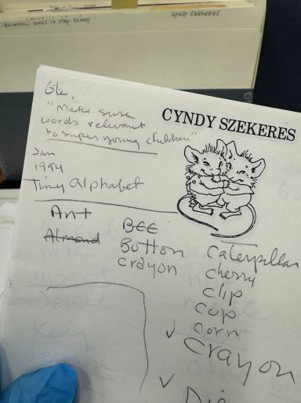
She has a notepad with her own art, and creates a letter stamp with her address perhaps an influence from Richard Scarry, her friend, he also did the same).
also note the list of words that might be relevant to young children.
As a picture book author and illustrator, it’s rare to get a peek behind the curtain of how a book is made. We tend to be secretive, not wanting to share the messy thumbnails and ideas that go through the long process of making a picture book (sometimes years! often years). Szekeres lays her work bare, the tiny thumbnail mice glued in above text. In her notes, she writes lists, of rhymes, of emotions, and asks questions like “Should this be a baby bunny?” . These are the hard hitting quesitons of a picture book creator.
My final big adventure was with the Kate Greenaway collection. She started out in the greeting card world before moving to picture books (very early picture books- the medium was very new when she started illustrating in 1880). Her art is decorative, it feels like pre-Ralphaelite paintings with her gentle figures in watercolor and ink (she
also had a long correspondence with critic and pre-Raphaelite advocate Ruskin). Her art was what I’d think of as being more commercial. Though she illustrated scenes, they weren’t story-specific. Because of this, her art was able to be reused in a lot of different ways.
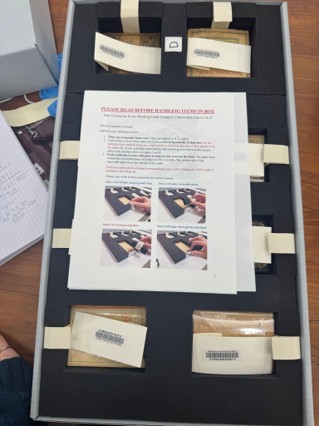
Kate Greenaway’s Almanacks in a carefully constructed foam housing
The Almanacks, which I got to look at, all lined up in their carefully-cut foam homes, were reprinted in the 1880s and again 30 years later. You have to handle these little books as carefully as original art- they are almost 150 years old!
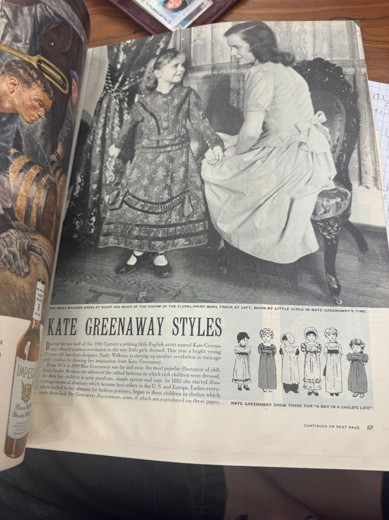
I remember reading how Maurice Sendak called her work vapid, which, first of all rude, but second of all, I think her work was just more decorative than narrative. One thing that stands out with Kate Greenaway’s work is its long lasting appeal. Two other pieces in the collection, a pair of Time Magazines, talk about how her work is being used to inspire fashion.
Returning to simple frocks!
Greenaway’s mother was a milliner and it gave her an eye for greating works that were just a little out of time, traditional but fantastical. She created this idyllic view of childhood that was only just beginning to blossom (child labor laws had only just started to pass around then). She was also someone who drew on her letters, a characteristic which seems to be common among all the artists.
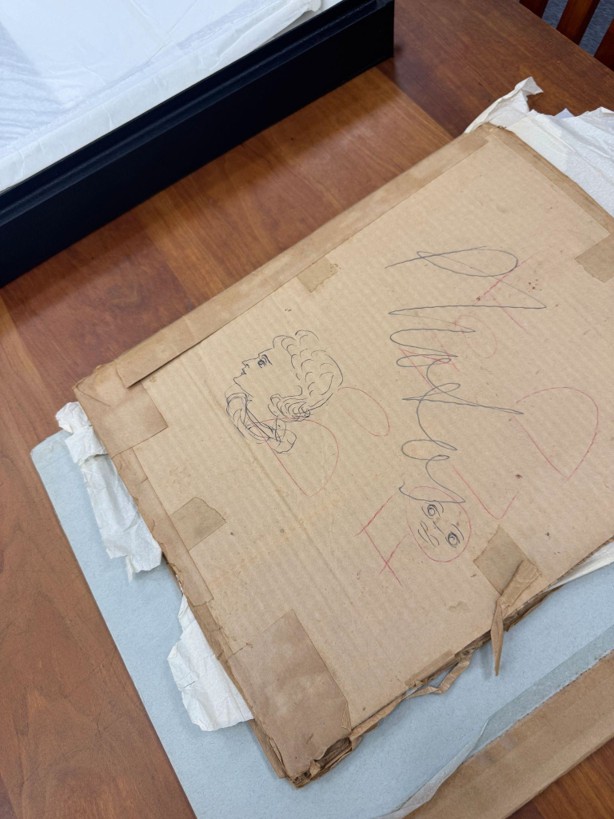
Seeing work in person is especially precious in a time like this. Digital is so easy to alter, to trim, to cut down. When I look through stacks of the “stuff” of someone’s life, I feel like I see connections easier. You can see the little comments that are too easy to erase digitally, to see empty sketchbook pages, pages with a single nose, a cardboard folder that Slobodkina drew a face on. How lovely, and how even many years later I feel like I am sharing the space and moment with her.
As I explore these artists of many careers, I’ve been saying I have a patchwork quilt of jobs. My mom is a quilter, and she’s really instilled in me the love of looking at a quilt and seeing all the fabrics that come together to make a whole. Even though this new world is daunting, and we’re having to do a lot of scrounging to make it work, maybe there is some joy in the new things that we’re doing. It affects our practice in new, wonderful ways, that you can’t always tell until many years later. If you can hold onto some of the little fires that keep you creating, even if it feels like there’s no money it, you can stoke them, let them grow, make something new even as you have to go off to do something else for a little bit. That’s what makes us artists.
As I look at the breadth of these artists’ careers in the Archives, I’m struck by how much they worked the business side of art as much as the creative. The creative oozed into everything, for sure, in letters and dummies and sketches, but as much as there was creativity there was business and setting up how to pitch things to make a living. To dive through the papers of someone’s life is to see how they made things work, and how they survived. Slobodkina, Szekeres, and Greenaway not only survived, but had long, successful careers doing many different things!
This post was written by Professor Aaron Coy Moulton of Stephen F. Austin University, who has been researching our collections for information to support his work of The ‘Communist Hand’ in Cuba and Birmingham: Cuban Exiles and the U.S. Right.
Supported by the Kellems Family Fellowship, I had the opportunity to spend a week in Archives & Special Collections as part of my project on the activities of Cuban exiles across the United States. This was a truly productive experience thanks to the help of a generous and patient faculty who accommodated my eclectic requests. After all, tracking transnational subjects whose histories defy simplistic categories often requires a wide-ranging research methodology across diverse collections. Together, the Kellems Family Fellowship and the great staff gave me ample time to locate fascinating items regarding Cuban exiles who rallied US support against the 1959 Cuban Revolution and regime of Fidel Castro.
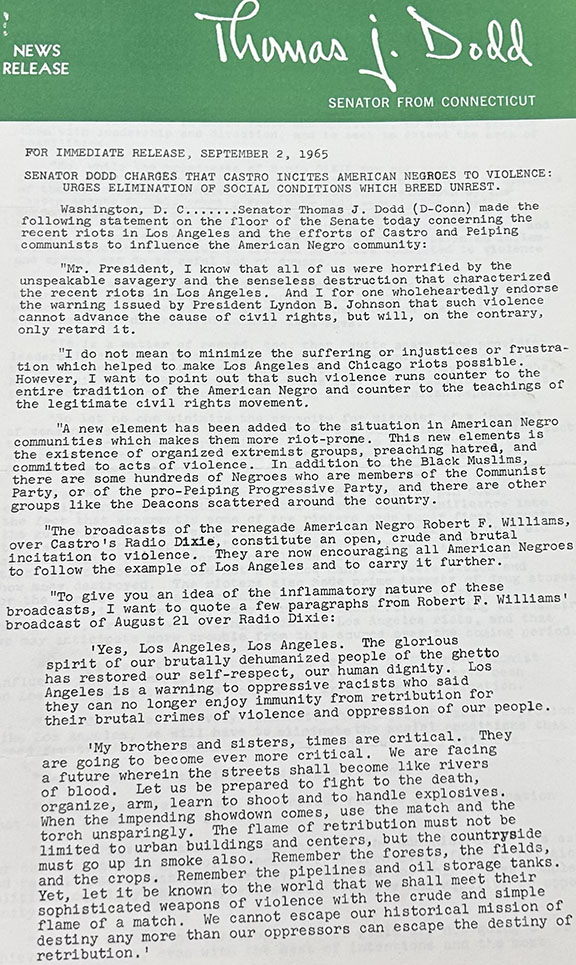
News release from Thomas J. Dodd, September 2, 1965, regarding incitement of American Negroes to violence.
Much of this can be found in the Thomas J. Dodd Papers. Dodd was an influential Connecticut Senator who supported myriad anticommunist causes during the Cold War, so I was curious about his relationships with anti-Castro organizations and Cuban exiles. Right away, I came upon Dodd’s many speeches and writings denouncing Castro as a Soviet puppet, and some directly cheered Cuban exiles seeking to remove the island’s regime. One that stood out was a September 2, 1965, press release where Dodd blamed the Los Angeles Watts Riots on Robert F. Williams, a North Carolina civil rights activist who fled to Havana where his writings and “Radio Dixie” radiobroadcasts encouraged self-defense rather than nonviolent protest.
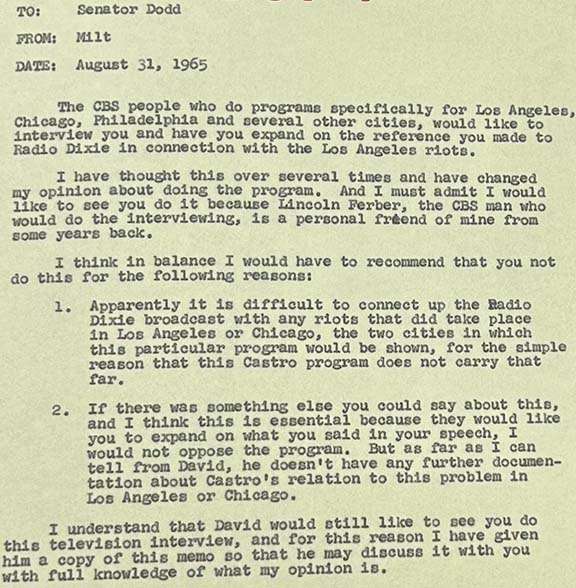
Memo to Senator Dodd from Milt regarding comments made on Radio Dixie interview, August 31, 1965
Conspiratorial right-wingers frequently summoned Williams as proof that Cuban communism influenced US civil rights activism, yet Dodd held a moderate anticommunist reputation that diverged strongly from those who put forward such claims; it was strange to find that the Congressperson agreed and insisted that Williams’s work in Cuba influenced African Americans to commit violent riots. Dodd’s public stance grabbed attention, and CBS requested an interview on this very subject. This forced his staff to intervene because they argued over whether Dodd should go onto a national forum and publicize a supposed link between “Radio Dixie” and US riots without evidence.
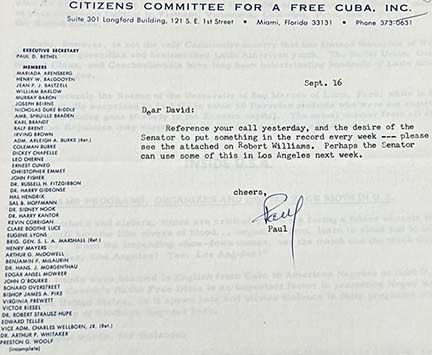
Correspondence to David from Paul on Citizens Committee for a Free Cuba, Inc. letterhead, September 16
Dodd’s Papers reveal that anti-Castro organizations including the Citizens Committee for a Free Cuba (CCFC) responded positively to Dodd’s unfounded allegation. The CCFC brought together leading anticommunist activists ranging from Clare Boothe Luce and Edward Teller to Victor Riesel and Edgar Ansel Mowrer and blamed US social and cultural issues on Cuban communism. Hoping to know more about Williams and Cuba, one of Dodd’s assistants called CCFC executive secretary Paul Bethel about “Radio Dixie,” and Bethel gladly provided Dodd’s office with their materials on Williams. This demonstrates that Dodd’s office had a cordial relationship with the CCFC, illustrating how anti-Castro organizations assisted anticommunist Congresspersons.
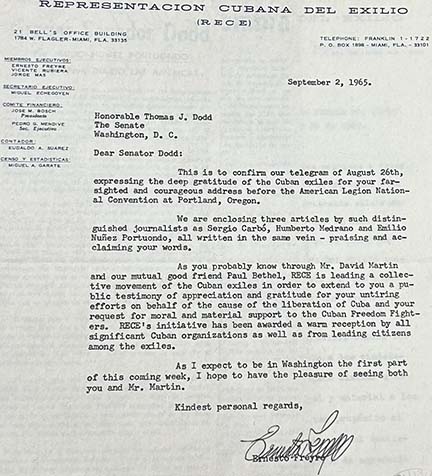
Letter to Senator Dodd from Ernesto Freyer thanking him for speaking to the American Legion National Convention in August 1965, September 2, 1965.
Cuban exiles also cultivated these relationships. Dodd’s Papers hold a handful of letters from Cuban exiles who cheered Dodd for his vocal opposition to Castro. José Bosch of the Bacardi liquor company was just one exile who thanked the Connecticut Senator for denouncing Cuban communism. Cuban exile organization Representación Cubana del Exilio [Cuban Exile Representation, RECE] both encouraged Dodd and gave the Congressperson’s staff various materials that could help Dodd make additional anti-Castro speeches. One reason I have found an ample number of Cuban exiles’ writings throughout the United States is that RECE, CCFC, and others disseminated those materials with the help of likeminded Congresspersons.
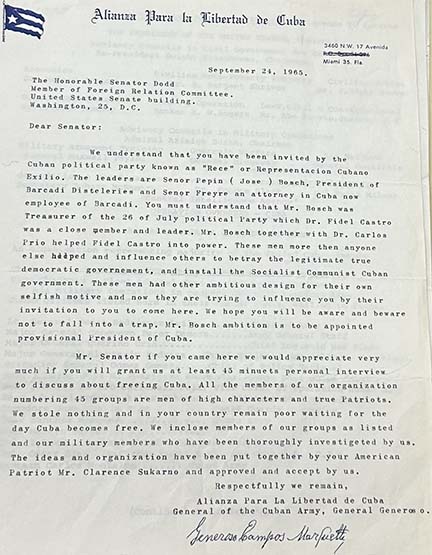
Letter to Senator Dodd from General Generoso of the Cuban Army on Alianza Para la Libertad de Cuba letterhead referencing an invitation from Pepin Bosch and Ernesto Freyer of the Cuban political party Representacion Cubano Exilio, September 24, 1965.
Dodd’s Papers also shed light into another aspect of my research: divisions among Cuban exiles. Even before the disastrous Bay of Pigs fiasco of 1961, exiles competed to secure the US government and US public’s support for their competing anti-Castro activities, severely undercutting the possibility of a unified movement. As a result, exiles regularly wrote Congresspersons and published articles denouncing their rivals as inauthentic, incapable, or even communist. At the same time that the CCFC and RECE were helping Dodd’s staff, Generoso Campos Marquetti with the Alianza Para la Libertad de Cuba [Alliance for Cuba’s Liberty, APLC] wrote the Congressperson. Marquetti warned Dodd against helping RECE and Bosch based upon how they had opposed the previous dictatorship of Fulgencio Batista whom Castro succeeded. APLC was another exile organization who kept alive longstanding grievances about fall of Batista and the rise of Castro, thereby hindering a universal movement to retake the island.
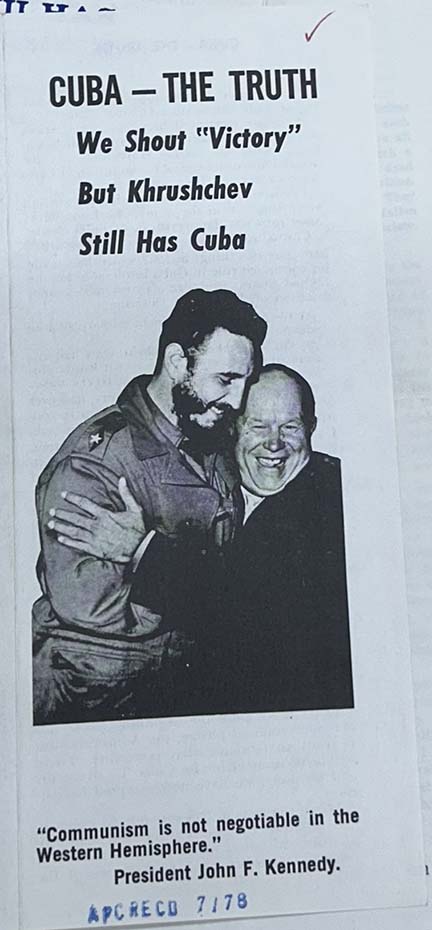
Pamphlet, “Cuba – The Truth. We Shout “Victory” But Khrushchev Still Has Cuba”, undated.
One of the most surprising finds, though, did not come from the Thomas J. Dodd Papers but the Alternative Press Collection. Elsewhere, I have often found Cuban exiles who reached out to right-wing organizations in order to raise financial and material support. For this reason, the staff allowed me to peruse the Alternative Press Collection’s various folders, specifically those for the Citizens Anti-Communist Committees of Connecticut. Like their compatriots across the United States, Connecticut citizens launched anticommunist organizations that reproduced the writings and allegations of regional and national outlets. For this reason, the Citizens Anti-Communist Committees of Connecticut folder happened to have a pamphlet published by the Committee on Pan American Policy (CPAP), a right-wing organization that in the late 1970s merged with the conspiratorial John Birch Society. CPAP spent two decades focused on alleged communist plots in Latin America, and here I found one of their popular pamphlets, “CUBA – THE TRUTH: We Shout ‘Victory’ But Khrushchev Still Has Cuba.” The pamphlet encouraged US citizens to oppose Castro’s regime, and this is certainly why it was distributed by Connecticut’s anticommunist organizations.
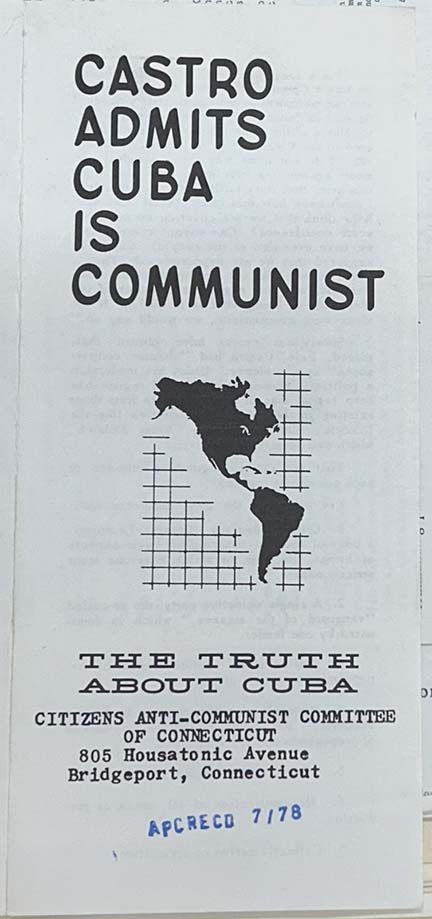
Pamphlet, “Castro Admits Cuba is Communist. The Truth About Cuba.” Citizens Anti-Communist Committee of Connecticut, undated.
However, what I did not expect to find was a second pamphlet, this one titled, “Castro Admits Cuba Is Communist.” This pamphlet was produced by a well-known Cuban exile organization called The Truth About Cuba Committee (TACC). Led by Luis V. Manrara, TACC distributed anti-Castro materials, deployed speakers, and lobbied multiple US Congresspersons in opposition to Cuban communism. At first, this pamphlet does little more than reinforce what we already know about various exile groups. What makes this pamphlet stand out, though, is that it was stamped with the address of the Citizens Anti-Communist Committee of Connecticut based in Bridgeport. Not only did TACC mail its pamphlets from its Miami headquarters to Connecticut but the state’s anticommunists distributed TACC’s publications. This pamphlet in the Alternative Press Collection thus illustrates how local anticommunists amplified the work of Cuban exiles.
Further research might uncover even more materials about how the Cuban Revolution reverberated in Connecticut. Though my project focuses on those opposed to Castro, an investigation into those who supported the Revolution might show the other side of this history.
The following post is by Brandon Hurst, PhD student in UConn’s Department of English. His research interests include Nineteenth Century British and American Literature, Book History, and Digital Humanities and Media Studies.
The Wayne S. Franklin Collection of early American works and reference materials consists largely of books published and printed during the nineteenth century—including novels, histories, and autobiographical/biographical accounts—assembled by the American Studies and literary scholar and faculty at the University of Connecticut, Wayne S. Franklin.
Wayne Franklin was a University of Connecticut Professor of English and Professor of SCI/American Studies from 2005 to 2026; he was regarded by his colleagues, students, and all who know him as a generous, kind, and encyclopedic scholar and teacher. Franklin arrived at the University of Connecticut to serve as director of the American Studies program and was chosen head of the English department in 2009. He authored the two-volume, definitive biography of James Fenimore Cooper: James Fenimore Cooper: The Early Years (2007) and James Fenimore Cooper:The Later Years (2017). Both volumes were Choice Outstanding Academic Titles. During his illustrious career, he authored or edited another 12 books (with an additional 2 authored books in progress upon the donation of the collection), including a study of early American travel writing, Discoverers, Explorers, Settlers (1979), and a study of Cooper’s frontier fiction, The New World of James Fenimore Cooper (1982). He founded the University of Iowa Press’s “American Land and Life” series in 1990, for which he edited 30 books. Franklin also served for 20 years as an editor of the Norton Anthology of American Literature and served as a reader for several university presses. During his career he was a Mellon Foundation fellow (1981), Guggenheim fellow (2004), and awarded an American Antiquarian Society-National Endowment for the Humanities grant (1994).
Many of the items were collected for Franklin’s research and writing on James Fenimore Cooper, especially his two-volume biography of the novelist. Materials include early editions of works written by J.F. Cooper, his family, and his literary contemporaries; those providing context on Cooper’s historical sources, the contemporary socio-cultural landscape and literary milieu, or used for historical reference by Franklin; those owned by members of the Cooper family; and miscellaneous items. The collection has been arranged into three series, following Franklin’s own groupings and the installments in which they were received.
Presently, finding aid descriptions are only available for items in the first series, which I spent this summer assembling. This first series contains two subseries: early and first editions of Cooper’s works published in the U.S., England, and Continental Europe, and works owned and/or authored by the Cooper family. The first subseries, which Franklin assembled for research on Cooper’s publishing and printing history and Cooper’s navigation of the still emerging and tenuously enforced transatlantic copyright laws, makes up the bulk of the series.
The second series, received in 2022, includes works related to J.F. Cooper and early American literature more broadly, with the bulk of items related to maritime or naval literature and history. The third series, donated in 2023, contains largely reference materials acquired during Franklin’s research for the Cooper biographies and early American literature.
While the first series may, on initial glance, seem of interest mainly to scholars of J.F. Cooper, what I found most intriguing during my time working with the collection is that these earlier editions, initially collected for a biography and historical background on their author, held an abundance of insight into so many more individuals—the owners, the printers, the publishers, the users, (and, in the future, researchers), illustrating the importance of texts and literature in our lives and relationships. The material evidence of both the texts creation and these artifacts afterlives reveals much about the way literature mediates between the individual and sociocultural dynamics.
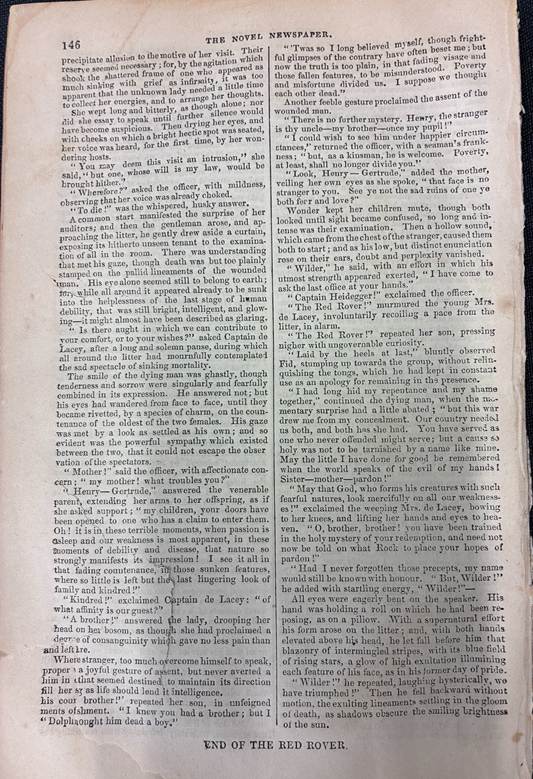
Perhaps the best, or at least one of the more interesting (to me), examples of this dynamic comes not in the form of any officially published edition of Cooper’s works. Rather, it was the paper-bound, cheap reprinting of Cooper’s The Red Rover by the London-based “Novel Newspaper” publication. The series republished novels cheaply, but did so by violating copyright. This inverted the more conventional practice, gestured to in the preface to the very first volume of the series (which contained “five of Fenimore Cooper’s novels: The Pilot, The Spy, The Pioneers, The Last of the Mohicans and Lionel Lincoln”), in which American penny newspapers and other publishers of inexpensive literature exploited the differences in English and U.S. copyright laws to reprint British novels in the U.S. without paying for the copyright, meaning their author’s received no compensation (Webby).
The Red Rover. A Tale. London: J. Cunningham, 1842. “Novel Newspaper”, 1842, /repositories/2/archival_objects/316176. Wayne S. Franklin Collection of early American works and reference materials, 2021-0097. Archives and Special Collections, University of Connecticut Library.
While the publishers behind this scheme justified their practice on moral and ethical grounds (and carried out their publishing quite ostentatiously, advertising in well-circulated journals their cheap reprintings of many American—and some British—works), what is particularly illuminating is that they also claimed that their work carried out a social good because it made Cooper’s novels more widely accessible and that the works would subsequently have an ameliorative influence on this newly reached class of readers. They wrote in the preface:
“Nor will Mr Cooper regret the wide circulation throughout England of the five novels contained in the present volume; since, being mainly on subjects of American history, they will tend to diffuse a better knowledge of his country amongst a class of persons whose national prejudices are even yet stronger than their reason.
Such practices and rhetoric point towards the shifting economics and politics of literary and cultural access in the nineteenth century. Book ownership, or lending, and printing was undergoing a large transformation in the eighteenth and nineteenth centuries with new technologies, changing legal practices, and increasing literacy rates all impacting who read, what they were reading, and in turn, what was being written and why—and artifacts like the “Novel Newspaper” reprinting of Cooper’s Red Rover provide us with examples that can teach us more about these dynamics.
Further revealing evidence about reading practices in the period, and the afterlives of these physical copies, can be found in the presence of bookplates in some of the volumes. (Notable bookplates in the collection include that of Henry A. Muhlenberg, son of U.S. Congressman Henry A. P. Muhlenberg; the American Antiquarian Society also holds bookplates from Muhlenberg. Another belongs to Dr. Noël J. Cortés, an early-20th-century collector of French manuscripts whose own collection is held at Yale. A third set belongs to Sir Frederick Milner (1849-1931), a former member of British parliament and a baronet).
These material markers of ownership personalize the text to the person, marking the book as one’s own while also identifying the individual as a “book owner” and “reader”. At the same time, by physically impressing or pasting a stylized signature and design, the physical book and content of the “text” become bound up with the owner’s identity. Together, owning the book and the intimate, process of materially making the book one’s own are acts of self-expression and identity-making.
The practice of adding a bookplate to a book is a curiously private and public act. The need to mark a text as one’s own implies that other readers may come across the text, and we need to identify our copy as ours—an inherently social practice. At the same time, the bookplate is pasted inside the book, and often kept in a private library, perhaps never to be seen by anyone. So not only does the bookplate signify an external act of identity/self-crafting, but it also reflects the very dynamics of identity itself: something deeply internal but defined by its capacity to be perceived and recognized by others.
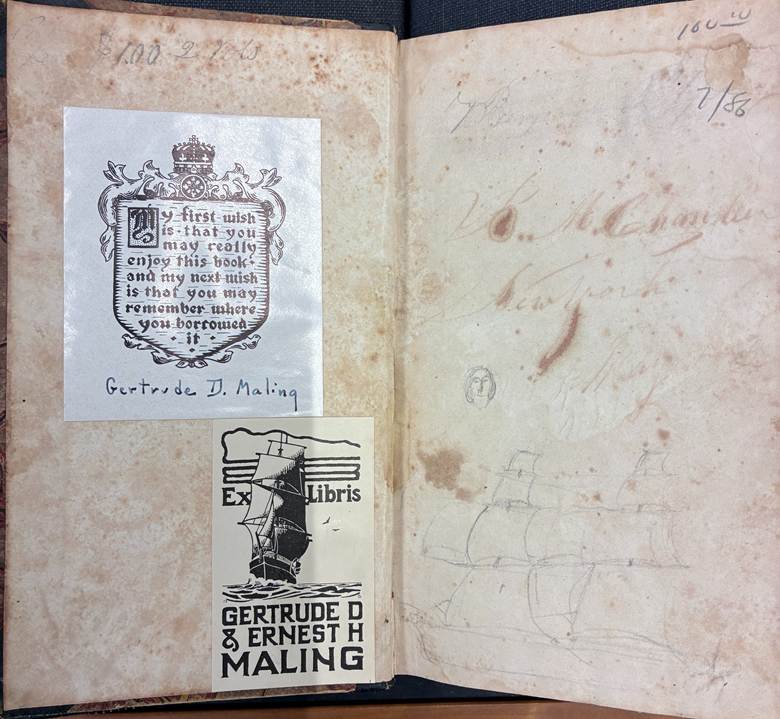
Such practices can, we may intuit, create or become part of deeply affective relationships. Not only do we form intimate relationships with literature and the physical copy, but the act of ownership can become part of the rituals and interactions that help establish and/or cement interpersonal relationships. For instance, in the collection is a copy of The Bravo that bears two bookplates in each volume. One, a bookplate signed “Gertrude D Maling”, which reminds borrowers to return the book to its owner (again, the dually social and personal dynamics of book ownership and reading), and the other, a bookplate indicating the shared ownership of the book by her and her husband: Ex Libris Gertrude D. and Ernest H. Maling. The couple’s bookplate marks the book as belonging to a shared library—a manifestation of their shared lives together in the form of shared property—giving form, expression, and reaffirmation to a shared identity as married couple. At the same time, the presence of Gertrude’s own bookplate and her signature reminds us that her individuality is not erased in their marital union. She owns her own books, shares them with people she cares about, and is her own person; her reading/book owning practices give a material form to and outwardly express her multidimensional identity.
The Bravo: A Tale. Philadelphia: Carey & Lea, 1831. 2 vols. (Copy 2), 1831, /repositories/2/archival_objects/316187. Wayne S. Franklin Collection of early American works and reference materials, 2021-0097. Archives and Special Collections, University of Connecticut Library.
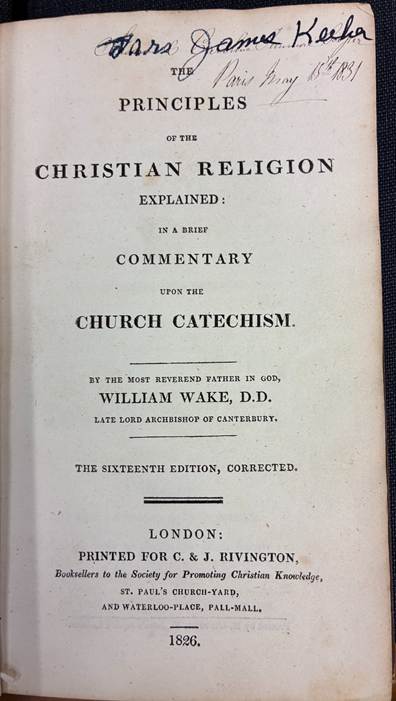
Gertrude’s bookplate reminds us that sharing books is another form in which books establish and reaffirm our affective, interpersonal relationships, a cultural practice we see further evidenced by the inscriptions many of the books bear, especially those in subseries two: the books owned and authored by the Cooper family. For instance, William Wake, D. D.’s The Principles of the Christian Religion Explainedcontains a signature marking the shared ownership of the book by the two Cooper sisters (inscribed “Susan & Caroline Fenimore Cooper | Paris May 15th 1831”), functionally reifying the sibling relationship in much the same way the Malings’ bookplate does for the marital connection. While this signature is partially overwritten, the evidence of their shared ownership of the book and the relationship it symbolized remains legible. Indeed, the palimpsest-like aspect highlights the accumulation of personal histories that the material book accumulates and records.
William Wake, D. D. The Principles of the Christian Religion Explained: in a Brief Commentary upon the Church Catechism. 16th edition “corrected.” London: C. & J. Rivington, 1826. Inscribed “Susan & Caroline Fenimore Cooper | Paris May 15th 1831”, 1826, /repositories/2/archival_objects/316140. Wayne S. Franklin Collection of early American works and reference materials, 2021-0097. Archives and Special Collections, University of Connecticut Library.
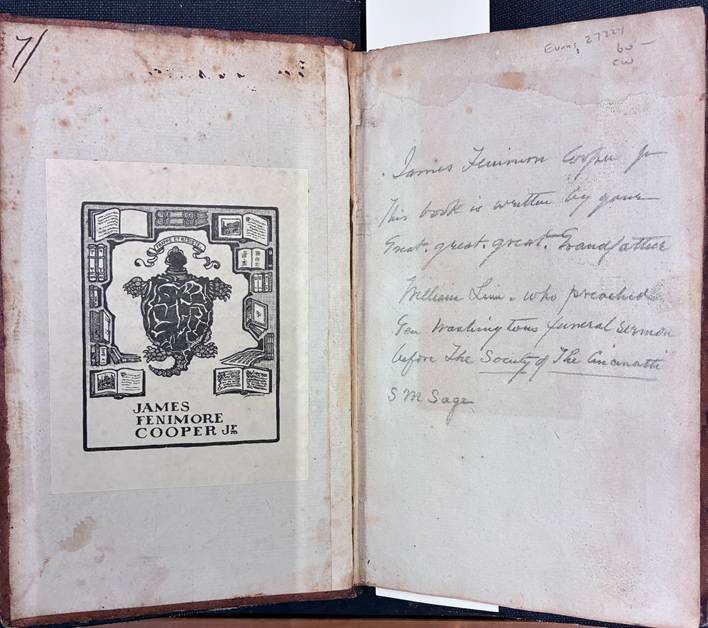
Many others in the series are gift copies (like this copy of Rural Hours, gifted on the winter solstice of 1993 “To Chris Schulty | Woodswoman | and | WYLDE writer”), with several being gifts between family Cooper family members, . The inscriptions mark the intimate, affective act of gifting, and the relationships these moments symbolize, reifying the familial bonds connecting one another, as demonstrated by Susan Fenimore Cooper’s gifting of her Rural Hoursto her sister Caroline, the copy of Pages and Pictures from the Writings of James Fenimore Coopershe gave to her brother-in-law H.F. Phinney, and the copy of Howitt’s Home and Haunts of the Most Eminent British Poets she received from Phinney. The fact that these books are owned and authored by family members accentuates these implications. As seen in Susan Manning Sage’s gift to J.F. Cooper Jr (great-grandson of J.F. Cooper), not only do inscriptions mark the personal moments and tie identity to book ownership, gifting, and receiving, but these books authored by self or a family member act as extensions of our self or physically instantiate a reminder of a shared lineage, link, and identity.
William Linn, D. D. (1752-1808). Discourses on Signs of the Times. New-York: Thomas Greenleaf, 1794. Bookplate of JFC Jr. [1892-1918], JFC’s great-grandson. Front flyleaf bears inscription to JFC Jr. signed by “S. M. Sage”, Sarah Manning Sage [Fenimore Cooper] (1841-1915), 1794, /repositories/2/archival_objects/316141. Wayne S. Franklin Collection of early American works and reference materials, 2021-0097. Archives and Special Collections, University of Connecticut Library.
To gift books in such a way can be “read” as gifting a part of the self, and a part of the self that is forever linked to the recipient. In some ways, it is to materialize and then gift the relationship itself in a material form.
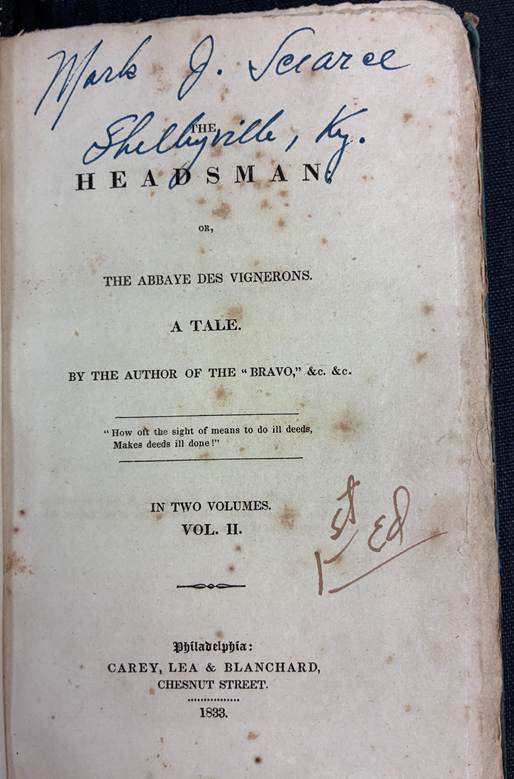
This deeply personal relationship with books and reading practices can take on a poignantly political valence as well. For instance, two copies bear the signature of Mark J. Scearce (the inventor of the Mint Julep cup): The Headsmanand Sketches of Switzerland; By an American. Alongside Scearce’s signature is his inscription of his locale, Shelbyville, Kentucky, where he lived in the early to mid-twentieth century. Considering this context, Scearce’s owning and ostentatiously autographing the pastedowns of at least two first-edition novels by Cooper—a New York Yankee—can be read as a politically charged act of inscription. This is especially the case for a book like The Headsman, which Franklin describes as “intent on critiquing hereditary rank in all its forms. Every instance of it entailed a curse, if not on the heir then on humanity at large” (“Republican Principles” 141). Like with the bookplate, the signatures in the books tie the identity and self-expression of the Southerner with the texts of a Yankee (and, notably, two texts inspired by that Yankee’s experience in Switzerland—the second being Sketches of Switzerland, which itself was critiqued “by the European press for overzealously defending American republican principles” (AAS)). Scearce’s signatures and ownership become implicit expressions of political identity—intimately private yet externally material acts—articulating republican and egalitarian ideals in a region and time period in which race and class politics were especially fraught and tense. Yet Scearce explicitly identifies himself as a Kentuckian, inscribing his hometown alongside his signature. But doing so in these specific books reveals how politically and personally complicated that regional identity could be. In the evidence of these two signatures, we can see the role that literature and the material book play not only in an individual’s navigation of the complex dynamics of identity-crafting and self-expression, but also in the additional meaning this takes on amid the sociocultural and political climate of a given period and region.
The Headsman; or, The Abbaye des Vignerons. A Tale. 2 vols., 1833, /repositories/2/archival_objects/316197. Wayne S. Franklin Collection of early American works and reference materials, 2021-0097. Archives and Special Collections, University of Connecticut Library.
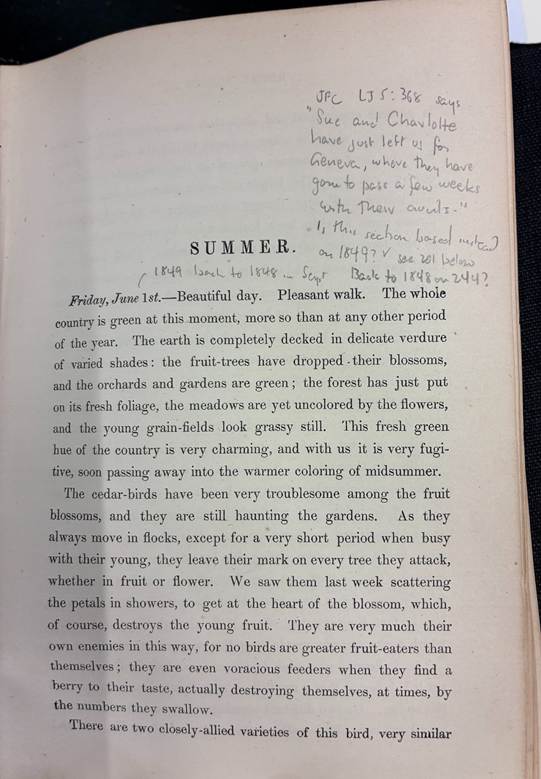
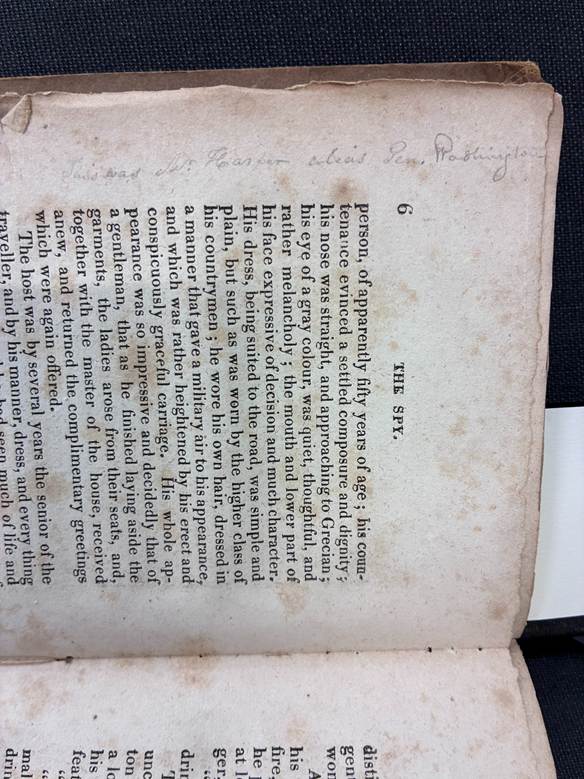
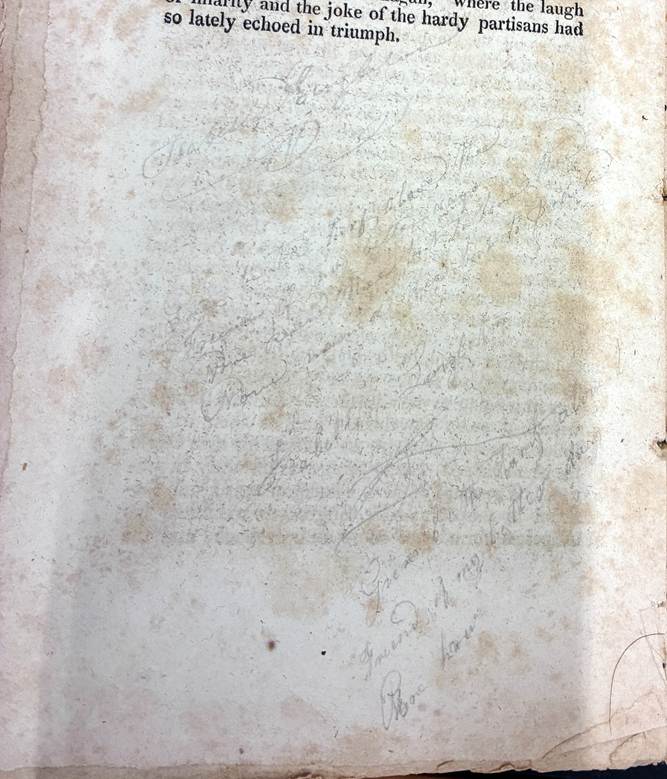
I’d like to end this blog with a brief aside about the variety of uses and reading habits on display in just this series of the collection. One copy of Susan Fenimore Cooper’s Rural Hours bears markings and annotations from Franklin himself, offering a fascinating glimpse into a research- and scholarship-oriented reading and marking practice. Franklin’s annotations, cross-references, and systematic markings contrast with the marginalia by other readers, which range from unrelated poetry and drawings (like those shown below), to sporadic markings or annotating of passages which appear to have been marked for their personal or seemingly universal relevance, important plot moments, and corrective emendations. So, while the series may seem, on its surface, to be primarily about J.F. Cooper, it puts on display so much more about our relationships to books—material and conceptual—and the ways books mediate our relationships with each other and to larger sociocultural dynamics.
[Susan Fenimore Cooper], Rural Hours by a Lady. New York: George P. Putnam, 1850., 1850, /repositories/2/archival_objects/316130. Wayne S. Franklin Collection of early American works and reference materials, 2021-0097. Archives and Special Collections, University of Connecticut Library.
The Spy. NY: Wiley and Halsted. 1822. “Third Edition.” 2 vols., 1822, /repositories/2/archival_objects/316143. Wayne S. Franklin Collection of early American works and reference materials, 2021-0097. Archives and Special Collections, University of Connecticut Library.
I hope my discussion (and digressions; my many thanks to the readers who’ve indulged me to this point) has piqued some of your interests. And should you wish to explore the collection, following up on idea or item that sparked your curiosity, don’t hesitate to schedule an appointment in the reading room!
Webby, Elizabeth. “The Novel Newspaper and Its Role in the Transmission of American Fiction to Australia.” Reading Across the Pacific: Australia-United States Intellectual Histories, edited by Robert Dixon and Nicholas Birns, Sydney University Press, 2010, pp. 167–76.
This writing is byAnna G. Joujan, CMA, CPT, MLIS, the recipient of a 2026 Archives & Special Collections Research Grant to study the use of non-traditional book formats with children experiencing vision, hearing, and physical impairments, ADHD, and Autism. Joujan is a Bilingual Medical Assistant/Phlebotomist at Lifespring Pediatrics in Chattanooga, TN and a pre-nursing student at Chattanooga State Technical Community College. Joujan was the recipient of a Billie M. Levy Research Grant in 2008.
I have always been fascinated by the human body. My first memory of being aware of my own was when an elementary school classmate alerted me to the fact that I had “muscles like a boy.” I was embarrassed, wishing I had the delicate, feminine limbs of my little sister instead of my own. I would soon discover the power of these same muscles, and learn that in harnessing, strengthening, and pushing them, I could also focus my brain, calm my nerves, and train myself to push through hardship in all areas of my life. I learned that a powerful motivator to me, in facing the demands of any given day, is the reminder that it will not get easier, but that I will get stronger. I cannot remember where I heard this, or from whom, but I did find a similar quotation, via an online search, from Asma Naqi: “A secret life taught me: it doesn’t get easier, you become stronger.” (wisefamousquotes.com)
When I became a professional educator, it came naturally to incorporate movement into my own lessons, in the library and in French classes. I understood the children who struggled to sit still, and I made lesson plans that included song-and-dance, games, and manual tools. I sought out studies that others have done about whole-body considerations, and learned that there are many. I am certainly not pioneering this idea.
I am, however, in a different era than the one in which past scholars, educators, and artists were in. As such, I have a different lens through which to consider these same topics: a lens that has been informed by the age of the Internet, AI, an ever-shifting political climate, immigrant and migrant upheavals, and other modern considerations. In order to adequately address the needs I see before me, in my pediatric clinic workplace, in my rural homesteading community, and in my continuing education, I must take these considerations into account.
What, then, I ask, do the individuals and communities I see before me need?
What do the insights provided by those who have gone before me have to offer to those I see now?
Alternative Approaches to Educating
One modern thinker who is asking some of these same questions as he addresses the state of educational systems is Aditya Vishwanath. In an interview with Kelly Corrigan on her podcast, “Kelly Corrigan Wonders,” Vishwanath describes the traditional method of schooling in India as heavily memorization–focused. And even though he thrived academically in this setting, due to his remarkable memory, his life work now is to campaign for a system that recognizes the value of creativity more than memorization. His reasoning is that considering the technology we have available to us, and the tools that allow for rapid calculations and AI solutions, it makes little sense to spend the majority of one’s education memorizing methods that can artificially be done much faster than is possible with the human brain. He concludes,
“So, in a nutshell, it is taking something as transformative, world transformative as AI, to wake us all up and say, we’re not teaching the right things . . . I’ve been doing a lot of work in the AI literacy space and the education reform space, even in the United States in public schools. And we’re seeing the same thing happening. A lot of people are in panic, throwing darts at a wall, trying to see what sticks without any real first principles thinking, without a more rigorous, intentional approach towards how do we systemically ask a broader overarching question of what should we be preparing our young people with, such that they are employable, happy, self-sufficient citizens tomorrow.”
In this interview, Vishwanath does not offer concrete ways in which to promote this creative incorporation. So I would like to do so now:
If a textbook is doing nothing for a struggling student, for instance, why not hand her the supplies (printed out from the Brooklyn educational manual website) needed to make a book with the instructions to write, and put together, your own textbook, that teaches the information in a way that you’d want to learn it? This textbook need not be a “book” at all, in the traditional sense. Along the lines of the books in the Artists’ Book Collection, it could look like a puzzle, such as State of the Union, by Pfeiffer. When I experienced this work, I wore gloves, following the instructions of the archivist, who walked me through the initial opening-up of this puzzle, which as a whole makes an American flag. I was careful to pick up one block at a time, unfolding it with care, reading the words printed on the front and the back of each one before refolding the accordion fold and placing it back in its slot. The blocks are categorized: “Economy,” “Health,” and “Business” are the short lines of the red and white stripes. “Education” is a long white stripe. Then “Politics,” “Environment,” and “Society.” Printed inside each of these is a collection of quotes about that topic, some of which are familiar to me, by poets, writers, and thinkers. The stars are a brief manifesto about the current state of the union. I read, “At the moment the ‘we’ (in the ‘We the people . . .’) has given way to a troublesome ‘us’ and ‘them.” The experience of handling this work of art is not unlike that of undertaking a delicate procedure on a patient in the clinic, and the sort of learning it offers is a far cry from any traditional educational texts.
If an effort is being made to solve a particular problem, or master a particular subject, and it seems like the student is just banging their head against a wall, why not take a break altogether, regardless of where in the expected day’s schedule this wall happens to fall? Countless examples from history have proven that sometimes a break is exactly what the brain needs in order to find clarity. In a recent lecture given about the physicist Freeman Dyson, a creative thinker named Andy Patton described what happened when he was working on a particular problem concerning the laws of quantum dynamics. As he explains it:
So he made that his work. He spent months … doing endless calculations by hand on giant stacks of paper at his desk. But he couldn’t find a solution…So he let his brain shut off. He switched from creative output mode, banging his head against the wall, to recover, rest, and incubate mode. So beneath the surface of his conscious thought, something was transforming. Something was about to rise through the surface of the soil. As Dyson spent days staring at the Pacific, walking up and down the beach, and just, as he said, bumming around, insights were assembling themselves in the silent dark of his unconscious mind. So at the end of the California getaway, he got on a bus and rode back to Princeton, and that is when the insights started to hit. He was staring out at the window on the prairies of Kansas, in the dark, and suddenly everything just clicked…The new growth didn’t break through the surface of the ground until after he rested. He took a breath, he let his mind roll along, and suddenly the whole thing was crystal clear.
If a student is arguing that their studies don’t mean anything in real life, why not let them do something that does? Aditya Vishwanath, a pioneer in the world of education is running a secondary school that incorporates hands-on learning in actual career fields, as an alternative to traditional classroom learning. These students learn to repair airplanes, install plumbing systems, and build houses. As he explains in an interview with Kelly Corrigan,
“And so we build a house every year for Habitat for Humanity. And again, if we ever get students who are a little disconnected from the project, all we have to do is go to the local area where folks are either in some of the tiny homes that we also build, or they’re actually going to be in the Habitat community. And we just have them meet the people who are going to live in the house. And it is an absolute motivator. They understand that this is a family that may or not have housing otherwise. And only then are they reinvested, which we’ve done a couple of times, it’s fantastic.”
Physical, Mental, and Social Considerations
The examples I have given so far can easily be imagined, potentially useful for any average student. For many students, however, there are specific challenges that make traditional classroom settings especially challenging:
Language, for instance–when a student is learning in a place that does not use the native tongue of his or her household. These children are often seen as slow, or behind, when in fact they are often highly intelligent, learning how to function in multiple languages while their peers are learning in the language they easily acquired from infancy.
Other children are faced with learning disabilities, such as ADHD and Autism Spectrum Disorder.
Still others have physical handicaps that affect their sensory abilities, such as hearing, visual, or physical impairments.
For these sorts of challenges, there are models that are addressing this in very practical ways. One is the Montessori Method, started by Maria Montessori in the early 1900s. In 1995, Joyce S. Pickering, in an article entitled “Montessori and Multisensory Structured Language Therapy Applied to At-Risk Children,” outlined ways in which children at risk for “specific learning disabilities” (5) benefit from non-traditional instructional methods. She begins the article with the clarification that “Learning disabled children have average or above average intelligence; they possess the visual acuity needed to see and the auditory acuity needed to hear; they are not physically handicapped, mentally retarded, or emotionally disturbed.” While I appreciate this acknowledgement of the intelligence of the children she is referring to, I would expand the value of non-traditional methods to children who do have actual physical handicaps, intellectual delays, or emotional struggles.
One of the specific methods she makes a note of includes geometric shapes in metal frames. While reading the article, I envisioned a sort of stencil, and verified this with an internet browse for images. This simple addition of tactile tools allows children to combine the touch of the shape with the limited auditory and visual lesson that a more traditional educational setting may include.
After describing aspects of this multi sensory approach, and detailing its benefits, Pickering concludes that, “The normal child quickly begins to associate visual symbols and sounds; remembers information after several exposures; grasps the concept of blending; begins to use ‘key words’ in a word pattern to help read other words (hat, cat, sat, etc.); begins decoding and comprehension; and, begins writing. An at-risk child has difficulty in sound-symbol associations, blending, and using ‘key word’ patterns to generalize other words. Not able to master the code (emphasis mine), the at-risk child relies on memory, avoids language activities (if possible); appears ‘nervous’ when asked to work with language; and struggles with written work.” (21)
When considering the value of the Montessori Movement as a whole, it is worth considering the background and, consequently, motivation of its founder, Maria Montessori. Maria herself was raised by parents who seemed ahead of their time. She considered the careers of engineering and medicine, deciding upon medicine and graduating as the first female doctor in Italy, at the age of 26. From there she went on to study illnesses in young children and, of course, education, incorporating the remainder of her life spent traveling internationally and publishing results of her research.
Historical Approaches to Learning Obstacles
As I considered the idea of physical handicaps that some students are faced with, I decided that it would be helpful to consider historical approaches to this topic. One collection I came across studied what was coined “handicapped homemakers,” conducted between the years of 1956 and 1957. This study proved fruitful for my research in two ways: one being the adaptive measures taken by handicapped individuals, and the other being the consideration of the challenges faced by the children of these handicapped individuals.
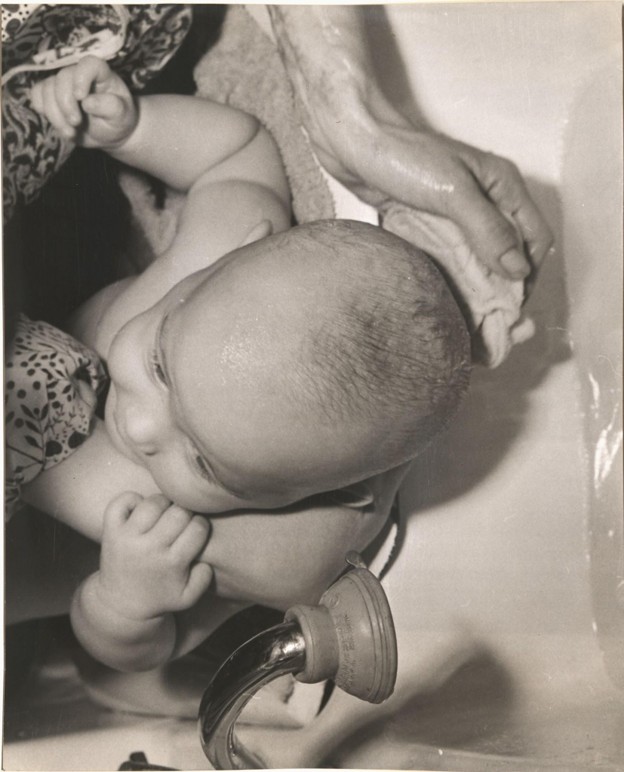
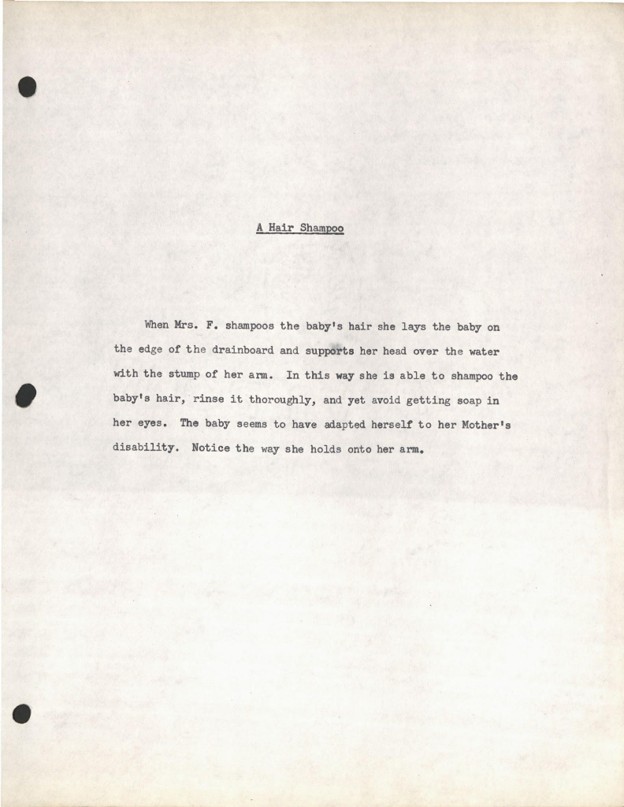
Our automated life has eliminated (for those who choose modern conveniences, at least) some of the original household difficulties that handicapped women dealt with: the labour involved in hanging items outside on a clothesline, for instance, or of washing and drying cloth diapers. So some of the types of solutions and aids that were being investigated in this study are inapplicable to modern life. The idea of adaptability and ingenuity, however, is timeless. In one image from this study, we see a woman with an amputated right arm and left side bodily burns.
She has learned how to lean her child against her right stump while shampooing his head with her left hand; the baby, meanwhile, learns to grasp onto that stump, rather than perhaps simply leaning against her forearm and hand as he would have if she had the limb available to support him.1 Her four children have the same needs any child would have of an able-bodied mother. Life does not adjust its expectations of her based upon her own limitations: rather, she adjusts her own expectations of what she will continue to do, and how she will do it.
Photograph from Handicapped Homemakers, Archives & Special Collections, University of Connecticut Library
Text from Handicapped Homemakers Collections, Archives & Special Collections, University of Connecticut Library
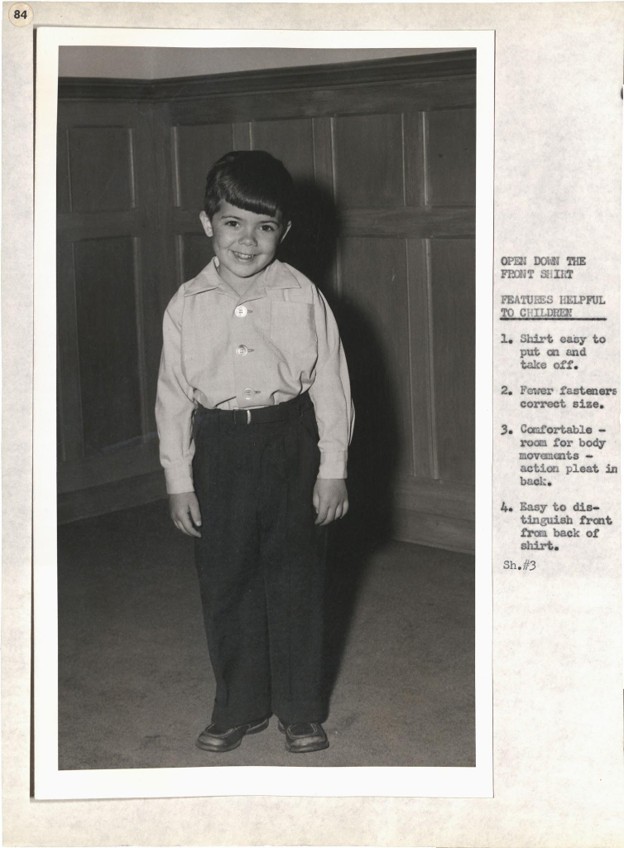
In one of these studies, the assertion was made that “Because of necessity, children of handicapped mothers often develop self-reliance, independence, and a sense of family cooperation at an early age.” One example of this independence, from the study, was in the need to begin dressing themselves at an earlier age than generally expected. In order to help with this, images in the collection show clothing designed so that children can more easily dress themselves (large buttons, fewer articles of clothing, easy to tell front from back, etc).2 The children, then, are able to learn this skill of dressing due to tactical aids, similar to the Montessori Method’s tactical aids for learning.
Photo from Handicapped Homemakers Collections, Archives & Special Collections, University of Connecticut Library
As the child of a handicapped parent, I can attest to this early development, which I witnessed in my younger siblings. When my mother was paralyzed, I was already independent enough (due to both age and the fact that I had been attending boarding school since the age of 5) that her handicap did not have as great of an influence on my early childhood development. It did, however, significantly affect my adolescence and teenage years. I consequently had a personal interest in this study, and found myself revisiting childhood memories while conducting my research.
One of the sections of particular interest to me, due to the focus of my research, was a project entitled, “Play Experiences Handicapped Mothers May Share With Young Children.” Many of the ideas given here (such as building a sandbox, sending bathing-suited little ones out into the lawn with a sprinkler, singing together, or making finger paint) are ideas any caregiver, able-bodied or not, could easily undertake. One of my own mother’s playtime inventions came to mind as I read this pamphlet: once she had mastered her wheelchair, she would zip down our zigzag-curved driveway, with a “Watch me!” While perhaps not the most readily-sanctioned of activities, I do suspect that my siblings and I benefited somewhat from the training in facing fears that we developed from our experimentation with our mother’s “play experiences,” as we learned how to steer her wheelchair and to “pop a wheelie” which she also demonstrated.
Present Day Hands-On Applications
An examination of the value of merging body and brain leads naturally into hands-on application. How, then, do I see the tactics examined in this paper being successfully applied in individuals today?
One of my tasks as a pediatric nurse is conducting vision tests. For this we use the standard Snellen eye exam. Many of the children I do this with are just beginning to learn how to read and, oftentimes, I find the immigrant children hesitant and underconfident when it comes to reading letters out loud, even if the parent assures me the child can read well. Considering the point I made earlier in this paper, concerning the intelligence of children who are learning in a culture that speaks a different language than that of their home, I decide to adjust my own expectations when conducting the Snellen. This child has to remember not 1, but 2 different names for each letter as they learn to associate the correct sounds for both languages. So perhaps a struggle to read a particular letter stems from the question, “Which language should I use?” or from the difficulty in memory recall when twice as much is being remembered as a single-language child.
The next time I am beginning a Snellen exam, then, and the child hesitates, I think of this struggle. I suggest that she give me the sound instead of the name. “Mmm,” she promptly responds. I point to the next: “Ah.” Then “sss.” We are on a roll. She passes the test with flying colors, now beaming with confidence. Since the purpose of this exam is to assess vision, rather than the child’s ability to read letters, I am not compromising the exam at all by making this alteration. I am, however, allowing the child to use her sense of hearing, with the formation of sounds, instead of requiring her to rely solely on her memory of words that she may struggle to associate with anything suitable to help them cement in her brain.
In another real-life scenario, I conducted my own situation in which children are making their own books. Incorporating my hobby of visual art (mostly pencil or ink drawing, but other mediums as well) into my experience as a writer and school librarian, I planned a summer day camp in my home, advertising it in my neighborhood, community, and friend groups. It was called “Creative Pages,” and the idea was to have the children spend the day reading award-winning picture books for inspiration, writing their own stories, illustrating with their own artwork, and then putting it all together into a book. I researched bookmaking techniques, found places to purchase discounted materials, and scheduled the sessions. Afterwards I was confident that I did well for these children, seeing the pride on their faces when they saw their own hard work come together.
This was years ago, before the existence of the Brooklyn education manual. But I see no reason why this same sort of scenario, as I did with my Creative Pages students, would not be equally as successful with a group of students making their own science, math, or geography textbooks.
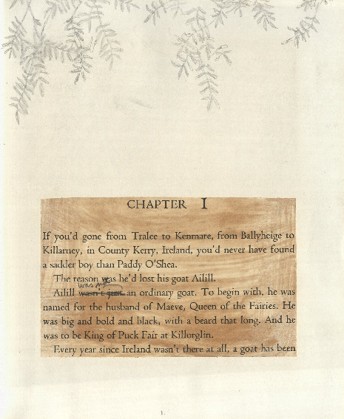
Book manuscript from the Nonny Hogrogian Papers. Archives & Special Collections, University of Connecticut Library.
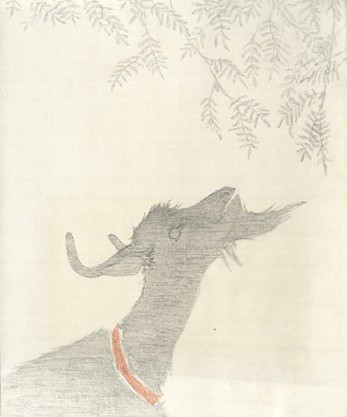
Illustration from the Nonny Hogrogian Papers. Archives & Special Collections, University of Connecticut Library.
While sitting in the library, working on this report, I overheard a conversation between two parents whose children are playing in the reading nook. They were speaking of their efforts to expose their children, at an early age, to multiple languages. One mom explains that her own experience includes 3 languages, living in one home country but raised by parents speaking a different language than that of the country in which they lived. English was the last language she learned, at the age of 6. She then mentions that she is dyslexic, but only in her 1st two languages. In English, oddly, she is not dyslexic. I cannot help but note the irony of this situation so introduce myself, ask a few follow-up questions, and request permission to include her as an example here. I cannot help but wonder if the challenges she faced, as a multiple-language child, played a role in her ability to now function exclusively in English, unhindered by dyslexia. I also suspect that she was aided in her learning ability, consciously or not, by some sort of incorporation of various senses as she navigated a challenging learning environment.
Suggested Applications of Researched Materials into Present-Day Scenarios
As I consider the value of the materials I have researched for this report, it occurs to me that a very recent educational situation could have benefited heavily from the wisdom of the past. Namely, the Covid pandemic. We are just now, 6 years since its beginning, starting to realize some of the effects this global trauma had on the learning of those in their educational years at the time. And as clearly horrible of a scenario as it was, there are ways in which it awakened us to things that needed to change. Of course there are those who suffered from the sudden isolation from their peers, and from the switch from in-class to virtual learning. But there are many others who managed to thrive, letting it be an opportunity to let go of expectations of how learning should look, and instead find ways to embrace the benefits available from a lack of schedule rigidity, from the freedom to be outside and not stuck in a classroom all day, and from the option of finding new methods available, beyond the textbook and the computer, with which to solidify a deeper understanding rather than rote memorization. When home schooling became the only option, many people realized that it could be turned into whatever each child thrived in, and let go of stereotypes of, and biases against, that option. I am by no means suggesting that children should forego traditional schools and all be home schooled. I am, however, suggesting that learning should expand outwards from the classroom, and that we should all consider ourselves lifelong learners, with the ability to learn in infinite ways and settings.
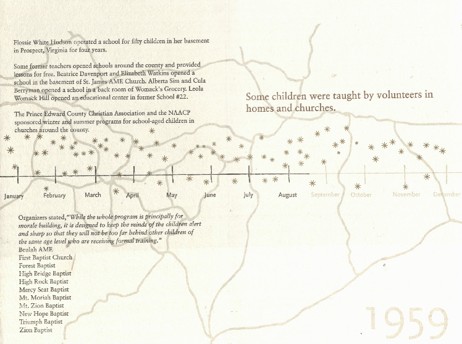
I saw this sort of expansive view in the American Montessori Society Records, in the Handicapped Homemakers files, and in the pages of the Artists’ Books. I saw ways in which those who came before us encountered unexpected challenges to learning, and found ways to thrive in spite of them. Our Pandemic is not the first time that physical school buildings have been removed as an option: one of the Artists’ Books I viewed was created as a commemoration of the Virginia school students affected when their public schools closed from 1959 to 1964, rather than obey a court order to desegregate. The book is composed of newspaper article clippings, quotes from students affected at the time, 50 years later, foldout timelines of court proceedings leading up to, and during those 5 years, and reactions to the “Free School” system (non-graded, tuition-free) that was set up for white students in the interim, and accounts of alternative solutions taken by other parents and former public school teachers.
While this closure came about as a result of a terrible racism, and created greatly negative disruption to the lives of those affected, it also bred a resilience and adaptability that has shown itself throughout history. When we take the time to consider the resilience that people have shown in the past, it can offer us the vision to see that we can show the same resilience in our present day challenges, and in those that are certain to arise in the future.
Page from Unbound, by Jessica Paterson, Archives & Special Collections, University of Connecticut Library
Conclusion
I spent my first 15 years in the workforce as a teaching librarian and a French teacher. I am now a pediatric nurse. I do not think these two careers are incongruous. The brain informs the body, and I feel like the years I spent in education play into my current work in healthcare.
When my brain feels stuck, or anxious, or upset, I go for a swim. Stroke by stroke, I let my brain wander in the silence, until suddenly, inevitably, the synapses start to fire, and I have a solution, am calm, or am soothed.
Whatever an individual’s particular physical needs may be, I think we all have this ability, if we are able to tap into it, to allow some sort of physical outlet to help with the needs of the brain. Consequently, there is great value in considering methods that have been successful in the past, as well as those being used in the present. My hope is that this paper can be an entryway to help us all to begin, or continue, the process of helping those around us, and ourselves, as we let the body teach the brain.
Works Consulted
Booklyn Education Manual: Bringing Bookmaking to Your Students. 2005, booklyn.org/programs/booklyn-education-manual-2/. Accessed 20 May 2026.
Written by Jonathan Trinque, Research Services Coordinator, UConn Archives & Special Collections
The UConn Library’s Archives & Special Collections holds over 1000 archival collections. Some of these collections are well known and are used all the time for research, while others may not have been accessed since they arrived at the archives. Because of this, I thought it would be fun to spotlight some collections that I have come across that seem interesting, and that researchers have not used much or simply do not know that they exist.
Here are some other collections that I have come across that piqued my interest. I hope you find them as interesting as I do, and maybe reading about them will spark your next research project!
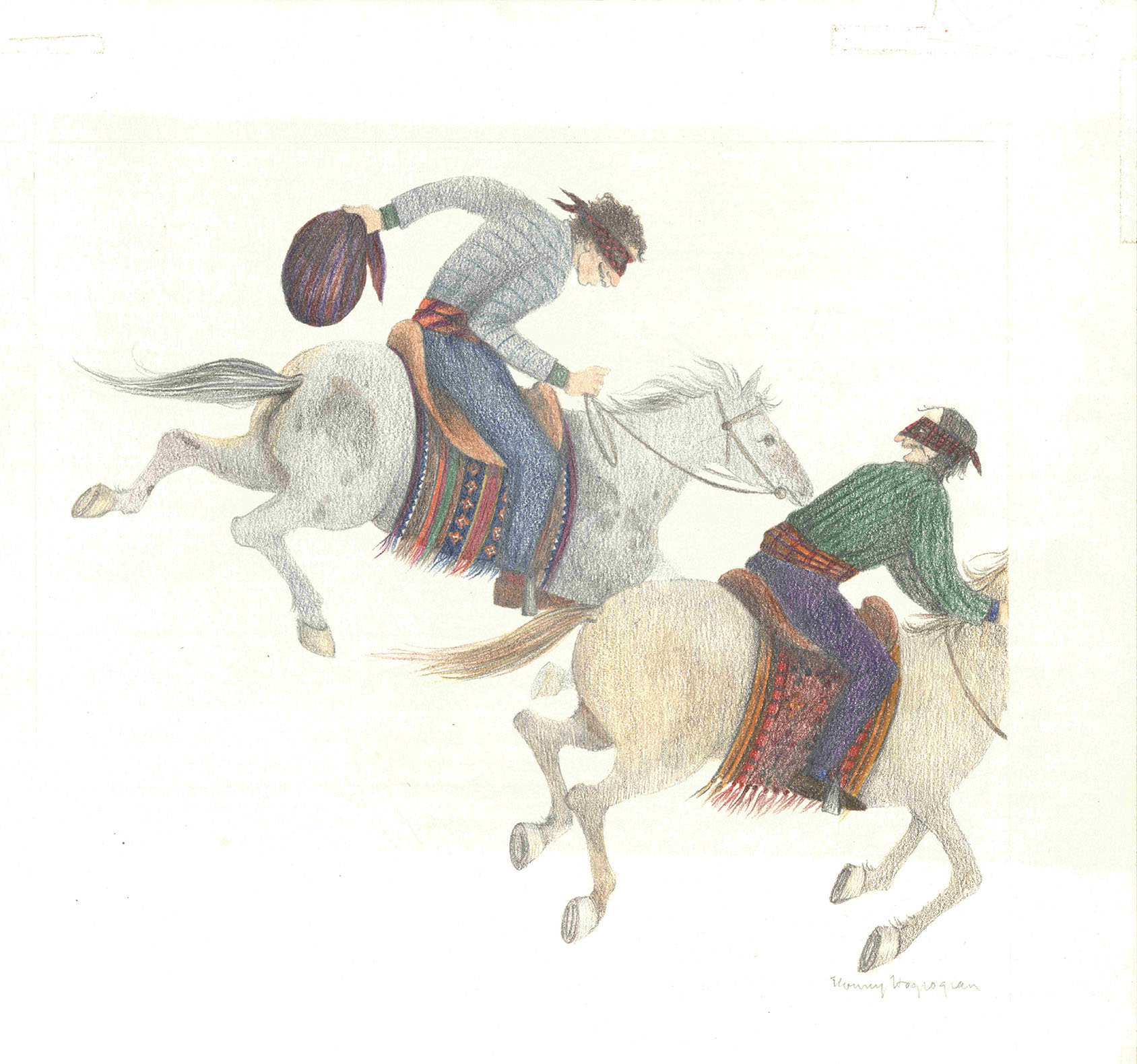
Original Artwork from Nonny Hogrogian’s The Contest (1976). Nonny Hogrogian Papers, Box 1, UConn Archives & Special Collections.
Nonny Hogrogrian was a critically acclaimed Armenian American author, illustrator, and designer of children’s literature.
Hogrogian grew up in an artistic family; her parents were amateur painters, and her sister went on to become an interior designer. Hogrogian began painting at a very young age. She always had a love for folktales and fantasy, as well as poetry, which is clearly shown in her body of work. Hogrogian is known for intricate illustrations and attention to detail that capture the personalities of her various characters. She has also been attributed to bringing multiculturalism into children’s literature by incorporating her Armenian heritage into her books.
Hogrogian studied fine art at Hunter College, earning herself a B.F.A in 1953. She freelanced as a book-jacket designer for William Morrow after graduation. Hogrogian continued her studies at The New School for Social Research where she studied life drawing. While at the New School, Hogrogian learned the art of woodcutting from Antoni Frasconi. Shortly after graduating from her master’s program in 1957, Hogrogian became a production assistant at Thomas Y. Crowell Co. in 1958. At Crowell, she illustrated her first published children’s book, King of the Kerry Fair. Hogrogian eventually moved on to work for Holt & Co. as an art director. Her work at Holt earned her first Caldecott Medal in 1966 for her work with Leclaire G. Alger (also known by the pen name, Sorche Nic Leodhas) on Always Room for One More. Hogrogrian won another Caldecott in 1972 for her self-illustrated book One Fine Day, and a Caldecott Honor Award in 1977 for The Contest, a retelling of an Armenian folktale.
I wanted to spotlight this collection because Nonny’s work is extraordinary but is often overshadowed by other big names that she has collaborated with. I resonate with her love of folktales and fairytales, and the beautiful illustrations that often accompany such stories. I also found her background and how she charted her career through various educational institutions and jobs in the publishing industry to be important and inspiring for early career professionals in children’s literature trying to break into the industry.
I strongly recommend experiencing Nonny Hogrogian’s collection in-person in our reading room and giving this underutilized collection the attention it deserves.
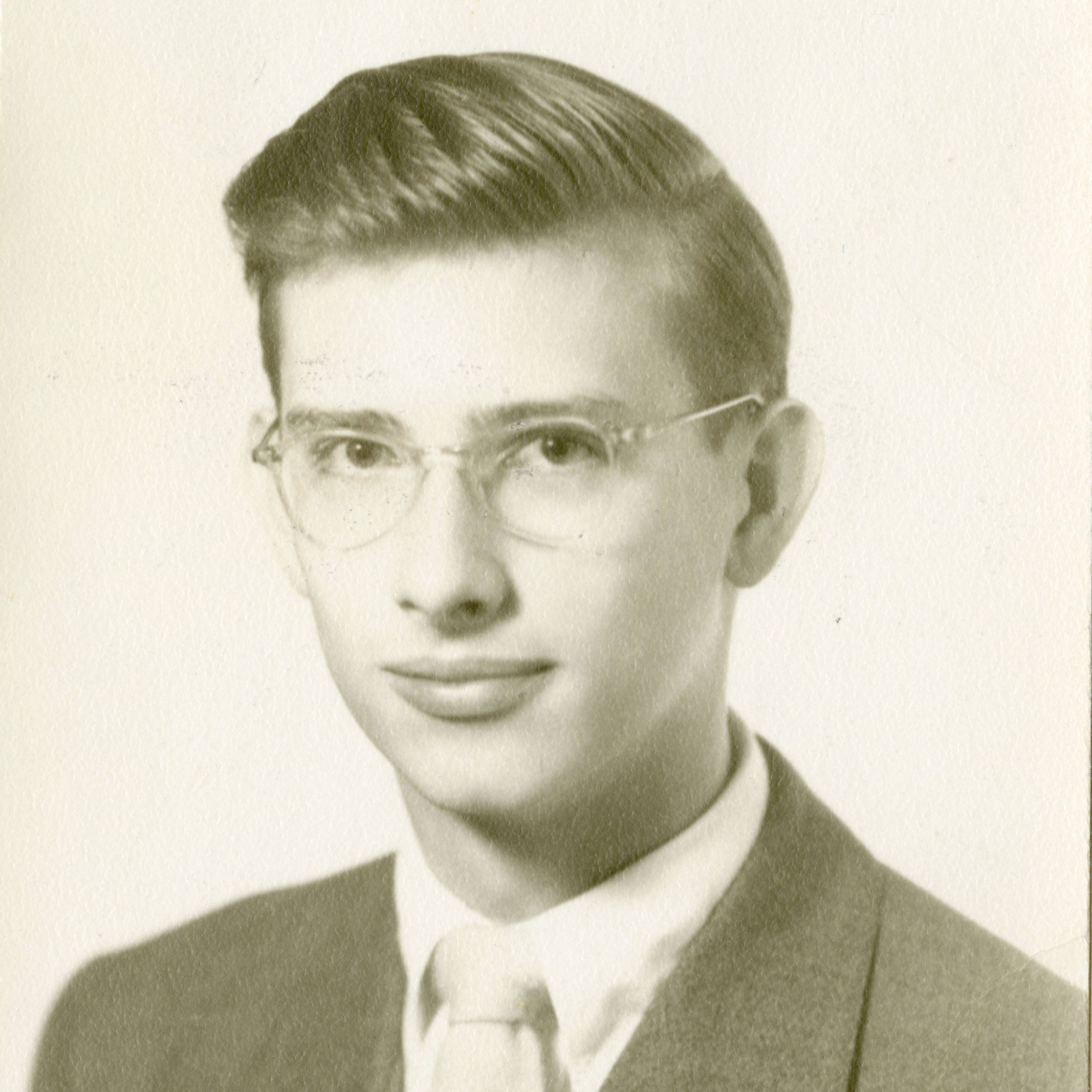
Michael Rumaker in Sausalito, 1956. Photograph by Jonathan Williams. Western Regional Archives. Asheville, North Carolina.
Michael Rumaker was an American author known for his semi-autobiographical novels that document his life as a gay man from his early life in the 1950s to his death in the 2010s.
Rumaker was born in South Philadelphia and grew up in a small town in New Jersey. He went on to attend Rider College in Trenton where he majored in journalism, but after hearing Ben Shahn’s enthusiastic praise of Black Mountain College, he applied and was accepted.
Rumaker was granted a work scholarship where he worked seven days a week in Black Mountain’s kitchens. During his time at Black Mountain College, Rumaker studied writing under the tutelage of Charles Olson and Robert Creeley. Rumaker’s breakthrough work was his short story “The Truck.” He originally wrote in one of Olson’s writing classes in 1954 and sent it to Robert Creeley to be published in the Black Mountain Review. This was a very encouraging experience for Rumaker that led to his writing of three additional stories during his winter break that followed, including “Exit 3” and “The Pipe,” both of which were eventually published.
In 1955, Rumaker graduated from Black Mountain with an honors degree with Robert Duncan as his outside examiner. He was one of very few students to have graduated during the college’s final years. After graduation, Rumaker worked various jobs during the day and worked on his writings at night. He worked in Philadelphia at an advertising agency. He eventually quit and hitchhiked all the way to San Francisco where he found work as a clerk for a steamship company. He continued writing in his spare time and stayed with friends from Black Mountain. From then on, his life continued to intersect with other artists from the Beat Generation.
There is still much more to Michael Rumaker’s interesting life and career that I could not include in this already-too-long blog post. I really wanted to spotlight his collection and published works as I feel together they really capture the life of someone who was a writer and creative to his very core and was so deeply dedicated to his craft. Reading about how hard he worked for his education, going from a kid in a small town to being a well-regarded published author, was inspiring and encouraging.
There is so much untapped research potential in this extensive collection, and if my enthusiastic review of it has not persuaded you to check it out, maybe George Butterick’s words will finally sell you on it.
According to George Butterick, who began reading and collecting Michael Rumaker’s literary papers at the University of Connecticut in 1974, “Rumaker has proceeded from writing about disengaged youth in a generation willing to declare its difference, to being a celebrant of total life and human joy. Actively participating in his own destiny, he has left a glowing trail of work to document the struggle toward identity. He represents, in his later writings, one extension of the Beat revolution: the embracing of sexual diversity. Governing all his work is an indefatigable spirit that gives the creative life reward.”
Merrill Gillespie photograph included with student application. Western Regional Archives. Asheville, North Carolina.
This small but important collection features correspondence from Michael Rumaker to his long-time friend and former partner, Merrill Gillespie, documenting the pair’s early relationship in the mid-1950s while they both attended Black Mountain College.
Gillespie was born in Kewanee, Illinois and attended Black Mountain College from Spring 1949 – Fall 1952 pursuing his studies in music composition. He attended with composer David Tudor, artist Herb Roco, poet Marie Tavroges Stilkind, and of course Michael Rumaker. At an early age, Gillespie contracted an ear infection that made him hard of hearing for most of life. Despite this, he followed his passion for music studying under Lou Harrison during his Black Mountain College years, and David Garner during the last 25 years of his life. Over the course of his life he composed many works including several chamber works and three orchestral works.
I wanted to draw attention to this small collection because it complements Michael Rumaker’s collection and is easy to overlook. I think through the letters included in this collection you can really get a sense of each of them as individuals, their relationship with one another, and what their lives were like while attending Black Mountain College. I think these collections work together to accomplish one of the main goals of an archive; to give the fullest picture possible of an individual, the life they lived, and the context in which they existed.
If any of these collections have piqued your interest, you are always welcome and encouraged to view them in-person in our reading room or by accessing them remotely through reproductions. To learn more about how to access our collections, please visit our website: https://s.uconn.edu/asc
Citations:
Photograph of Michael Rumaker in Sausalito, 1956. Photograph by Jonathan Williams. Western Regional Archives, Asheville, North Carolina. Retrieved on February 17, 2026. https://bmcyearbook.org/bio/michael-rumaker
Photograph of Merrill Gillespie included with student application. Western Regional Archives, Asheville, North Carolina. Retrieved on February 17, 2026. https://bmcyearbook.org/bio/merrill-gillespie
Original Artwork from Nonny Hogrogian’s The Contest (1976).Nonny Hogrogian Papers, Box 1, University of Connecticut Library, Archives & Special Collections
The UConn Library’s Archives & Special Collections holds over 1000 archival collections. Some of these collections are well known and are used all the time for research, while others may not have been accessed since they arrived at the archives. Because of this, I thought it would be fun to spotlight some collections that I have come across that seem interesting that researchers have not used much or simply do not know exist.
Here are some of the collections I found while perusing our online finding aids and physical collections:
Based on the collection’s title I did not expect it to be as interesting as it turned out to be. I assumed that this collection would only be administrative records and economic data, but I was completely wrong.
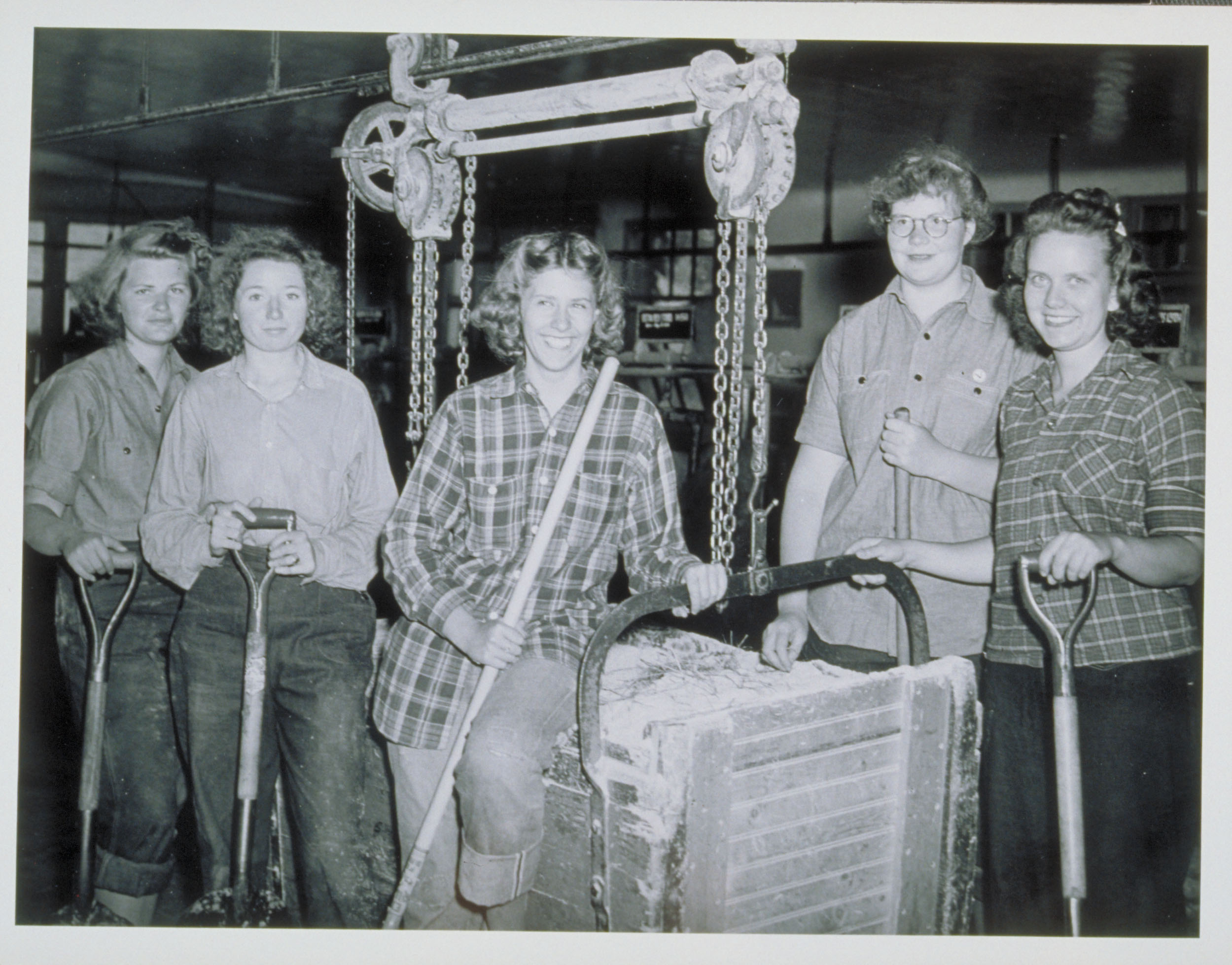
This collection contains over 80 linear feet worth of newspaper clippings, correspondence, pamphlets, brochures, photographs, and other print materials that document the evolution of the agricultural sector on a local and national level over the course of more than a century! It covers the intersection of agriculture and massive historical events such as World War II and the labor shortage created as a result of the Selective Service draft and how the State of Connecticut and the University of Connecticut worked together to create the Emergency Farm Labor Department in response to this crisis.
The Emergency Farm Labor Department established the Woman’s Land Army as well as nine farm labor camps for housing and training new agricultural workers. These farm laborers included urban youth and women, soldiers, white collar professionals, displaced Japanese Americans, returning war veterans, workers from other states, migrant workers from Mexico and Jamaica, and even German prisoners-of-war.
This collection also includes correspondence documenting UConn’s Agricultural Department’s growing responsibility as part of the Emergency Farm Labor Committee and their work with the United Stated Department of Agriculture.
When I came across this small collection, I knew I had to shine some light on it as it covers many of my interests, children’s literature, illustration, and natural history. This collection contains materials relating to Margaret Waring Buck’s self-illustrated books that often detail the lives of animals in the wild through black-and-white drawings of the flora and fauna of the outdoors. These books are often geared towards young naturalists who are just starting their dive into ecology and natural history.
I think it is important to note Margaret Waring Buck’s interest in physiognomy, also known as face reading and anthroposcopy, a pseudoscience now considered to be a form phrenology. I feel analyzing her work through this lens could yield interesting discoveries regarding the various influences on her work.
In this collection you will find many different types of materials from Margaret Waring Buck’s personal papers, correspondence, and photographs from the early history of photography, as well as original notes and sketches. I highly recommend reading through this collection’s finding aid and inventory and visiting our reading room if anything in the finding aid catches your eye.
Charles Pease was a Connecticut-born businessman who worked as a printer and editor of the Connecticut Western News in Canaan Connecticut. Pease had a love for beekeeping that turned into a small but profitable side hustle.
This tiny collection (only 2 linear feet) is largely comprised of his own handwritten journals documenting his beekeeping activities (cutely named Pease’s Beeses) from 1919 through 1949. Pease also documented his observations of birds, flowers, and the natural world in his hometown of Canaan, Connecticut.
We also have another collection, the Hewitt Bee Collection, that complements Pease’s and is comprised of over 300 books and 40 different periodical titles on beekeeping and bee culture.
If you are an avid beekeeper, looking to start your own honey-selling business, or simply interested in Pease’s activities as a naturalist, I recommend experiencing these collections in person by visiting our reading room.
The Connecticut Digital Archive is a collaborative member organization that supports digital preservation and access for all Connecticut’s people. Established in 2013, the CTDA has become the digital repository for multiple cultural heritage institutions across the state, including Archives & Special Collections (ASC).
As one of the inaugural members of the CTDA, the ASC digital collections have grown and expanded over the years. The original seven categories have expanded to ten but the addition of thousands more resources has pushed the limits of these categories.
In the intervening years, ASC has also enhanced access to our collection finding aids and the ability to create direct links between the finding aids and the digitized collection materials has expanded discoverability, access, and availability of materials to researchers across Connecticut and beyond.
With the historic upgrade of the CTDA undertaken in 2022-2023 and expanded capabilities, ASC will also be revamping its space and collection presentation in the CTDA. All the content currently available digitally will retain their URLs (handles) but the categories in which they “live” will be expanded to mirror the collection areas under which our finding aids are categorized (https://archivessearch.lib.uconn.edu/classifications ).
We believe this restructuring will make it easier to identify and locate our digital and digitized collections and ask for your patience as this migration unfolds in the New Year.
If you have any questions or have difficulty locating our digital content during or after this transition, please contact us at archives@uconn.edu for assistance.
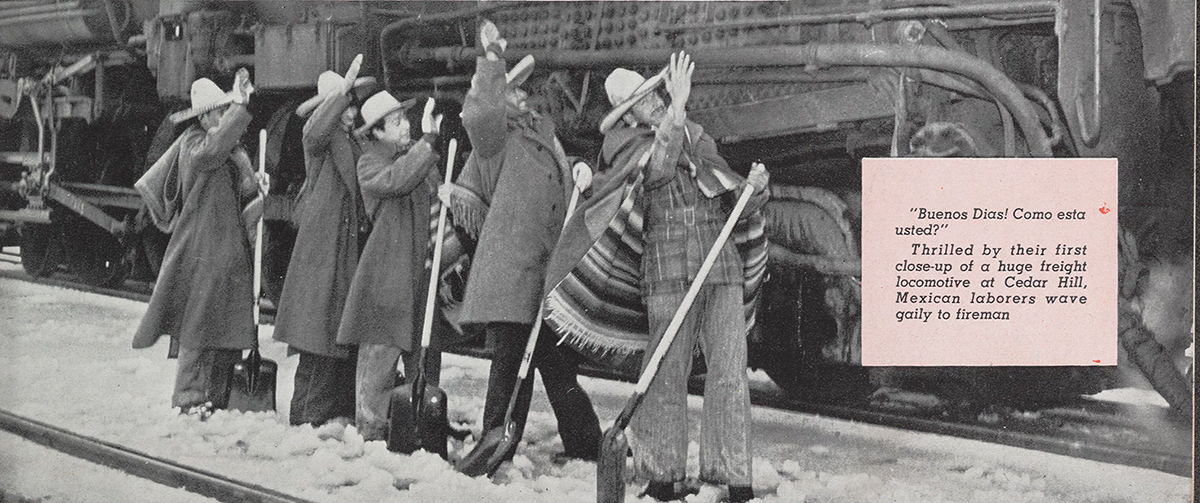
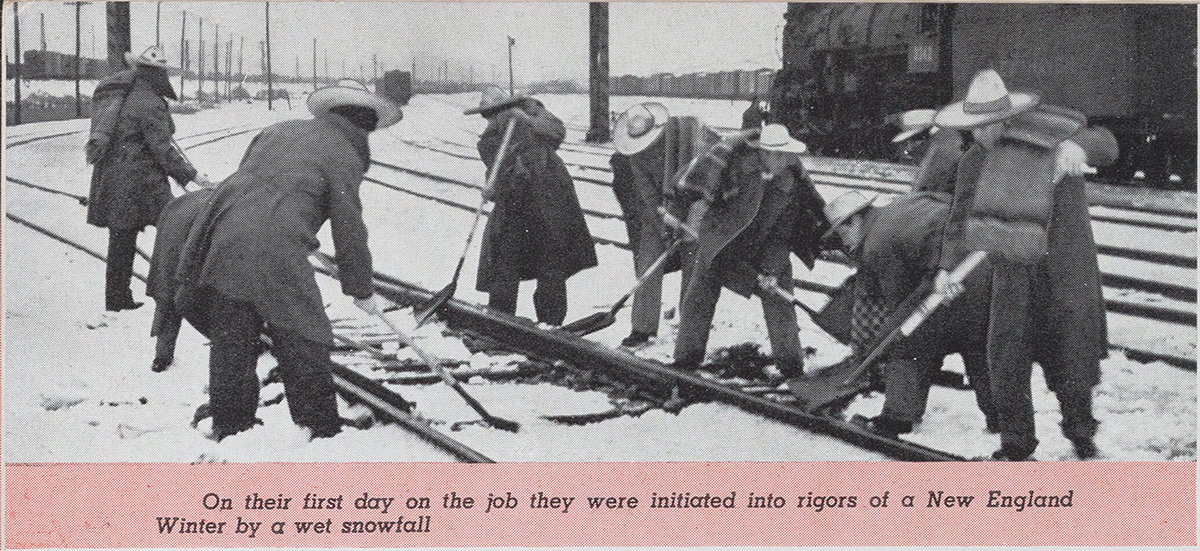
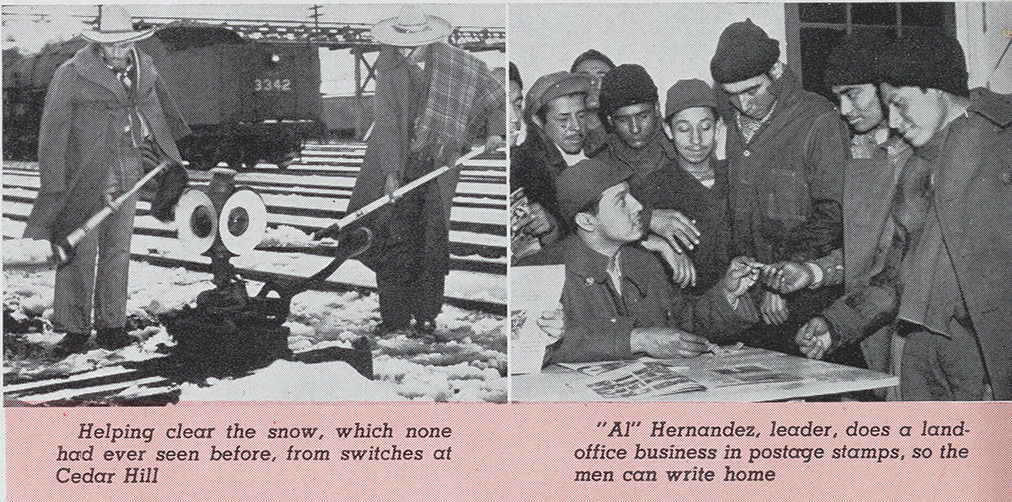
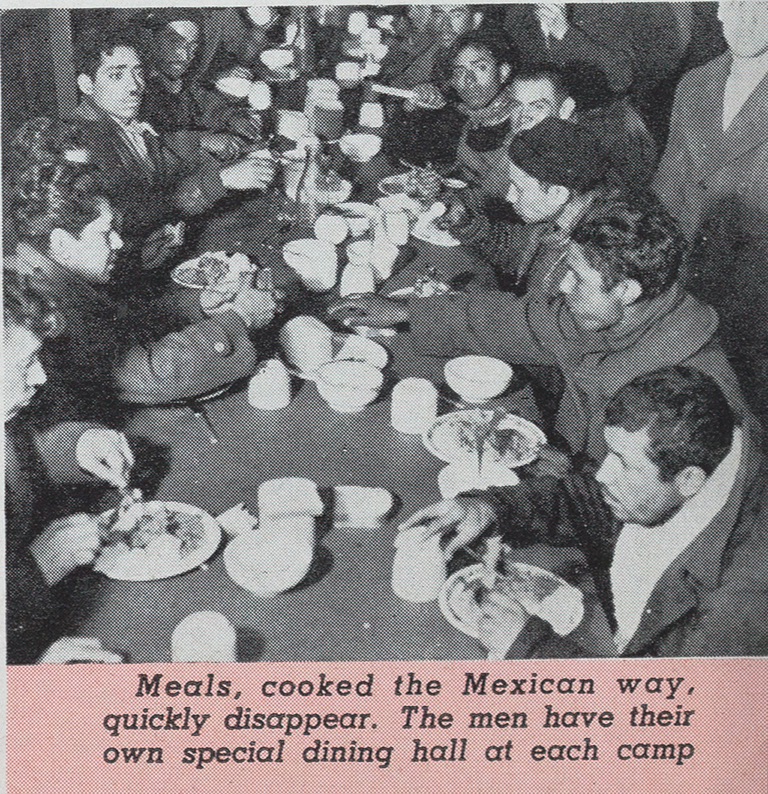
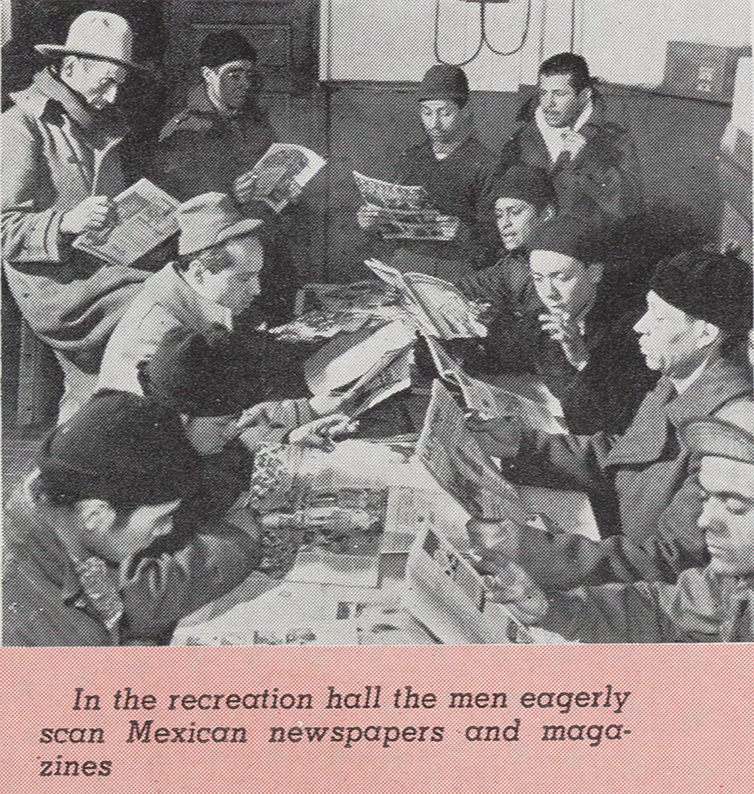
On January 3, 1944, 300 men from Mexico arrived in Connecticut after a journey of 3700 miles which started six days earlier in Mexico City. They were hired as Braceros, or manual labor, to work on the New Haven Railroad for a term of six months through a diplomatic collaboration between the United States and Mexico which provided needed workers for the nation’s railroads during World War II.
The Bracero program had its origins as far back as the 1880s, when Mexican workers were recruited in building the vast network of railroads in the United States. Although later better known as a program for agricultural workers, the Bracero program was an important means to alleviate the shortage of American workers in the railroad industry.
America’s railroads had a crucial role to play during World War II, transporting war materiel from industries that switched production to provide arms, ammunition, and other goods, to transporting soldiers to training camps and points of embarkation. Shipping slowed due to the threat of German submarines off of the U.S. east coast, thus the demand for moving oil and coal fell on the railroads. Civilian passenger service was up due to the rationing of gas for private automobiles. Just at the time the railroads needed more employees to handle this surge in service, they were left short-handed when many of their workers left for the armed forces.
The New Haven Railroad, which provided passenger and freight service throughout southern New England, noted in their 1944 annual report that as of May 1944 over 5500 of their workers left for the armed services; that number rose to 7200 by the war’s end. Although the railroad was able to hire women to make up some of the lost workers, they relied on the Bracero program for the unskilled labor they needed to clean ash pits and fires, load coal, shovel sand, remove snow from tracks, and many other manual labor jobs.
Beginning in Spring 1943 the Bracero program recruited over 100,000 Mexican men to work for thirty railroads throughout the United States. While most of the men were recruited for railroads in the Midwest, South and West, over the two-and-a-half-year period of the program the New Haven Railroad received approximately 1000 workers.
The Mexican men, with an average age of 28, were dispersed among several locations in the New Haven Railroad area; in Connecticut they worked at engine houses and railyards including Cedar Hill in New Haven, East Greenwich and Guilford. The contracts drawn up between the U.S. and Mexican governments stipulated that the men would receive the same rate of pay as American workers and work a ten-hour day, six days a week.
In an article that ran in the February 1944 issue of the railroad’s employee magazine, Along the Line, it was noted that the men were given warm clothing suitable for hard industrial work in cold climates. They were housed in a dormitory in North Haven and chefs were brought from Mexico to accommodate the men’s eating preferences. Priests were brought in for Sunday services. It was also noted that most of the men sent their pay back to their families in Mexico.
The men were given a warm welcome by the railroad, with the acknowledgement in Along the Line that “…it takes plenty of courage voluntarily to break off home ties, to leave families three thousand miles away, in an endeavor to improve their living conditions. It was the same spirit which in earlier years guided immigrants to America and resulted in the building of our great nation. We salute our Mexican friends, as fellow employees, thank them for their cooperation in coming, and express the hope that they will enjoy their stay with us. Bien Venido, Amigos!”
By the end of the war, with the return of almost 90% of the New Haven Railroad’s workforce from the armed forces, the contracts for the Mexican Braceros expired and the men returned home.
An exhibit created by Edward Junhao Lim, the Business & Entrepreneurship Librarian of the UConn Library, and a member of the Association for Asian American Faculty and Staff (A3FS).
Target Practice was a comic strip published in the Daily Campus illustrated by Chris Sienko ’88 (SFA). This bigotry – depicting Asian teaching assistants as illiterate and stupid because of their accent or English language ability – reflected the sentiment in many American university campuses in the 1980s-1990s. This was published in the October 7, 1987, issue, p. 13.
The Target Practice comic strip on Asian teaching assistants sparked off a series of letters to the editor published in the October 12 & 14, 1987 issues of the Daily Campus. The Vice President of the UConn Korean Club defending Asian T.A.s, two letters suggesting that Asian T.A.s are poor in communicating in English, and even the comic artist (Sienko) defending and denying its racist intent.
December 3, 1987, was a significant marker for the Asian American movement at the University of Connecticut. Eight Asian American students boarded a bus at Belden Hall to attend an off-campus semi-formal dance at the Italian American Club in Tolland. Belden and Watson Hall sponsored the semi-formal.
The written statement to the UConn Department of Police about the bus incident by Feona Lee ’87 (CLAS, BUS) – one of the eight victims – dated December 12, 1987. She describes how the perpetrators – a group of white, drunken students, some of whom were chewing tobacco – spat on her and her friends and making racist remarks.
During the 45-minute bus ride, they were spat upon and subjected to racial slurs and physical intimidation from a group of UConn football players. Even at the dance hall, one of them continued harassing the group, including indecent exposure. The victims asked one of the Resident Advisors for help and permission to leave but were denied and asked to stay away from the troublemakers. The female victims hid in a closet until the threat of violence had seemed to pass.
This photograph published on the May 16, 1988 issue of the Hartford Advocate featured two of the eight victims of the December 3, 1987 bus incident: Marta Ho (left) and Ronald Cheung ’89 (CLAS, BUS) (center). Accompanying them is Maria Ho ’88 (CLAS) (right), sister of Marta. Both sisters played an important role in the founding of the UConn Asian American Association student group in January 1988, formed as a response to the bus incident.
The inability of both local law enforcement and university officials to address and remedy the situation led to eighteen months of struggle, protest, and examination. No one seemed willing to help at the beginning: the UConn affirmative action office could not interfere because it did not involve faculty and students; the UConn campus police claimed no responsibility since it happened off campus, and three other local police departments (Vernon, Stafford Springs, and Tolland) claimed to have no jurisdiction since the incident started on campus.
Paul Bock was the Professor Emeritus of Hydrology and Water Resources at the University of Connecticut. He pitched a tent on the Student Union lawn at Storrs campus and conducted a hunger strike to call attention to their demands. He obtained seven hundred signatures on a petition to bring about an investigation of the incident. He chose the window between the end of the summer session and the beginning of the fall session in August 1988 to avoid disrupting classes. This photograph by Rick Hartford was published in the Hartford Courant as an update a decade after the bus incident on May 17, 1998.
The perseverance of the victims eventually led to the identification and prosecution of only two from a group of attackers. One was suspended for one year. The other was barred from living on campus but continued to play for the UConn football team until his graduation.
This exhibit seeks to raise awareness about the incident on December 3, 1987, against Asian Americans at the UConn. This incident was a catalyst for change at UConn, leading to the establishment of the Asian American Cultural Center (AsACC), which provides resources to enhance the University’s diversity commitment through its recruitment and retention efforts, teaching, service, and outreach to the Asian American community on campus.
Through personal narratives and historical documents, the exhibition will explore this event’s origins and immediate consequences on the Asian, Asian American and broader campus communities. The day after the incident, Homer Babbidge Library was where Marta Ho told her sister Maria Ho what had happened. Maria insisted on reporting the incident to the police.
Students encountering materials from the Alternative Press Collection in the John P. McDonald Reading Room, image by Zoey England.
Come visit – a lot is new!
On Thursday, March 28, 2024, from 3-5 pm, Archives & Special Collections will host an open house to welcome our community into our newly-renovated John P. McDonald Reading Room. More information about how to find us is available on our website.
We have recently updated our reading room to enhance patron services, instruction, and exhibition for our unique and diverse collection. This open house will feature curated materials on display and staff archivists to engage with about the work we do.
Learn about the 1974 Black student sit-in
In conjunction, the archives will be opening a new exhibition in the Schimmelpfeng gallery to mark the 50th Anniversary of the 1974 Black student sit-in at Wilbur Cross Library. During the sit-in, 370 students occupied the library at varying times across three days. The sit-in was the culminating event during a semester-long campaign of student organizing to demand representation and resources for students of color at the University of Connecticut.
Through curated documents this exhibition will feature the perspectives of the student organizers, the Afro-American Cultural Center, the University and its administration to remember this campus-wide call to action which resonates to our present day. This 50th anniversary is also an opportunity to highlight approaches to student activism and the centrality of the library as an institutional setting both for democracy and also one vulnerable to upholding systems of oppression.
Talk with an archivist
Have a question about your research interests? Want to learn more about Zine making? All are welcome to explore the archives and hear from archivists about how we can connect you to your history!
We hope you join us
This event is free and open to the public. Light refreshments will be served. If you have further questions or accommodation requests, we are eager to have you contact us archives@uconn.edu
Please Respond Personally: Commemorating the 1974 Black Student Sit-In
March 11th – December 13th, 2024, Schimmelpfeng Gallery, Monday – Friday, 9-4pm
Dodd Center for Human Rights, University of Connecticut
Exhibit Opening Event: March 28th, 3-5pm @ Archives & Special Collections, Dodd Center
Opening to the public Monday, March 11th, 2024, the UConn Library’s Archives & Special Collections will mount a 50th Anniversary Exhibition commemorating the direct action taken by Black and Brown students on the Storrs campus to challenge structural racism in higher education by sitting in at the Wilbur Cross Library on April 22nd 1974. This historic event of activism, where roughly 370 students occupied the library at varying times across 3 days, was the culminating event during a semester long campaign of student organizing to demand representation and resources for students of color at the University of Connecticut. Through curated documents this exhibition will feature the perspectives of the student organizers, the Afro-American Cultural Center, the University and its administration to portray this campus-wide call to action which resonates to our present day. This 50th anniversary is also an opportunity to highlight approaches to student activism and the centrality of the library as an institutional setting both for democracy and also one vulnerable to upholding systems of oppression.
This exhibition draws from the experiences of alumni Rodney Bass (’75BA/’76MA) who read the demands during the sit-in and was co-chair of the Organization of African American Students (OAAS). The archives podcast d’Archive produced an interview with Rodney about Black student organizing in the mid-1970s on the Storrs campus which is revealing in understanding their approach to making demands upon the university for their representation in the student body.
An exhibit of historical records and items manufactured by the J.B. Williams Company, shown on the Plaza Level of Homer Babbidge Library through March 2024.
The exhibit shows photographs, advertisements, and historical documents from the J.B. Williams Company Records, but includes a special component — almost 80 collectible items manufactured by the company.
All of the collectibles shown in this display are from the collection of Boyd and Melissa Williams, residents of Franklin, Tennessee.
Melissa and Boyd Williams, 2023
About eight years ago Mr. and Mrs. Williams were in an antique store and found a J.B. Williams Company shaving soap box. Knowing nothing about the company, with no connection to Connecticut, they purchased the box on the basis that the company’s name was theirs as well. After that, they perused antique shops and Ebay for other company items and slowly amassed their collection of about 150 items, which they display in a vacation cabin they own.
The focus of the collection is solely on items that indicate that they were produced in Glastonbury, 1960 and earlier.
In June 2023 Mr. Williams contacted the UConn Archives asking for information from the J.B. Williams Company Records about their products, to supplement his knowledge of the company. When the archives staff learned about the Williams’ extraordinary collectible collection, the couple generously agreed to loan the items for this display.
About the J.B. Williams Company:
James Baker Williams was born in Lebanon, Connecticut, in 1818 and worked at a general store in Manchester beginning at the age of 16. When he was 22 he began to experiment with soaps to determine which were best for shaving, and developed Williams’ Genuine Yankee Soap, the first manufactured soap for use in shaving mugs.
In 1847 Williams opened his soap company on Williams Street in Glastonbury, where he continued to manufacture shaving soap and other products.
By the early 1900s the company was known throughout the world for its line of shaving creams, talcum powder, toilet soaps, and, later, for Aqua Velva, Lectric Shave, and Skol. After 1950 the company, in mergers with other businesses, became known for producing Conti Castile Soap, Kreml Hair Tonic, and Kreml Shampoo.
In 1957 a New York based conglomerate, Pharmaceuticals, Inc., acquired the J.B. Williams Company and moved the headquarters to New Jersey. In 1971 the company was sold to Nabisco.
The plant in Glastonbury was taken over by former Williams Company employees and became Glastonbury Toiletries, producing shaving soaps, bathroom soaps, aerosol shaving creams, body lotions and shampoos. This company closed in 1977. The original 1847 factory was converted to condominiums and, in 1983, was placed on the National Register of Historic Places.
The company records were donated to the UConn Archives in 1967.