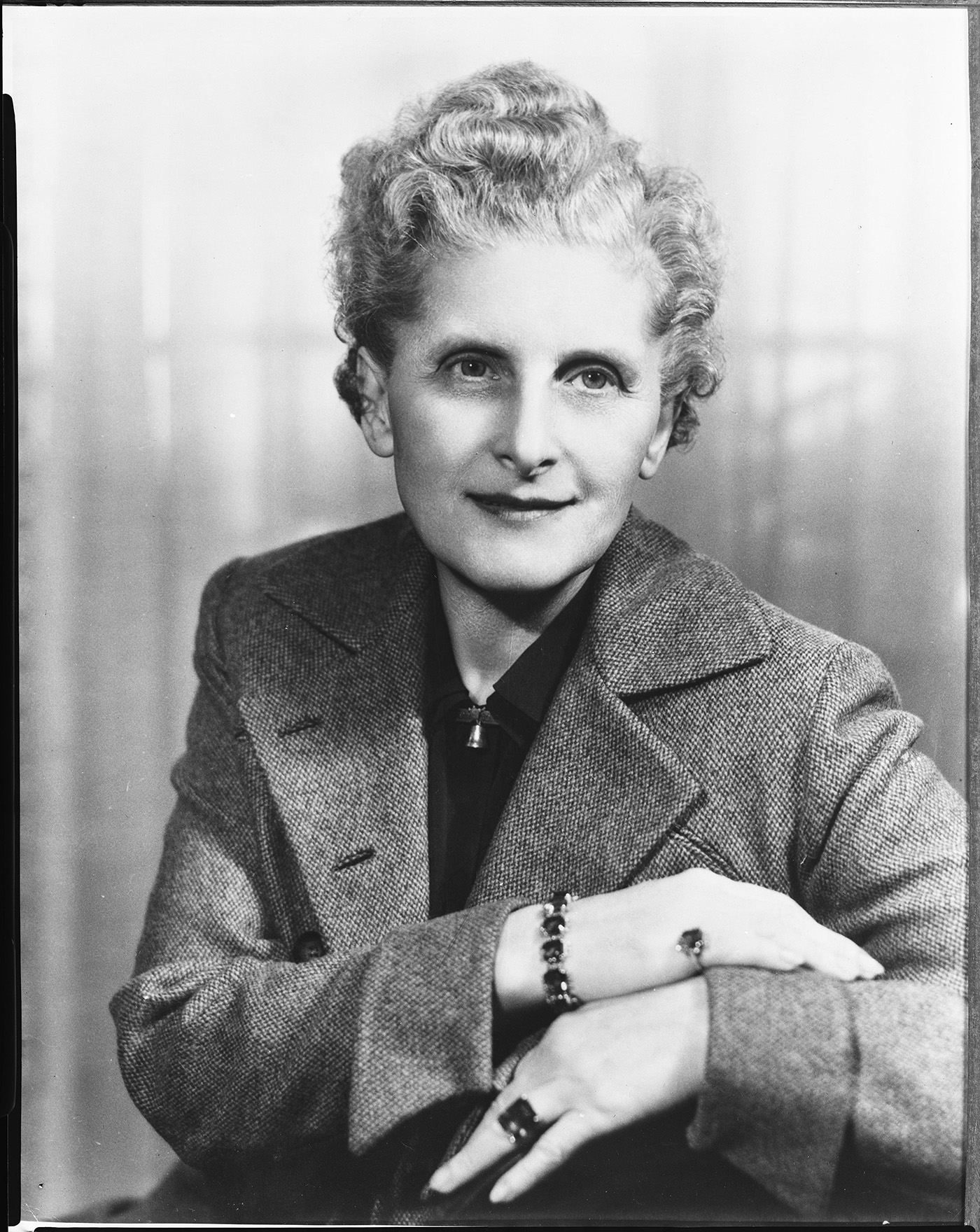
Viven Kellems was an inventor, businesswoman, political candidate, philanthropist, and most notably, an activist. Her fight with the Internal Revenue Service over tax reform, specifically the withholding tax introduced in the 1940s, was a journey that produced her book, Toil, Taxes, and Trouble, which is being translated into Italian and expected to be published in 2027.
Why translate a 1952 book about Kellem’s protest of the federal income tax withholding system? Paolo Luca Bernardini, Professor of Early Modern and Modern History at Insubria University in Como-Varese, Italy, believes that her work, and her energy, are much needed in today’s European environment where classical-liberal and libertarian ideas are struggling to be heard.
Back in the early 90s, Italy’s Radical Party attempted to call up a national referendum on this very issue, but it failed. During that time, Kellems’ arguments were used in the debate, which still resonate in today’s political environment, leading Bernardini to translate the full text into Italian. To, in his words, “write a decent introduction, without turning to Wikipedia or AI, but working with the very sources,” his search led him to the archival documents and unpublished papers in Archives & Special Collections.
The collection, which includes more than one hundred boxes, donated by Viven’s nephew Vangelder Kellems in 1992 and funded for digitization by Suzy Kellems Dominik, is a glimpse into the life of this prominent Connecticut figure. Bernardini described the collection as “a treasure for historians,” with so much to discover. Not just for political thought, which is his specialty, but for economic and political history as well.
Bernardini’s research at UConn was partially funded by the Rose and Sigmund Strochlitz Fellowship, and as part of that program he will be giving a presentation on his research this Thursday, October 29th from 12-1 in the Dodd Center for Human Rights Public Lounge, and a blog post will be published at a later date.
The Asian American Forum radio archive is an irreplaceable audio archive documenting Asian American life and activism on the East Coast. The first radio program of its kind in the region contains more than 250 episodes of Asian American activism, scholarship, and community life from 1990–1996. Digitized by the UConn Library, the radio program, launched by Dr. Paul Bock, Professor Emeritus of Hydrology and Water Resources at UConn, is now available to support AAPI education and curriculum development nationwide.
The panel will provide an opportunity to understand the impact the program had in documenting Asian American life and activism on the East Coast, on the Asian American community, and how it is still being used today in supporting Asian American and Pacific Islander curricula in Connecticut schools through initiatives such as UConn’s Curriculum Lab and providing region-specific primary source material for Asian American Studies programs nationwide.
Dr. Judy W. Yu is the Co-founder of the Black and Asian Solidarity Collective. She is currently the Principal Investigator of a Spencer Foundation-sponsored research and conference grant entitled: “Building Racial Solidarity Across Black and Asian American History in K-20 Education” This research and community engagement project utilizes historical narratives, educational research, art, media, and curriculum development with educators, youths, parents, scholars, and community activists in and out of the academy. Currently, Dr. Yu has a joint appointment as a faculty member at Boston College, Lynch School of Education and Teachers College, Columbia University.
Dr. Judy W. Yu is the Founding Director of REACH®, an education consulting firm based in New York City. She is an organizational leader, scholar, and educator. As a former elementary school teacher in the Los Angeles Unified School District and a youth educator in New York City, she has developed a series of K-12 critical multicultural and Asian American studies programs for students, parents, and communities that empowers people to utilize their diverse lived experiences, narratives, and personal artifacts as bodies of scholarship in re-telling our American history.
Dr. Yu was an active Commission Member of the Black, Race, & Ethnic Studies Initiative (BRESI) at the City University of New York (CUNY). She was chosen in 2021 as one of the 17 scholars to serve in the commission to provide expertise in building ethnic studies, racial, and social justice coursework and programs across 25 college campuses. Currently, she is working with Dr. Karen Umemoto, Chair of the Asian American Studies Center at UCLA and the Founder of the Foundations and Futures project, to pilot a teacher professional development programs for NYC’s public schools to implement an Asian American and Pacific Islander multimedia textbook in public schools. Foundations and Futures is the most comprehensive collection of Asian American and Pacific Islander histories and perspectives available for free and online for high school, college, and lifelong learners. She is super excited to be in community with fellow Asian American Studies activists.
Grace Lou
Grace A. Lou, Esq. is Partner and Co-founder of Pacific Coast Legacy Partners, LLP. For almost 25 years, Ms. Lou has dedicated her professional life to the practice of trust and estate law and is a Certified Specialist in Estate Planning, Trust and Probate Law by the California State Bar Board of Legal Specialization. Ms. Lou was the principal of The Law Offices of Grace A. Lou (also known as Grace Lou Law) from 2008 to 2024, where she diligently worked with clients through the estate planning and administration process. She also serves as Founder, President, and Chief Legacy Officer of GraceNotes, Inc., a repository of human wisdom at leavegracenotes.com.
Ms. Lou earned her Juris Doctor with research & writing honors from Georgetown University Law Center in 2000, and her Bachelor of Science, Magna Cum Laude from Northwestern University in 1996. She was selected by the Daily Northwestern as “Top 10 People to Know” from her activist efforts to establish an Asian American Studies Program.
A former Jersey girl, Ms. Lou now resides in Manhattan Beach, California, where she and her husband Andy have raised their three children, Christian (Go Bruins!), Nicolas (Go Brown Bears!), and Geneva (Go Costa!). She is a member of Lighthouse Community Church in Torrance and served on the boards of the Mira Costa High School Basketball Boosters, South Bay F.O.R., and the Asian Pacific Community Fund. In 2006, the Joint Affinity Group of Southern California recognized her as a leader in local philanthropy. She is conversationally fluent in Mandarin and Taiwanese.
In her free time, Ms. Lou can be found reading books by Haruki Murakami while listening to classical jazz, on a Pilates reformer, traveling the globe in search of street food at night markets (especially in Taipei and Tokyo), or conversing over coffee with good friends. Her goal as an attorney is to walk closely alongside clients through their life journey and to accurately memorialize their true legacy for the next generation.
Renee Tajima-Peña
Professor Renee Tajima-Peña is Professor of Asian American Studies, Director of the Center for EthnoCommunications, and holder of the Alumni and Friends of Japanese American Ancestry Endowed Chair. She is an Academy Award-nominated documentary filmmaker who has chronicled the Asian American experience through films such as Who Killed Vincent Chin? and My America…or Honk if You Love Buddha, Asian Americans, the first-ever 5-hour docuseries on the Asian American experience that aired on PBS in 2020.
Her other films on themes of immigration, race, ethnicity, gender and social justice include The Best Hotel on Skid Row,Calavera Highway, Skate Manzanar, Labor Women, and No Más Bebés. Tajima-Peña’s latest production is the May 19 Project, which she co-founded/executive produced with Jeff Chang in collaboration with independent filmmakers across the US. The May 19 Project is a social media campaign that traces the legacy of Asian American Pacific Islander solidarity with other communities through fourteen short videos and social media content.
Her online media projects explore the history of Japanese American incarceration and resistance. Building History 3.0 is an interactive documentary and video game-based learning project and is supported by the National Parks Service and the California Civil Liberties Public Education Fund. Tajima-Peña is co-founder and co-producer of the Nikkei Democracy Project, a multi-generational multi-media collective that uses the power of the Japanese American imprisonment story to expose current threats to Constitutional rights.
Tajima-Peña’s work has screened at the Cannes Film Festival, Hong Kong Film Festival, New York Film Festival, Sundance Film Festival, and the Whitney Biennial, and has been broadcast throughout the US and abroad. She has been honored with two Peabody Awards, the Alpert Award in the Arts, a Guggenheim Fellowship, the United States Artists Broad Fellowship, and a Dupont-Columbia University Award.
Tajima-Peña has been deeply involved in the Asian American independent film community as an activist, writer, and filmmaker. She was the director of Asian Cine-Vision in New York, and active in the founding of the Center for Asian American Media (formerly NAATA) and A-Doc/Asian American Documentary Network. During her time as a regular contributor to The Village Voice, she was the only Asian American woman film critic writing for a national publication. She was also a cultural commentator for National Public Radio and editor of Bridge: Asian American Perspectives.
The UConn Library’s Conservation Lab has received Gold Certification from My Green Lab, advancing the university’s commitment to sustainable research practices. The certification, recognized by the United Nations Race to Zero campaign, is considered the global gold standard for laboratory sustainability.
Founded in 2013 by neuroscientist Allison Paradise, My Green Lab emerged from firsthand observations of the significant waste and inefficiencies common in research environments, many rooted in long‑standing practices. My Green Lab has challenged the scientific community to rethink how research is conducted and make more sustainable choices in their daily work.
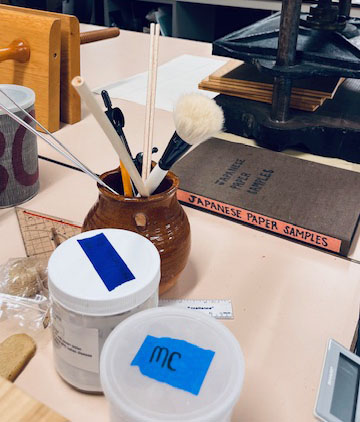
At UConn, the Conservation Lab plays a vital role in preserving, protecting, and ensuring access to library collections for scholars at home and around the world. Using advanced conservation techniques, staff safeguard rare and unique materials so they can be used safely for research, teaching, exhibitions, and loans to other institutions.
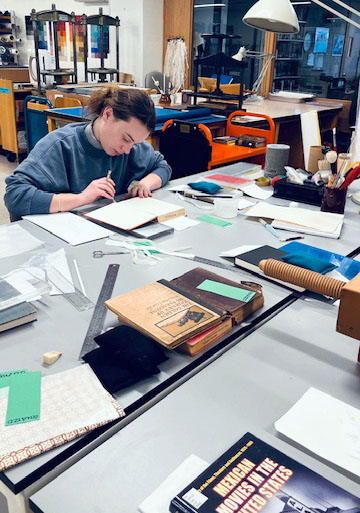
Student employee Emma works on a book from the collection
The materials treated in the lab are as varied as the methods used to preserve them, from books found in the general collection to rare archival volumes, photographs, maps, and manuscripts.
“The need for the care and protection of printed materials, especially rare and valuable items, remains essential to the library’s mission,” said ConservatorNatalie Granados. “By taking a hard look at our processes, we’ve been able to make both small and significant changes that reduce the lab’s environmental impact without disrupting the critical work underway.”
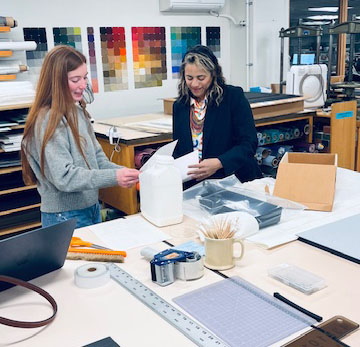
Journalism student Nora Broderick speaks with conservator Natalie Granados
These improvements include reducing paper towel use by 90%, replacing disposable supplies with reusable alternatives whenever possible, installing low‑flow aerators in sinks, and making energy‑saving upgrades to doors and lighting, among other changes.
“We are the first lab at UConn to achieve a Gold Certification from My Green Lab,” noted Dean Anne Langley. “It demonstrates our commitment to advancing UConn’s sustainability goals.”
The certification is recognized by the United Nations Race to Zero campaign as a key indicator of progress toward a zero‑carbon future and is considered the gold standard for sustainable laboratory practices.
Explore the Homer Babbidge Library with us on Friday, August 23 from 12-2pm. Grab a card and visit all 8 stations around the library to learn about all the great services we provide. Grab some swag, get your card signed and the first 100 students to visit them all will get a prize!
Stations include
Level B
Facilities & Security – learn how we keep you safe and happy while you are here.
Liberated Zine Zone – get your creativity on and make a zine.
Wellness & Leisure Reading – it isn’t all about studying – we have great resources to help you find your way and read for fun.
Level 1
Archives & Special Collections – rare books, cool collections and so much more to explore.
Library Assessment – interested in how we get information from you on what you’d like to see?
Level 2
Research Services – have a research project to do? Our librarians can help.
Interlibrary Services – what happens when you need an article that we don’t have? Ask!
Level 3
Conservation Lab – ever wonder what we do with gum stuck in books or ripped binding?
It’s that time of year again when you have a love-hate relationship with finals! Finals are hard, but it means Paws to Relax is back in Homer Babbidge and how can you not love that?!?!
Below is both a flyer of the schedule to share with your friends or you can find the straight list. Any changes will be posted inside Homer Babbidge.
Tuesday, April 30 12-1 Shadow, Cocker Spaniel 1-2 Ryder, Mini Australian Labradoodle 2-3 Mazzie, Cocker Spaniel 3-4 Gracie, Pug 4-5 Benny, Shih-Tzu
Wednesday, May 1 12-1 Wrigley, Newfoundland 1-2 Andy, Golden Retriever 2-3 Seneca, Yellow Lab 3-4 Finley, Yellow Lab 4-5 Tori, Golden Retriever
Thursday, May 2 12-1 Shelby, Golden Retriever 1-2 Dugan, Australian Shepherd 2-3 Grant, Golden Retriever 3-4 Cora, Bernese Mountain Dog 4-5 Tucker, Golden Retriever
Friday, May 3 12-1 Toby, Golden Retriever 1-2 Sheena, Hound Mix 2-3 Willow, Foxhound
After a review of our market research databases and in consultation with the UConn School of Business, we will not renew our subscription to two databases – Passport GMID and Mergent Intellect.
Passport GMID
UConn will lose access on December 31, 2023.
Due to decreasing usage and growing costs, Passport GMID (Global Market Information Database), Euromonitor International’s global market research database will be cancelled as of December 31, 2023.
For more information, contact our Library’s Acquisitions and Discovery team at ermsupport@uconn.edu.
Mergent Intellect
UConn will lose access to Mergent Intellect after January 31, 2024.
Mergent Online offers the same comprehensive business information to global public and private businesses. This is supplemented by our access to S&P NetAdvantage, S&P Capital IQ, and LSEG Workspace. For a full list, see the Business Subject Guide
Access to Mergent Archives, Mergent Bond Viewer, Mergent Investext, First Research, and Key Business Ratios will continue unchanged.
For more information, contact our Library’s Acquisitions and Discovery team at ermsupport@uconn.edu.
It’s that time of year when we balance your stress with some of the best doggos around! Come ease your stress all week long – December 11-15. Starts at noon on Monday, Tuesday, Thursday, and Friday and 1:00 on Wednesday, all on Level 1 in Homer Babbidge Library. The schedule can change so make sure you check back for any updates. Good luck on finals – you’ve got this!
Monday December 11 12pm Benny – Shih-Tzu 1pm Fireball – Golden Retriever 2pm Dodger – Golden Retriever 3pm Comet – Golden Retriever
Tuesday December 12 12pm Hunter – Shetland Sheepdog 1pm Finn – Labradoodle 2pm Willow – Foxhound 3pm Grant – Golden Retriever
The Future of Journals strategy, which shifts us away from cost prohibitive just-in-case collection building to a budget sustainable just-in-time approach, has resulted in both large cost savings and better efficiency in providing UConn researchers articles with speed and accuracy. In fact, between January and September, the overall efficiency of the service delivery for faculty and graduate students has improved; 97% of the article retrieval requests through the new system from journals previously subscribed to (those part of the Future of Journals strategy) took less than a minute to be delivered via email, and 99% within an hour. Interlibrary loan services for all other requests (including articles outside of the project) remain within the industry standard of 11 hours. We are committed to getting researchers the articles they need.
Beginning in 2020, it became clear to the UConn Library and the Provost that managing the library budget amid decreasing state aid and rising annual costs of journal subscriptions was going to require new ways of thinking. At that time the library permanent rescissions and loss of one-time collections support for that fiscal year totaled ~$2.8M. The strategy developed in consultation with the Future of Journals Committee, composed of faculty and researchers from a variety of fields, is entering its fourth year of successfully shifting how we provide access to scholarly information, with a primary focus on getting researchers what they need easily and quickly. With the shift we met the rescissions, and annually spend between $150K-$200K on providing articles through the new service. Additionally, the budget is not affected by the annual journal subscription cost increases of 6%-10%.
Simply stated, the scholarly publishing crisis of escalating journal costs, rising exponentially over the last two and a half decades, is unsustainable. For “Big Deal” subscription bundle packages, once a way for libraries to pay for access to large amounts of packaged content, the costs have outpaced both inflation and library budgets. Additionally, many of the journals included in the bundles are used very little (very much in line with the Pareto 80/20 principle). “Big Deals” put pressure on the entire library budget and forced academic libraries, including UConn, to eliminate not only journal subscriptions and other material purchases (books, databases, etc.), but also staff, programming, and support services to meet those increases.
One of the most significant changes to date that came out of the Future of Journals strategy, was the non-renewal of the bundled contract with Elsevier at the end of 2022. Since the start of 2023, the article processing statistics through this new system show a successful rate of delivery, with 97% arriving instantly, usually within a few seconds. Additionally, we have streamlined the process of accessing materials by combining two services into one link, called ‘Get This PDF’, for a more seamless user experience.
According to our timeline, this January we will not be renewing contracts with the publishers Wiley and Taylor & Francis. We will provide access at the article level to researchers from those publishers through our expedited article delivery system for faculty and graduate students and the UConn community via Interlibrary Loan.
Academic libraries across the globe regularly cancel journals or end publisher contracts, including schools such as MIT, Rutgers, Purdue, and UNC Chapel Hill, to stay within their budgets, and our strategy has been taken note of by our peers. We have been working with other academic libraries, regional organizations, and attending conferences helping other institutions struggling with finding solutions to their own budget crises.
It will always be a top priority for UConn Library to support the research mission of the university. The Future of Journals approach has given UConn the flexibility to be nimble in how we provide access to the library materials you need as the publishing landscape continues to change. Looking ahead our collection strategy will continue to be fine-tuned to allow us to continue to provide the materials, services, and spaces you also rely on. We build responsive and relevant collections by regularly assessing use, publishing models, usability, and monitoring and adopting new functionalities. Our collections remain reflective of the current scholarly communication environment.
Nancy Dryden at retirement reception at the Stamford Library, June 2023
Nancy Dryden retired from the position of Research & Instruction Librarian at the UConn Stamford Library on June 28, 2023.
Throughout her tenure, Nancy has been a beacon of knowledge, professionalism and dedication. Nancy joined UConn in 1981. Forty-two years later, she has had a huge positive impact on UConn Library across UConn’s Regional Campus Libraries and in collaboration with colleagues on the Storrs campus.
Nancy first worked as a cataloger/ILL Librarian at the Jeremy Richard Library at UConn Stamford at its former space on Scofieldtown Road. The UConn Stamford Campus relocated to its current location in the heart of downtown Stamford in 1998.
Nancy has held many positions within the library from cataloger, Head of Cataloging, Head of Technical Services, Director of the Jeremy Richard Library, and the Director of the Regional Campus Libraries for 11 years, which covered Avery Point, Greater Hartford, Stamford, Torrington and Waterbury.
Nancy, 2007 file photo
As the Regional Campus Libraries Director, Nancy was instrumental in coordinating the learning commons projects at each regional campus library. Her work helped create beautiful and vibrant student-centered library spaces. At Stamford, Nancy led a project to build a wireless classroom, The Thomson eClassroom, from grant funds and a $200,000 donation from The Thomson Corporation (now Thomson-Reuters Corp). She also in collaboration with a past campus director, Dr. Michael M. Ego, had installed a WPA mural by Connecticut artist, James Daugherty in the library. This historic WPA mural is one of seven murals painted by James Daugherty and on loan from the City of Stamford.
The Stamford Library staff from L-R, Phara Bayonne, Nancy Dryden, Jenny Gregory
Nancy has been an invaluable mentor and well-respected colleague of the UConn Stamford campus and her retirement is a tremendous loss to the many faculty, student, and staff she has engaged with for so many years. Her kindness, patience, and willingness to help our students has made the Jeremy Richard library a welcoming place. Her commitment and contribution to the UConn Library has significantly shaped its success. Her presence in our library will be sorely missed.
Please join us in wishing her a well-deserved retirement filled with relaxation and new adventures!
Written by Phara Bayonne, Director, UConn Library Stamford.
Lesbian, Gay, Bisexual, Transgender and Queer (LGBTQ) Pride Month is celebrated each year in the month of June to honor the 1969 Stonewall Uprising in Manhattan. The Stonewall Uprising began at the Stonewall Inn, a bar located in New York City’s Greenwich Village, when patrons and neighborhood residents fought back against a violent police raid on the gay club in the early morning hours. The crowd’s fierce resistance against law enforcement quickly grew into an uprising that lasted six days and signaled the arrival of a militant and confrontational movement for the liberation of LGBTQ+ people.
The UConn Library has several great resources and activities to help you learn more of the history, challenges, and victories around LGBTQ+ issues in celebration of Pride Month.
Archives & Special Collections
Connecticut has deep roots in the movement, including here at UConn which can be found in several archival collections.
Foster Gunnison, Jr.
Foster Gunnison, Jr. Papers. In the early 1960s, Foster Gunnison, Jr., who had arrived in Hartford, Connecticut, to pursue a master’s degree at Trinity College, immersed himself in the homophile movement by working with local organizations and founding his own, the Institute for Social Ethics (ISE). A collection of his materials includes correspondences, organizational records, posters, fliers, buttons, newspaper clippings, and photographs relating to LGBTQ+ activism in the 1960s and 1970s. Finding Aid Digitized Materials
The UConn Gay Alliance was founded in 1967 and had their own Stonewall moment in 1971-72 when one of their dances was met by an angry crowd. There are several collections that are available for researchers interested in learning more about the movement here at UConn including:
University of Connecticut, President’s Office Records most notably presidents Homer D. Babbidge (1962–1972) and John A. DiBiaggio (1979-1985). Both contain material relating to LGBTQ+ issues on campus, such as the emergence and activities of the gay liberation movement in the early 1970s.
Alternative Press Collection (APC) includes national and international publications, ephemera, and artifacts documenting activists and organizations from the 1800s to present as well as LGBTQ+ organizing at UConn. Especially notable are materials from the Storrs Gay Coalition and the UConn Gay Alliance. The APC can best be consulted using the card catalog available in the archives, though some digitized materials can be accessed here.
Daniel R. Campbell Papers. Daniel R. Campbell attended UConn in 1967-1968 and was one of the first openly gay students on campus. The collection describes Campbell’s experiences at UConn and elsewhere, and offers insight and perspective on pre-Stonewall LGBTQ+ culture on campus.
UConn Rainbow Center Records. Founded in 1999, the Center is dedicated to supporting the needs of the LGBTQIA+ members of the campus community. The collection documents the center’s history and activities up to the present day.
Don’t stop there! There are a wide variety of books of poetry, and children’s literature from the Northeast Children’s Literature Collection, and several more great resources for research in Archives & Special Collections, with thanks to Shaine Scarminach for the compilation.
Wellness Collection
LBGTQIA Wellness titles includes books, many available electronically, related to Lesbian, Gay, Bisexual, Transgender, Queer, Intersex, and Asexual communities’ wellbeing, and identities. The LGBTQIA Community Wellness Guide features selected memoirs, advice, and other books by authors for the LQBTQIA + (Lesbian, Gay, Bisexual, Transgender, Queer, Intersex, and Asexual) community which relate to mental health or wellness.
UConn Health Library
With the assistance of a Collection Equity Award from the National Library of Medicine, a new collection of LGBTQIA+ materials is available at the Health Library which was recently highlighted in UConn Today.
Databases
LGBT Magazine Archive. Articles from journals covering LGBT interests from 1954-2015.
Independent Voices. Alternative press publications produced by feminists, dissident GIs, campus radicals and the New Left, Native peoples, antiwar activists, Black Power advocates, Latino/as, LGBT activists, right-wing extremists, and more.
LGBT Thought and Culture. Influential books, periodicals, letters, speeches, interviews, and ephemera covering LGBTQIA political and social movements in the 1900s and 2000s.more.
LGBT Life. Covers gay, lesbian, bisexual, and transgender issues including civil liberties, culture, employment, family, history, psychology, and religion.
Gender & Sexual Minorities (LGBTQIA) Studies Subject Guide provides tips and resources for locating books, films, journal articles, news sources, and websites for lesbian, gay, bisexual, transgender, queer, intersex, and asexual, and other gender and sexual minorities studies.
Exhibits
If you happen to be on campus – we have displays of published materials in the Homer Babbidge, Avery Point, and UConn Health libraries.